
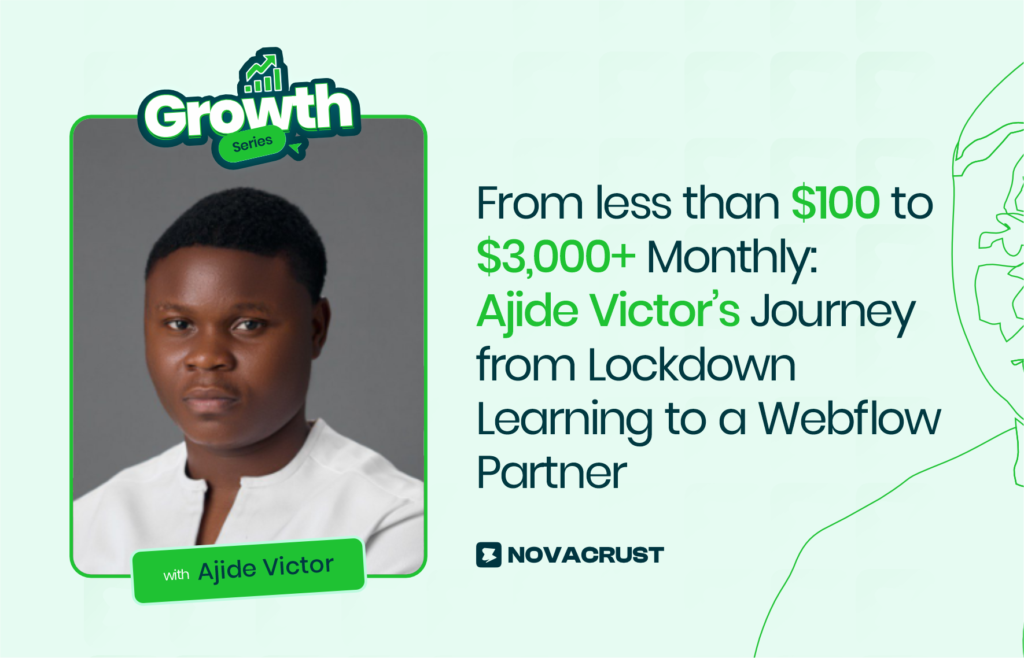
Victor Ajide didn’t stumble into web design by accident. What started during the COVID lockdown as curiosity and experimentation has grown into a full-fledged career building scalable websites and digital products for startups and businesses.
Today, Victor runs a web studio in Nigeria, mentors upcoming designers, and helps founders turn ideas into products that don’t just look good but work. In this Growth Series interview, he shares how consistency changed his life, the lessons freelancing taught him early, and why his younger self would be proud of how far he’s come.
Hi Victor, welcome to our Growth Series. Can you tell us about yourself and your journey into web design and Webflow?
My name is Ajide Victor. I’m a web designer, developer, and product builder. I run a web studio in Nigeria where we work with startup founders and businesses to turn ideas into scalable websites and digital products that don’t just look good but actually work.
My journey into tech started during the COVID lockdown when schools were shut down and we were all at home. While exploring online, I discovered web design, and a friend who was already a developer introduced me to Webflow. I took my time to learn the tool, shared my learning process publicly, and gradually began building real products.
What I enjoy most is taking ideas from zero and turning them into usable products. Along the way, I’ve also mentored people and guided others who are just starting out.
What was your first paid project, and what did it teach you?
My first paid gig wasn’t web design it was graphic design. I used a mobile app called PixelLab to design flyers and mockups for small businesses. I earned between ₦500 to ₦3,000 per job.
At that time, many people my age were involved in internet fraud, so realizing I could earn honest money from a digital skill even if it was small meant a lot to me. It showed me that skills could pay and that growth was possible.
Was there a moment you realized this could be a full-time career?
It wasn’t sudden. I didn’t even know about freelance platforms at first. What changed everything was understanding the power of visibility.
I started posting consistently on Facebook sharing my work, teaching what I was learning, and documenting my progress. I showed up daily and weekly. Over time, people began to understand what I did, and clients started reaching out. That consistency made me realize this could become something serious.
Did you recognize your potential before seeing it as a career path?
Not initially. I was still a student then and graduated in July 2025. Design was just a side hustle to survive.
That changed when I worked on a Webflow project that pushed me beyond my comfort zone. It required problem-solving, attention to detail, and confidence in my decisions. Completing that project made me realize I could handle complexity and that this skill could take me far.
Can you share a major challenge and how you turned it into growth?
One major challenge was communicating with international clients, especially because of my accent. I used to be afraid of speaking on calls because some people judged me before hearing what I had to offer.
Instead of letting that stop me, I worked on improving my communication. I started speaking more at events, slowed down my speech, and let my work speak for itself. Over time, the fear faded, and my confidence grew. That experience taught me resilience and adaptability.
How do you stay motivated during slow periods or with difficult clients?
I don’t wait for motivation I focus on preparation. During slow periods, I improve my skills, review past work, identify gaps, and learn new things.
I also optimize my portfolio, refine my Upwork profile, experiment with ideas, and stay visible online. Slow periods are part of freelancing, and I use them as opportunities to level up.
How do you balance creativity with client expectations?
It starts with clarity. Before designing anything, I make sure I fully understand the client’s goals. Creativity is a tool for solving problems not just making things look good.
Every design decision I make is tied back to business goals and performance. Clear communication and regular updates help keep everything aligned.
Do you follow a structured workflow or work intuitively?
I follow a structured workflow. Structure gives creativity direction and ensures smooth delivery.
I start by understanding requirements, reviewing the brief, and breaking the project into milestones. I communicate consistently so there are no surprises. This approach helps me deliver quality work every time.
How do you position yourself to attract high-paying clients?
I focus on value, not volume. I’m intentional about the clients I work with and clearly state my pricing.
I showcase recent, relevant work, explain my process publicly, and maintain a strong presence on X (Twitter). My portfolio, pricing, and online presence are aligned with the level of clients I want to attract.
Do you share your process publicly to teach or inspire others?
Yes. I share my work openly. When I was active on Upwork, I helped people optimize their profiles, reviewed accounts, and even sponsored connects for some.
I also share educational content, host X Spaces, and organize learning sessions for people interested in Webflow and no-code development.
Have you mentored others? Can you share a moment where your help made a difference?
Yes. One case I remember clearly was someone who had been applying for jobs for a long time without success. Instead of only advising him, I brought him in to work with me, gave him real tasks, and paid him.
That experience helped him gain confidence, build experience, and move forward in his career.
How important is community to growth?
I haven’t built a personal community yet, but I’ve actively participated in many. I’ve contributed by helping others, sharing resources, and answering questions.
In some communities, I was eventually made an admin because of my involvement. Community accelerates growth, exposes you to opportunities, and keeps you accountable.
How do you balance learning, work, and mentorship?
Time management is key. I schedule mentorship sessions between 9pm and 10pm after my workday ends.
During the day, I focus strictly on client work. At night, I mentor, respond to messages, and attend to requests. Clear boundaries help me stay productive.
What’s a hard truth about freelancing beginners should know?
Not every proposal gets a response. Many clients don’t understand the work happening behind the scenes.
Freelancing includes rejection, slow periods, and misunderstandings. It’s part of the journey.
Have you faced challenges with international payments?
Yes. Many platforms like PayPal and Wise are limited or unsupported in Nigeria. This is a major challenge I’ve personally faced when working with international clients.
What advice would you give your younger self?
Start early and ask for help not money, but guidance.
I reached out to people to learn about Upwork, proposals, and profile optimization. Those conversations saved me months of confusion. Don’t try to figure everything out alone.
What mistake shaped your growth the most?
For a long time, I believed I didn’t need better tools. I kept using an old HP laptop because it could “manage” the work.
Eventually, I invested in better equipment, a proper workspace, and a refined workflow. My speed, quality, and confidence improved. Investing in yourself matters.
How do you define success today?
Success isn’t just money. When I started, I was simply using Webflow. Today, I’m Webflow certified. That progress means a lot to me.
Growth and consistency matter more than numbers.
Would your past self be proud of you?
Absolutely.
If you weren’t in web design, what would you be doing?
Before tech, I was into music. I played drums at parties, concerts, and events. If not web design, I’d probably still be pursuing music.
What’s one truth young creatives in Nigeria need to hear?
Consistency beats talent. If you don’t show up, people won’t know how good you are. Talent without visibility is almost the same as no talent.
How do you handle rejection?
I treat rejection as feedback. I reach out, ask for the criteria used to select the successful candidate, and improve on those areas so I don’t repeat the same mistake.
Can you share your first earnings versus now?
My first earnings were ₦500 – ₦3,000 per graphic design gig.
Today, I earn between $3,000 and $5,000 monthly, depending on projects. There’s no fixed amount, but the growth has been consistent.
Victor’s journey reminds us that growth doesn’t always come from big breaks it comes from showing up consistently, learning in public, and being willing to start small. From earning a few thousand naira designing on his phone to building to a Webflow Partner and mentoring others, his story proves that visibility, preparation, and resilience can open global doors. If you’re navigating freelancing, web design, or no-code development, Victor’s path is a powerful reminder that steady effort compounds over time.