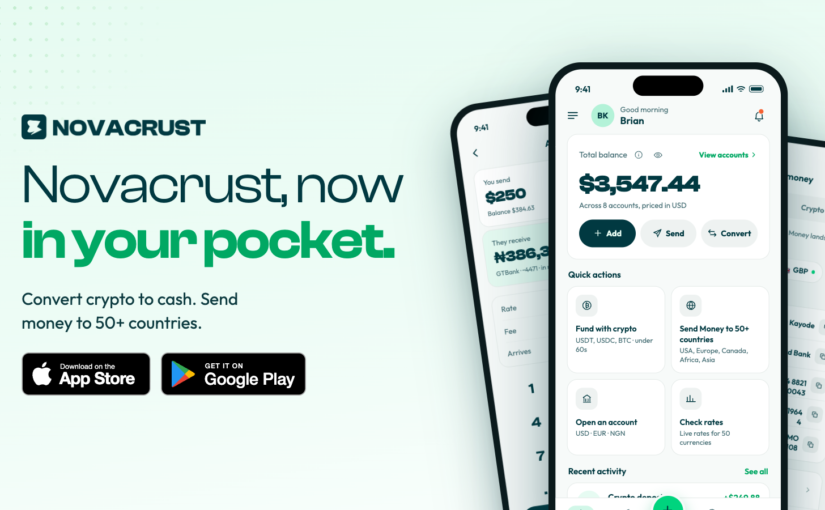
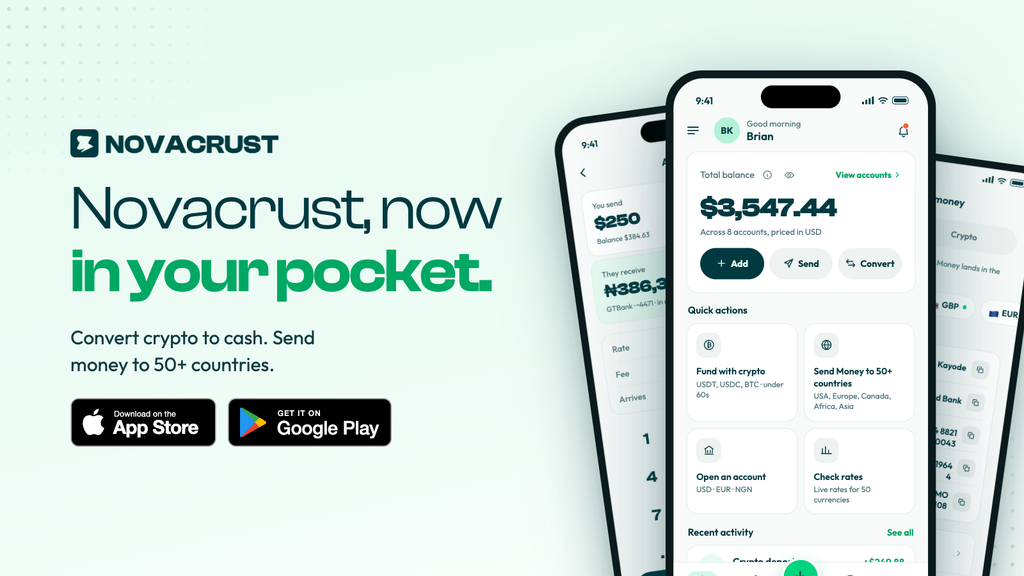
Stablecoins power some of the most important features you use on Novacrust, such as USD Accounts, Virtual Cards, international payouts, and seamless conversions. Today, we’re excited to take that even further.
We’re officially rolling out full support for USDC and USDT, giving you a faster, more stable, and more flexible way to fund and use your Novacrust account. Whether you’re making routine transactions or managing high-value payments, stablecoins make the entire process smoother and more reliable.
What You Can Now Do
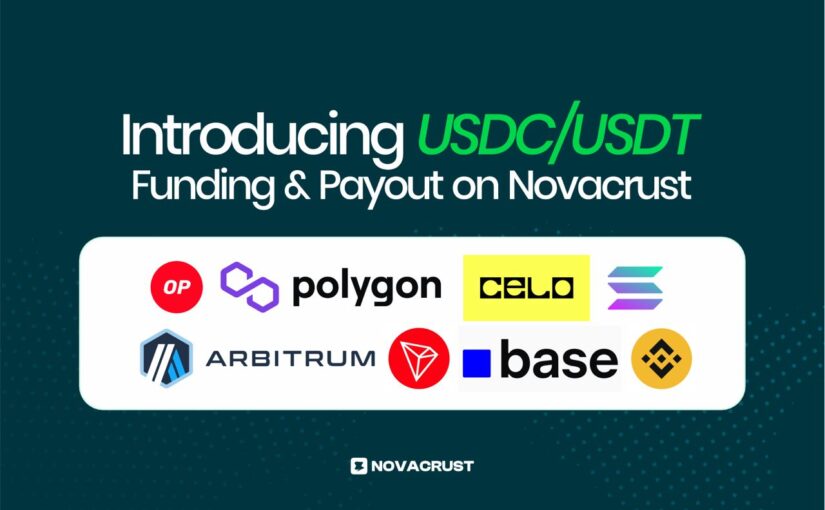
Fund your USD Account with USDC/USDT: Instantly top up using stablecoins across multiple chains, including Solana, Celo, Optimism, Polygon, BNB Smart Chain, Tron, and more.
Payout in Stablecoins: Withdraw or receive payments in USDC or USDT with speed and predictability.
Save in Stablecoins: Hold value in USD-denominated assets without worrying about local currency fluctuations.
Convert to Cash & Send to Local Accounts: Easily convert stablecoins to local currency and send to bank accounts or mobile money in supported countries.
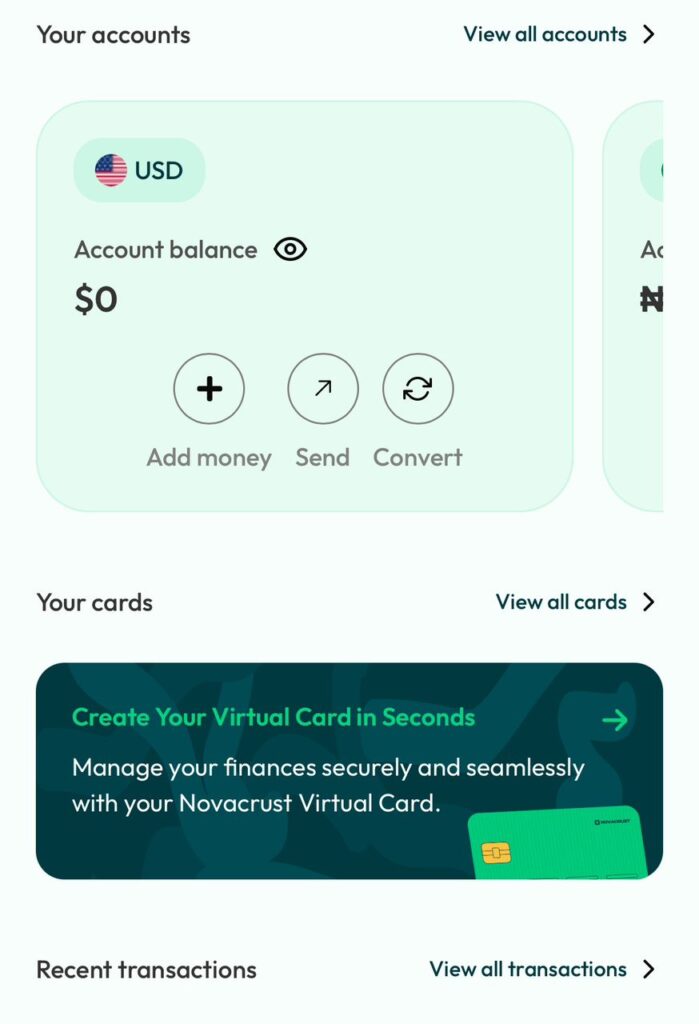
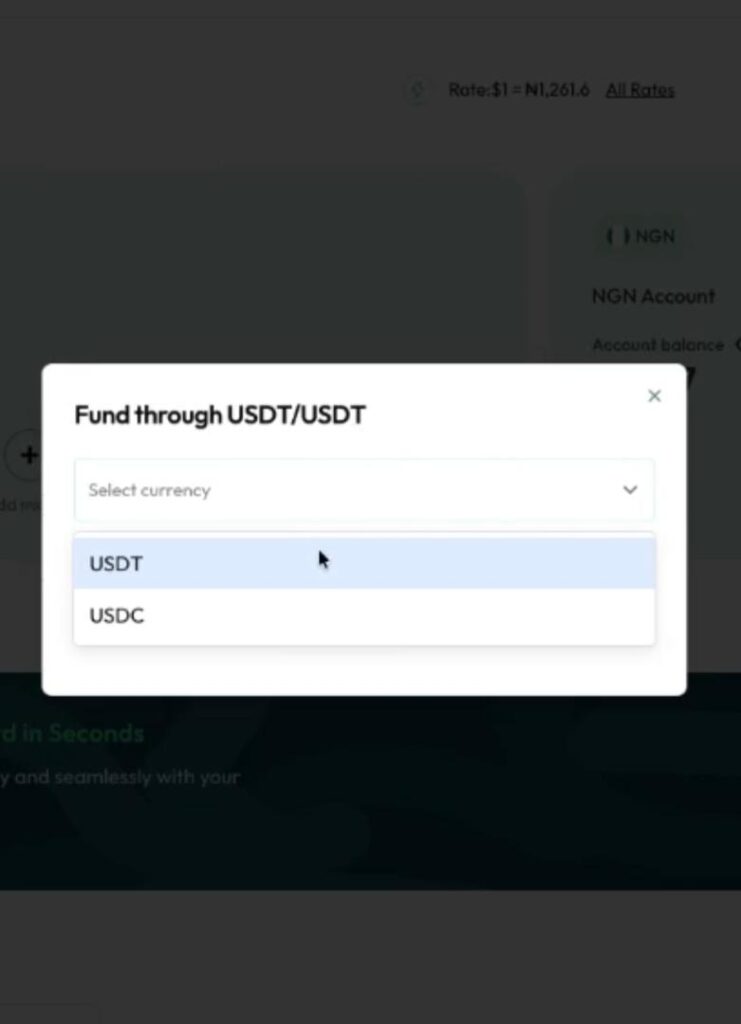
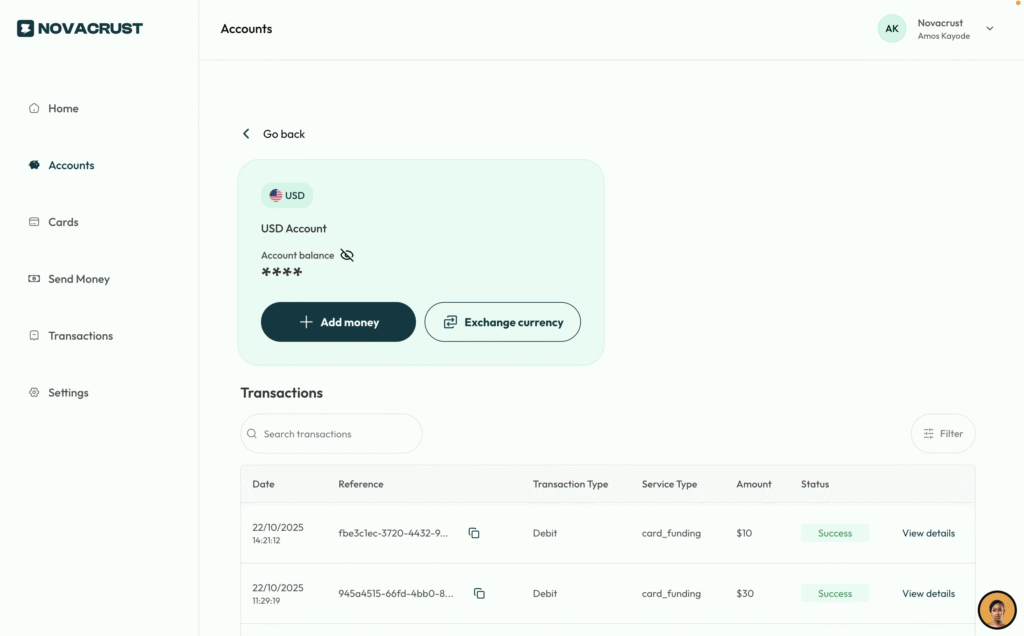
To help you get started, here’s a quick guide on how to access and use USDC and USDT on Novacrust:
At Novacrust, we’re building a borderless payment experience for freelancers, remote workers, and businesses by making it easy to receive and move money across different channels.
A few months ago, we launched USD Accounts in your name, allowing you to receive ACH and Wire transfers seamlessly, convert your funds to local currencies, and even send money to others directly from your dashboard.
Since then, many of you, especially freelancers and remote teams, have asked if we could make receiving payments even more flexible with options like Zelle, Cash App, PayPal, Revolut, and payment links.
We listened.
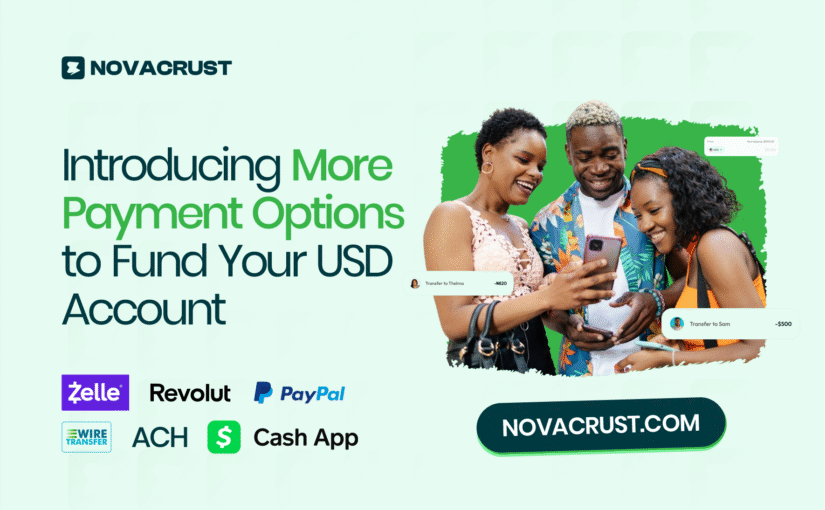
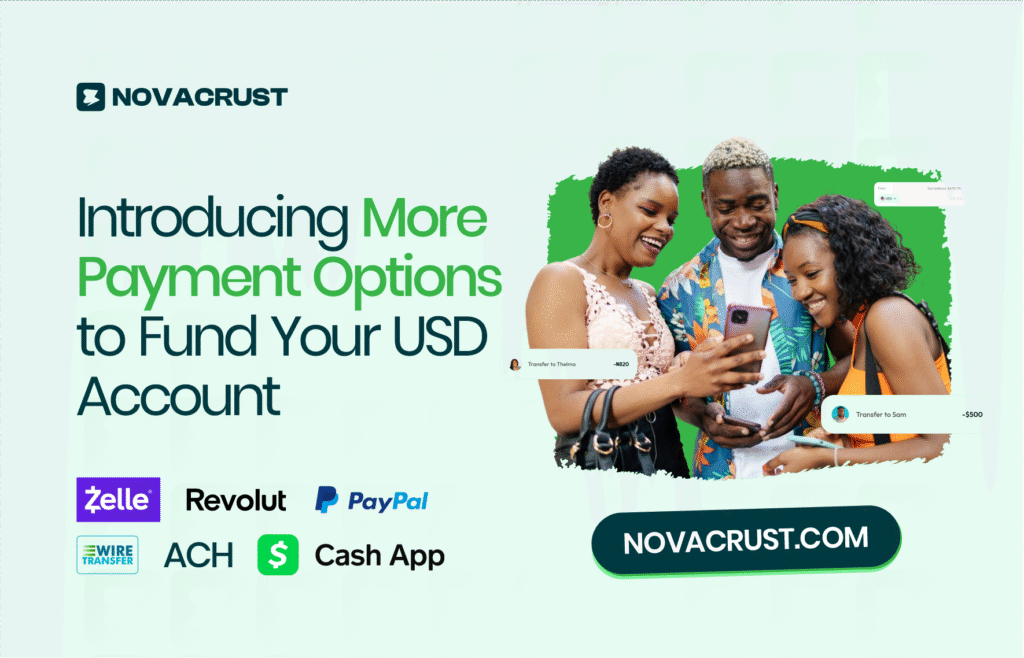
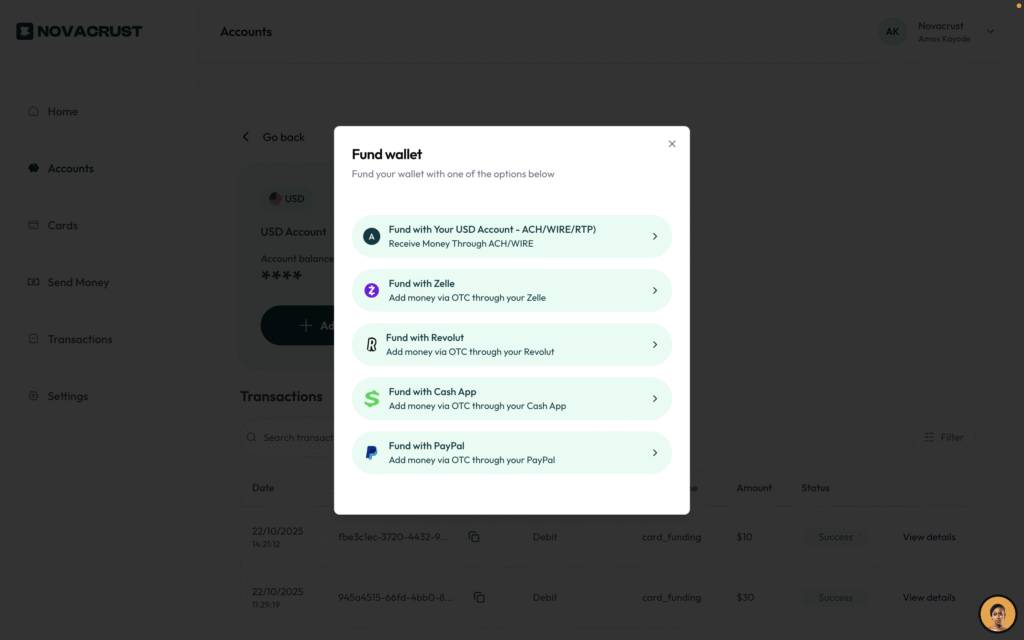
Now, with Novacrust, you can receive payments through Zelle, Cash App, PayPal, and Revolut – all credited straight to your USD account on Novacrust.
Somewhere right now, a freelancer is standing in a bank queue with a folder of documents, two references, and a passport photo, trying to open a dollar account. And somewhere else, another freelancer just opened a USD account online from her phone in under ten minutes, got US account details in her own name, and sent them to her client before lunch.
Same goal. Wildly different experience. The difference is knowing that in 2026, you no longer need a traditional bank, a US address, or a plane ticket to own a dollar account.
This guide covers how to open a USD account online from anywhere in Africa, the Middle East, or Europe, what you can do with it, what to check before choosing a provider, and how to start receiving dollar payments the same week.
What Is a Virtual USD Account?
A virtual USD account is a dollar account you open and manage entirely online. It comes with real US account details in your name, an account number, and a routing number, with support for ACH, wire, and RTP transfers. To anyone paying you, it works exactly like a US bank account. To you, it is an app on your phone.
That single feature unlocks a lot. Clients and employers can pay you the way they pay anyone in America. Freelance platforms can deposit your earnings directly. And your money sits in USD, protected from local currency swings, until you decide to convert.
If any of these sound like you, a USD account is not optional; it is infrastructure:
Freelancers and remote workers. You earn from clients in the US, UK, or Europe and need a clean way to receive dollar payments without losing a chunk to middlemen. A USD account for freelancers means you invoice in dollars and keep dollars.
Creators. YouTube, sponsorships, digital product sales. Platform payouts land far more easily in a US account than through legacy transfer chains.
Savers. When your local currency is volatile, holding part of your income in a dollar account is the simplest hedge available. You convert what you need when the rate favors you.
Small businesses and SMEs. Paying international suppliers and receiving from international customers both get easier when you operate a dollar balance.
Here is the entire process, and why it answers the classic search: how to open a dollar account without visiting a bank.
Step 1: Sign up and verify your identity
Sign up on Novacrust, create your account, and complete identity verification with a valid government ID or passport. No branch visit, no references, no minimum deposit. Verification typically takes minutes, not days, and works across most countries in Africa and the wider EMEA region. This is also the answer to another high-intent search: a USD account without a US address. You do not need one. The account is in your name, at your address, wherever you live.
Step 2: Get your US account details
Once verified, you get your account number and routing number with ACH, wire, and RTP support. These are the same details any American would hand over to get paid.
Step 3: Start receiving dollar payments
Share your details with clients and employers, or plug them into platforms like Upwork, Fiverr, Toptal, Andela, Deel, Gusto, Rippling, and YouTube. If you have ever searched for a USD account to receive Upwork payments, this is the setup: withdraw from the platform straight into your own dollar account.
Step 4: Hold, spend, convert, or send
Your dollars are yours to manage. Hold them as savings. Spend them with a virtual USD card on subscriptions, tools, and ads. Convert to your local currency at a competitive rate. Or send money to a local bank account or mobile money wallet, yours or anyone else’s.
What to Check Before Choosing a USD Account Provider
Not every dollar account is built the same. Compare providers on these five points:
Real US account details with ACH and wire support. Some apps only give you an internal wallet. You want an account number and routing number that any US employer can pay, which also covers the search dollar account with ACH and wire support.
Receiving fees. The best providers charge little or nothing to receive ACH payments. Wire fees vary, so check both.
Conversion rates. The exchange rate is the hidden fee. Compare what actually lands in your local currency, not the advertised rate.
Withdrawal options. Look for direct withdrawal to local banks and mobile money in your market, whether that is naira, cedis, shillings, rand, or dirhams.
Everything in one app. A USD account gets far more useful when it lives beside a virtual card, crypto conversion, and local transfers, so your money moves without app hopping. That is the Novacrust ecosystem in one sentence.
Virtual USD Account vs Traditional Foreign Currency Account
Traditional bank dollar account
Virtual USD account (Novacrust)
Opening time
Days to weeks, branch visit
Minutes, fully online
Requirements
References, paperwork, and sometimes a minimum balance
Valid ID
Receiving a US wire
$60 to $100 in combined fees
Low, transparent fees
ACH support
Rare
Yes, standard
Withdrawal
Branch processes
Local bank or mobile money from the app
Best for
Large occasional transfers
Regular international income
For most remote workers in Africa and EMEA, the comparison ends quickly. The best USD account for remote workers in Africa is the one that opens in minutes, receives ACH for little or nothing, and cashes out locally on your schedule.
Smart Ways to Use Your Dollar Account
Split your income the moment it lands. A common freelancer formula: convert what you need for the month, hold the rest in USD as savings, and keep a small buffer on your virtual card for subscriptions.
Time your conversions. Rates move. Because your money sits in dollars by default, you convert on the days that favor you, not the day your payment happens to arrive.
Keep your payment history clean. Regular international income into an account in your own name builds a paper trail that helps with visa applications, apartment hunting, and credit.
Can I open a USD account online without a US address?
Yes. Novacrust gives you US account details in your own name using your local identity documents. No US address, residency, or SSN required.
How long does it take to open a dollar account online?
Minutes. Sign up, verify your ID, and receive your account details, typically the same day.
Is a virtual USD account safe?
Reputable providers use identity verification, encryption, and regulated banking partners. Your account details work like standard US banking rails via ACH and wire.
Can I withdraw from my USD account to mobile money?
Yes, in supported markets, you can convert and withdraw funds directly to local banks or mobile money wallets through the app.
Does a USD account work for platform payouts?
Yes. Upwork, Fiverr, Toptal, Deel, YouTube, and many more can pay directly into your US account details.
The Bottom Line
A dollar account used to be a privilege that required the right passport or the patience for bank bureaucracy. Now it is a ten-minute setup. If you earn internationally, save seriously, or run a business across borders, opening a USD account online is the single upgrade that makes everything else about your finances simpler.
Open your Novacrust USD account in minutes and get US account details in your own name. No US address required.
Here is a number that should make you angry: families and workers sending money across borders lose an average of 6 percent of every transfer to fees and exchange rate markups. Send $500 home every month, and that is over $360 a year, gone. Not to the person you love. To the middlemen in between.
It gets worse. Some services advertise zero fees, then quietly take their cut through a padded exchange rate. Others charge honestly but take three business days while your recipient waits. The best way to send money internationally is not about one flashy feature. It is about what actually lands on the other side, and how fast.
This guide breaks down how to send money online, locally, and globally, what transfers really cost in 2026, and how to stop donating a slice of every payment to the payment industry, regardless of where you are.
The Two Numbers That Decide Every Money Transfer
Every international money transfer has exactly two costs, and providers hope you only look at one:
The transfer fee. The visible number. Easy to compare, easy to advertise, easy to set to zero.
The exchange rate margin. The invisible number. The gap between the real mid-market rate and the rate you are given. A “zero fee” transfer with a 4 percent rate markup costs more than a $3 fee at an honest rate.
The only comparison that matters: how much local currency arrives per dollar sent. Judge every money transfer app by that single figure.
Sending Money Globally: Your Options Compared
Banks and traditional wires. Reliable for large sums, painful for everything else. International wires stack sending fees, correspondent bank fees, and receiving fees, often $40 to $100 total, and take days.
Cash pickup services. Western Union and MoneyGram reach almost everywhere, including recipients without bank accounts. You pay for that reach with some of the highest combined costs in the industry.
Money transfer apps. Wise, Remitly, LemFi, WorldRemit, and others have pushed prices down dramatically, especially on popular corridors into Africa. Strong options, though most only solve sending, not the rest of your financial life.
All-in-one platforms like Novacrust. If you already receive international income, the smartest move is to send from the same place your money lives. With Novacrust, your USD account, currency conversion, and transfers sit in one app: receive dollars from clients or family abroad, convert at a competitive rate shown upfront, and send to local bank accounts or mobile money wallets across supported markets in Africa and EMEA. No app hopping, no double conversion, no mystery rates.
If you have ever searched for how to send money from a USD account to a local bank, this is the flow:
Step 1: Fund your account
Your balance might come from a client payment into your USD account, a crypto conversion, or a top-up. It all lands in one place.
Step 2: Choose your recipient
Send to a local bank account or mobile money wallet. Sending locally to a bank in your own country works from the same screen as sending across a border.
Step 3: See the rate before you commit
The exchange rate and what your recipient gets are shown upfront. If the numbers work, you send. If not, you wait for a better day. That transparency alone beats half the industry.
Step 4: Money arrives fast
Transfers to supported banks and mobile money wallets typically arrive within minutes to hours, not days. For anyone searching for the fastest way to send money internationally, speed plus an honest rate is the full answer.
Sending Money to Africa: What Actually Works
Remittances to Africa remain among the most expensive corridors in the world, which makes choosing well worth real money. What to know per use case:
Supporting family. For anyone searching to send money to family in Africa, prioritize mobile money delivery. In Kenya, Ghana, Tanzania, and much of East and West Africa, M-Pesa and MTN Mobile Money reach recipients who never visit a bank. A platform that sends directly to wallets saves your family the trip and the wait.
Paying suppliers or staff. Consistency beats everything. You want a platform where the rate is visible before every transfer and delivery times are predictable, so payroll never becomes an apology.
Cheapest way to send money to Nigeria, Kenya, or Ghana. The honest answer is always the same formula: compare the received amount, not the fee. On most corridors, app-based transfers from a held USD balance outperform cash services and banks by several percentage points.
Global gets the headlines, but local transfers are the daily reality: rent, a vendor, your cousin’s school fees. The advantage of an all-in-one platform is that local sending uses the same balance as everything else. Convert exactly what you need from your USD balance and send it to any local bank account in minutes. Your dollars stay dollars until the moment they need to be anything else.
Six Rules for Never Overpaying on Transfers Again
Compare received amounts, not fees. One number tells the truth.
Beware “zero fee” marketing. The rate is where zero-fee services get paid.
Hold your money in USD until you send. Converting on your schedule, not the provider’s, protects you from bad rate days.
Use mobile money for the last mile in Africa. It is usually faster and reaches more people than bank deposits.
Send larger amounts less often when costs are partly flat, since fixed fees hurt small transfers most.
Keep receipts in one app. Scattered transfers across three services mean no clean record of what you sent and at what rate.
Frequently Asked Questions
What is the best way to send money internationally in 2026? Use a platform that shows the exchange rate upfront and delivers to local banks or mobile money quickly. Compare what the recipient receives, not the advertised fee.
What is the cheapest way to send money to Nigeria? Sending from a held USD balance through an app with transparent rates typically beats banks and cash services. Always compare the naira amount that arrives.
Can I send money directly to mobile money wallets? Yes. Novacrust supports sending to mobile money wallets in supported African markets, alongside bank transfers.
How fast do international transfers arrive? App-based transfers to supported banks and wallets usually arrive within minutes to hours. Traditional wires can take several days.
Can I send money locally and internationally from one app? Yes. With Novacrust, local and global transfers come from the same balance, next to your USD account, virtual cards, and crypto conversion.
The Bottom Line
Every transfer is a small negotiation, and the industry wins whenever you compare the wrong number. Look only at what arrives, keep your money in dollars until sending day, and use one platform for local and global so your finances live in one place.
CTA: Send money locally and globally with Novacrust. See the rate before you send, every time.
We already gave you USDC and USDT funding and payouts, and you used it well. Now, we are expanding that even further. Bitcoin, Solana, Tron, Ethereum, and more crypto options are officially live on Novacrust, giving you even more flexibility to fund, save, and move money the way that works best for you.
Why We Expanded
Stablecoins solved a real problem: fast and predictable funding without the volatility headache. But not everyone holds their value in stablecoins. Some of you hold Bitcoin. Some prefer Ethereum. Some move funds through Solana or Tron because the network fees are lower and the speed works for you. Limiting Novacrust to just two coins meant leaving a huge part of how our users actually hold and move crypto outside the platform.
That changes today.
What You Can Now Do
Fund your USD Account using Bitcoin, Ethereum, Solana, Tron, and other supported coins, across multiple networks for faster confirmation.
Payout in your crypto of choice instead of being restricted to stablecoins alone.
Hold a mix of crypto and stablecoins inside your Novacrust wallet based on what works for your strategy.
Convert any supported coin to local currency and send it straight to your bank account or mobile money wallet across supported countries.
How to Fund or Withdraw With Your Preferred Coin
Getting started takes a few simple steps:
To help you get started, here’s a quick guide on how to access and use USDC and USDT on Novacrust:
4. Select your preferred currency network and create a wallet.
5. Your wallet is created. Add money, send, or convert to complete your payment.
Built for However You Hold Your Money
Crypto users in Africa are not all the same. Some are traders. Some are remote workers getting paid in Bitcoin. Some are long-term holders who only convert when they need cash. Novacrust now meets you wherever you fall on that spectrum, without forcing you into stablecoins if that is not how you operate.
This is just the next step in making Novacrust the platform that adapts to how you actually use crypto, not the other way around.
You sent the invoice three weeks ago. The client confirmed payment days ago. And yet your money is still floating somewhere between a foreign bank, an intermediary you have never heard of, and an exchange rate that quietly shaved off a chunk you will never get back. If you earn a living online and get paid from abroad, you know this feeling. The work is the easy part. Getting paid, keeping the value of what you earned, and spending it is where the real friction lives.
Money management for remote workers is not about budgeting apps or colour-coded spreadsheets. It is about something more basic: getting your money in quickly, holding it in the currency you earned, spending it anywhere, and moving it home at a fair rate, without losing time or money at every step. This guide covers how to get paid as a remote worker in 2026, how to keep more of what you earn, and how to choose a platform that handles the whole journey instead of forcing you to stitch five tools together.
Why money management for remote workers is harder than it looks
When you work for a local employer, money is simple. The salary lands in your local bank, in your local currency, and you spend it locally. Remote work breaks that loop.
Now your international clients might be in New York, your bank in Lagos or Cairo or London, your subscriptions billed in dollars, and your rent due in a currency none of those clients use. Every handoff between currencies and countries is a chance to lose money to fees, time to slow transfers, or value to a poor rate. Multiply that by every invoice, and the leak becomes a flood. The people who keep the most of what they earn are not the ones who hustle the hardest. They are the ones who fixed their setup once and stopped bleeding value on autopilot.
The four jobs your money setup needs to do
A strong setup does exactly four things: receive, hold, spend, and send money from one platform, instead of logging into a different service for each.
1. Receive international payments without the wait
Many remote workers still rely on slow transfers that pass through several banks, take five to seven working days, and arrive lighter because each bank took a cut. If you have ever searched for how to get paid as a freelancer with overseas clients, this is the problem you were trying to solve.
What you want is a multi-currency account for freelancers, a foreign currency account in your own name, that lets you receive dollars, pounds, or euros through familiar rails like ACH and wire transfer, so your international clients can pay you the way they pay anyone else. When a client can pay you with no extra effort, you get paid faster and look more professional doing it.
2. Hold your money in the currency you earned
Here is a costly mistake. You earn in dollars, the money lands, and it gets force converted into your local currency on arrival. Next week, you need dollars again for software or ads, so you convert back, losing a slice each way.
A proper setup lets you hold foreign currency as foreign currency. If your next expense is in dollars, the money should never detour through your local currency and back. Holding multiple currencies in one place means you convert only when you choose, at a moment you choose.
3. Spend globally without your card getting declined
You found the perfect setup, the money is in, and then your card is declined for a tool you need for work. Anyone paying for international subscriptions from outside the US or Europe has lived this. Local cards get rejected by global merchants constantly, and the ones that work often carry painful limits.
This is where a virtual dollar card changes your day-to-day life. A good one pays for the services you actually use, from streaming to design tools to advertising platforms, and lets you fund it from local currency, your dollar balance, or crypto you convert on the spot. No foreign bank account required, with limits high enough that you are not topping up every hour.
4. Convert and send money home at a fair rate
Eventually, you need some of that income in your local currency, for rent, for family, for life. Many platforms advertise zero fees and then bake their profit into a rate that sits well below the real market rate. You feel good about the no-fee headline while losing more than a fee ever would have cost you.
What you want is a transparent rate close to the real mid-market rate, so you see exactly what you get before you confirm. A fair rate on every conversion, across a year of income, is the difference between keeping your money and donating it to a spread you never agreed to.
Digital nomad banking: what changes when you move
If you are moving between countries, the stakes climb. Digital nomad banking has its own quirks. Your home bank may freeze a card it sees used in three countries in a month. Opening a local account in each new country is slow and often impossible on a tourist or nomad visa, which is why a traditional bank account for digital nomads is so hard to keep.
The countries courting nomads, the UAE chief among them, with its digital nomad visa, have pulled in a wave of location-independent earners and expats facing one question: how do I manage money without permanent residency anywhere? The answer is a digital nomad bank account that travels with you, holds multiple currencies, issues a card that works across borders, and does not panic when your spending map looks like a flight route. Sorting out your digital nomad visa finances before you land somewhere new saves you the scramble of fixing it once you are already abroad.
The mistakes that quietly cost remote workers the most
Four patterns show up again and again, and each is avoidable. The first is juggling too many tools, where every handoff costs a fee and a delay. The second is ignoring the exchange rate because the platform said “no fees,” when the rate is the fee. The third is force converting the income you will need again into the same currency. The fourth is staying with a slow, traditional channel out of habit. Changing is a one-time cost. The savings repeat every month for as long as you work.
How to choose the best fintech platform for remote workers
Judge each option against the four jobs. Run through this list:
Can you receive USD, GBP, and EUR into a foreign currency account in your own name, using ACH and wire transfer?
Can you hold more than one currency and convert only when you choose?
Does it issue a virtual dollar card that works with global merchants, with real limits?
Is the exchange rate transparent and close to the real market rate?
Does it cover the countries and corridors you actually live and work in, not just one market?
The best fintech platform for remote workers answers yes to all five, because that is the one that lets you stop managing money and get back to your work.
Bringing it together: one platform instead of five
This is the gap Novacrust was built to close. Instead of one tool to receive, another to hold, a third to spend, and a fourth to send, it brings the whole journey into a single platform. You can receive international payments through a USD account in your name with ACH and wire support, hold and manage multiple currencies, spend worldwide on a virtual dollar card you fund from local currency, dollars, or crypto you convert in app, and send money home at a transparent rate. For creators, freelancers, and remote workers tired of watching income leak across half a dozen services, that consolidation is the entire point.
Frequently asked questions
What is the best way to manage money as a remote worker?
Build your setup around four jobs: receiving payments, holding your money in the currency you earned, spending globally, and converting or sending money home at a fair rate. The fewer tools involved, the less you lose to fees and delays.
How do remote workers get paid by international clients?
The most reliable approach is a multi-currency account in your own name that supports ACH and wire transfers, so clients can pay you using rails they already know. This is faster than slow transfers that pass through several banks.
What is the best app to receive money from abroad?
Look past the label and judge on substance. The best option lets you receive money from abroad into an account in your own name, hold it in the currency you earned, spend it on a global card, and convert it at a transparent rate, all in one place. A platform that does the full journey beats a single-feature tool every time.
Do I need a foreign bank account to manage money as a digital nomad?
No. Modern platforms give you a digital nomad bank account that holds multiple currencies, receives international payments, and spends on a virtual card without opening a local bank account in each country.
How can I avoid losing money on currency conversion?
Hold foreign currency as foreign currency and convert only when you choose. Always compare the platform’s rate to the real market rate, because a “no fees” claim often hides its cost inside a poor exchange rate.
Mary closed her biggest design contract yet, a US client paying four figures a month. She invoiced, the client paid the same day, and she spent the week feeling like a professional who had finally made it. Then she waited. Six days later, the money landed, except it was short by $40 she could not explain, skimmed by a bank she had never agreed to deal with. The work had gone perfectly. The getting paid part was a mess, and nobody had ever taught her the difference between the options her client kept asking about.
That gap is what this guide closes. ACH, wire transfer, and SWIFT are the three ways most international payments move, and the difference between them is real money and real days. Understanding the ACH vs wire transfer question, and where SWIFT fits in, means you can tell a client exactly how to pay you, get your money faster, and stop losing a cut to fees you never needed to pay.
The short answer first
ACH
Wire transfer
SWIFT
Best for
Routine US payments
Large or urgent payments
Payments across borders
Speed
1 to 3 business days
Same day to 1 day domestically
1 to 5 business days
Cost
Low or free
Higher fixed fee
Higher, often with intermediary fees
Reach
Within the US
Domestic and international
Global, bank-to-bank worldwide
If your client is in the US and the payment is routine, ACH is usually cheapest. If the payment is large or urgent, a wire is faster and more certain. If the money is crossing borders, SWIFT is the network doing the work behind the scenes. Now, let us make each one make sense.
What is an ACH payment?
ACH stands for Automated Clearing House. It is the network that moves money between banks inside the United States. If you have ever had a US salary deposited automatically, paid a US bill online, or received a refund into a US account, ACH did the work.
The appeal of ACH is cost. It is cheap, often free, which is why it is the default for recurring and everyday payments in the US. The trade-off is speed and reach. An ACH payment usually takes one to three business days to settle, and it only works within the US banking system. So if a US client is paying you and you hold a US-style account, ACH is the low-cost, no drama option for regular invoices.
How long does ACH take?
Most ACH payments clear in one to three business days. Some processes are same-day if the sender uses faster ACH options, but plan around the standard window. ACH does not move on weekends or US bank holidays, so a payment sent on a Friday may not land until the middle of the following week.
What is a wire transfer?
A wire transfer is a direct, bank-to-bank movement of money. Instead of being batched and processed in groups like ACH, a wire is sent individually and tends to settle much faster, often the same day for domestic transfers.
Wires are the tool of choice when speed and certainty matter, for example, a large project payment, a deposit, or anything where both sides want confirmation that the money has truly moved. The cost is the catch. Wires usually carry a fixed fee on the sending side, and sometimes on the receiving side too. For a small invoice, that fee feels heavy, but for a large or time-sensitive payment, the speed is worth it. To receive a wire transfer, you give the sender your account details and a routing number or equivalent, plus a few extra pieces of information for international wires.
What is SWIFT?
SWIFT is not a payment in the way ACH and a wire are. It is the messaging network banks around the world use to talk to each other and instruct international transfers. When money moves between a bank in one country and a bank in another, a SWIFT message usually coordinates it. This is why an international wire is often called a “SWIFT transfer.”
The strength of SWIFT is global reach. It connects thousands of banks worldwide, which is how a client in one country can pay a freelancer in another at all. The weakness is what happens along the way. An international SWIFT transfer can pass through one or more intermediary banks, and each can take a fee and add a day. This is the mystery slice that goes missing between the invoice amount and what finally lands in your account. It is exactly what cost Mary her forty dollars.
ACH vs wire vs SWIFT: the differences that affect you
Speed, cost, and reach are the three levers. ACH wins on cost but is slow and US only. A wire wins on speed and certainty but costs more per transfer. SWIFT is what makes an international wire transfer possible at all, with the widest reach but the highest chance of intermediary bank fees and delays.
For most freelancers, the practical reality looks like this. A US client paying a routine invoice reaches for ACH because it is cheap and easy on their end. A client sending a large payment, or one who wants it to land fast, uses a wire. And the moment that money travels from one country to another, SWIFT carries it, with the extra cost and time international hops add.
Which should you use when?
A few simple scenarios cover most situations:
Your client is in the US, and the invoice is routine. Ask for ACH. It is the cheapest and most reliable for regular work.
The payment is large, or you need it quickly and confirmed. Ask for a wire. The fee is worth the speed.
You and your client are in different countries. The payment travels over SWIFT, so build in a few extra days and expect possible intermediary fees.
You want the smoothest experience over time. Set yourself up to accept both ACH and wire, so a client can pay you the way that suits them rather than the way you are stuck with.
The catch for anyone outside the US
Here is the part most guides skip. ACH and US-style wires assume you have an account that can receive them, with a real account number and routing number in your name. For people living outside the US, that has long been the hard part. You can know everything about how to receive a wire transfer and still have nowhere for the money to land.
This is the gap modern financial platforms close. With a USD account in your own name that supports both ACH and wire transfers, you can hand a US client your details and let them pay you exactly as they would pay anyone local. Novacrust offers this kind of account, so you can receive international payments through familiar rails, hold the dollars you earn, and convert or spend them on your own terms rather than losing value the moment the money arrives. Once you have the right account, the ACH vs wire decision stops being a source of anxiety and becomes a quick, informed choice you make to get paid faster and keep more of what you earned. Mary switched to one after that first short payment, and her next invoice landed whole.
Frequently asked questions
What is the difference between an ACH and a wire transfer?
ACH moves money between US banks in batches, which makes it cheap but slower, usually one to three business days, and limited to the US. A wire transfer is sent individually and settles much faster, often the same day domestically, but carries a higher fee. ACH suits routine payments, and wires suit large or urgent ones.
Is SWIFT the same as a wire transfer?
Not exactly. A wire is the transfer itself, while SWIFT is the global messaging network banks use to coordinate international wires. An international wire usually travels over SWIFT, which is why the terms get used together.
How long does ACH take to arrive?
Typically, one to three business days. ACH does not process on weekends or US bank holidays, so timing depends on when the payment is sent.
Which is cheapest for receiving international payments?
ACH is usually cheapest when it is available, but it only works within the US. For payments across borders, you are often dealing with a SWIFT-based wire, where the key is an account that minimises intermediary bank fees and gives you a fair conversion rate once the money lands.
Keep reading
Money Management for Remote Workers and Digital Nomads: The Complete 2026 Guide
For many people, the internet is a place to consume content. For others, it’s a place to build opportunities. For Extrastiv, it became the foundation of an entire career.
What began as hours spent learning digital skills online eventually evolved into a thriving career in content marketing, writing, and education. Today, he works with brands across different industries, teaches aspiring writers how to monetize their skills, and shares the stories of freelancers and entrepreneurs through his newsletters.
But like many African freelancers working with international clients, the journey has involved more than mastering a skill. It has required learning how to build credibility, navigate global opportunities, overcome payment barriers, and stay consistent through periods of uncertainty.
In this conversation, Extrastiv shares the lessons he’s learned from building a career online, the realities of working with international clients, and why reliable payment infrastructure remains one of the most important pieces of the freelance ecosystem.
Can you briefly introduce yourself and tell us what you do?
My name is Extrastiv. I’m a content marketer and writer with over five years of professional experience. I’ve worked with B2B and B2C brands like Storipod, Gamms, Cleva, etc.
Beyond client work, I teach content marketing and run a writing course called Get Paid To Write, where I help writers transition into content marketing and start earning from their skills.
I run two newsletters. One is called CREATORS DIARY, where I profile freelancers, entrepreneurs, and creators by sharing their real stories the wins, the struggles, and the lessons in between. The other is a personal newsletter on Substack called Extrastiv Notes.
How did your journey into the digital or creative space begin?
My journey started from curiosity and survival at the same time. I was constantly online learning different digital skills and trying to understand how people were making money from the internet. Writing stood out to me because I enjoyed communicating ideas and storytelling. What started as learning online eventually became a career path.
What first inspired you to start building your career online?
Freedom and possibility. I saw people building careers online regardless of where they lived, and that opened my mind. As someone growing up in Nigeria, the internet felt like a bridge to opportunities that normally wouldn’t be accessible. I wanted to prove that talent and consistency could create global opportunities.
What were some of the biggest challenges you faced when starting out, especially working internationally?
The first challenge was just being taken seriously. When you’re starting out with no portfolio and no case studies, every pitch is essentially you asking someone to bet on potential.
But beyond visibility and credibility, the more frustrating challenge was infrastructure, specifically getting paid. Working with international clients sounds exciting until you realize that the systems built for receiving global payments aren’t exactly designed with African freelancers in mind. There were limitations, restrictions, and more than a few moments where money I had earned was simply out of reach.
Did you ever face issues receiving payments from international clients? How did that impact your growth?
Yes, several times. I’ve had situations where clients struggled to pay because the available payment options were either unavailable in Nigeria, too expensive, or unreliable.
It affects confidence and workflow because after delivering quality work, the last thing you want is uncertainty around payment. It also slows growth because freelancers need smooth systems to operate professionally.
What was your very first international payment experience like?
It was a mix of excitement and anxiety. The excitement of earning in a foreign currency for the first time is something most freelancers never forget, it feels like a milestone.
But there was also this underlying anxiety about whether the money would actually land, how long it would take, and what fees would eat into it. That first experience taught me that getting the client is only half the job. Knowing how to receive what you’ve earned without friction is just as important.
How did you handle the payment challenges at the time?
I had to rely on different alternatives, ask fellow freelancers for recommendations, and sometimes even use third-party options. It wasn’t always convenient, but it taught me the importance of having reliable financial tools as a freelancer working globally.
In your opinion, how important is having a reliable dollar payment account for freelancers and digital creators?
It’s extremely important. For freelancers and creators, payment infrastructure is not just a convenience, it’s part of the business. A reliable dollar payment account helps you work confidently with international clients, receive payments faster, and operate more professionally without unnecessary delays or limitations.
Was there a particular breakthrough moment that changed your trajectory?
There have been several, but the one I always enjoy sharing is my very first paid writing gig. I got it through Facebook, someone posted that they needed a writer and I responded. The pay was five thousand naira.
By most standards, that’s a small amount. But to me, in that moment, it was proof that this was real. Someone had looked at my words and decided they were worth paying for. That felt enormous. It gave me the morale to keep going, to pitch more, to take the craft seriously, and to start thinking of writing as a legitimate career rather than a side interest.
What skills or mindset helped you grow the most in your career?
Consistency helped me the most. A lot of people underestimate how powerful showing up consistently can be.
I also focused heavily on communication, adaptability, and learning how to market myself not just my skill.
What lessons would you share with African freelancers looking to work with global clients today?
Lead with your thinking, not just your execution. A lot of African freelancers undersell themselves because they’ve been conditioned to compete on price. But global clients aren’t just buying deliverables, they’re buying perspective, strategy, and reliability. Show them you understand their business.
Also, sort out your financial infrastructure early. Don’t wait until you’ve landed a big client to figure out how you’re going to receive the payment. That should be ready before you even send the first pitch.
How do you stay consistent and motivated even during slow or challenging periods?
I remind myself that every career has seasons. Slow periods are usually opportunities to learn, improve systems, and build better positioning.
I also focus less on motivation and more on discipline because consistency is what compounds over time.
What is one honest truth about building a global career that nobody tells young African creators and freelancers?
Talent alone is not enough. You also need visibility, communication skills, patience, and systems.
A lot of people think success online happens quickly, but most sustainable careers are built quietly over time through consistency and resilience.
Novacrust is a platform that makes receiving international payments fast, simple, and secure. How do you think having access to a solution like this could help freelancers like you?
It would remove one of the most consistent friction points in the freelance journey. When I think about what held me back in my early years and what still creates unnecessary stress for many freelancers today, payment infrastructure is near the top of the list.
A platform that makes receiving international payments fast, simple, and secure means freelancers can focus their energy where it belongs: on the work, on the clients, on building their reputation.
It also lowers the barrier to pitching global clients, because you’re no longer privately anxious about whether the payment will actually come through cleanly. That kind of peace of mind is worth a lot.
Would you consider signing up for a platform like Novacrust to make getting paid from international clients easier? Why or why not?
Of course. Any platform that genuinely makes international payments faster, simpler, and more reliable is valuable for freelancers and digital creators.
Smooth payment systems improve trust, workflow, and overall business experience when working with global clients.
Outro
Extrastiv’s journey highlights the evolving reality of building a creative career in today’s digital economy.
Beyond writing skills and content strategy, his story reflects what it truly takes to succeed globally, consistency, positioning, adaptability, and the ability to navigate systems that often determine how far talent can go.
For many African freelancers and creators, his experience is a reminder that opportunity is not only about ability, but also about access, structure, and persistence. And while the path is rarely linear, it remains open to those willing to keep building, learning, and showing up.
You can be the most talented developer in your country. You can win innovation awards. You can land international clients. And still lose opportunities not because you’re not good enough, but because they simply can’t pay you.
Kali Kimanzi knows this reality too well. As someone who’s navigated the gap between African innovation and European optimization, who’s registered businesses on two continents, and who’s watched transaction fees eat into hard-earned payments, he’s learned that talent without access is just potential waiting to be unlocked.
In this conversation, Kali shares what nobody posts on LinkedIn: the rejections, the waiting, the payment nightmares, and the unglamorous truth about building a global career from Africa.
Can you briefly introduce yourself and tell us what you do?
My name is Kali Kimanzi. I’m the CTO and Co-founder of CodeX Safari, and I also serve as the CEO.
At CodeX Safari, we build technical solutions both hardware and software for businesses, governments, and NGOs. We also develop internal products that help businesses manage their operations more efficiently.
One of our key products is Codex POS Store, which is an inventory and point-of-sale platform.
Currently, we work with clients across Kenya and internationally, including the United States, as we are incorporated both in Kenya and in Wyoming, USA.
How did your journey into the digital or creative space begin?
My journey began during my university days. My background is in Mathematics and Computer Science.
In 2019, I went to Austria to pursue my Master’s degree in Computer Science. During that time, I got my first experience working in the digital space within a larger company.
Over time, I started comparing what was happening in Europe and Africa. Europe is more focused on optimization improving existing systems while Africa is still in the innovation stage, where there are many problems to solve.
I saw bigger opportunities in Africa, especially in Nairobi. That’s what led me to start my company and eventually return in 2022 to focus on building it fully.
What first inspired you to start building your career online?
For me, it has always been about solving problems.
From high school, I was involved in innovation programs where we created solutions for societal challenges. In university, I was recognized among the top innovators in the country for a water management system I digitized using IoT devices.
That experience showed me there is a huge gap where technology can improve systems and make life more efficient.
So my inspiration has always been to build solutions that automate processes and improve how society functions.
What were some of the biggest challenges you faced when you were just starting out?
One of the biggest challenges was not just building solutions, but getting people to adopt them.
Many businesses across Africa are not yet fully digital. A large number of business owners belong to older generations Gen X and baby boomers who are not as quick to adopt new technology.
So even when we had strong solutions, it took time for them to understand the value:
How it improves their business
How it makes operations easier
Why they should trust it
Adoption has been one of the biggest challenges, because building a solution is one thing, getting people to trust and use it is another.
Did you ever face issues receiving payments from international clients? How did that impact your growth?
Yes, receiving payments was very difficult in the beginning.
There were high transaction fees, especially with platforms like PayPal. You could receive $500 and lose a significant portion to fees and conversion charges.
This affected growth because even when you had clients, accessing your money wasn’t always smooth.
What was your very first international payment experience like?
It involved a lot of waiting.
On paypal, SWIFT transfers were supposed to take about 4 to 5 days, but in reality, it could take a week and a half or even two weeks.
So most of the time, I just waited for days, hoping the payment would come through.
How did you handle the payment challenges at the time?
I adjusted and adapted.
There weren’t many options, so I learned to be patient and plan around delays.
In your opinion, how important is having a reliable dollar payment account for freelancers and digital creators?
It’s like oxygen for freelancers.
Without a reliable way to receive payments, you miss out on opportunities not because you lack skills, but because clients cannot pay you easily.
Was there a particular moment or opportunity that really changed things for you?
Yes.
At one point, I had to register a business in the United States just to be able to receive payments properly. That meant paying taxes both in Wyoming and in Kenya, which wasn’t ideal.
But it became a breakthrough moment because it allowed us to operate internationally and receive payments more reliably.
What skills or mindset helped you grow the most in your career?
Networking and continuous learning.
You can be highly skilled, but if you don’t network, opportunities won’t find you. Most of the projects I’ve worked on came through connections, conversations, and referrals.
What lessons would you share with African freelancers looking to work with global clients today?
Trust and reliability are everything.
When clients trust you and you deliver consistently and on time, they don’t just come back, they refer you.
Growth often comes from referrals, and over time, that builds into something much bigger.
How do you stay consistent and motivated even during slow or challenging periods?
I remind myself that I’m not alone.
I talk to other entrepreneurs, and I’ve realized that everyone faces challenges, even if they are different.
That helped me understand that business is about challenges, it’s how you respond to them that matters.
What is one honest truth about building a global career that nobody tells young African creators and freelancers?
There will be a lot of rejection.
You might face hundreds or even thousands of rejections, but that’s part of the process.
People only show success online, they don’t show how many times they failed before getting there.
Platforms like Novacrust are trying to make international payments easier for freelancers. What are your thoughts on solutions like this?
Solutions like this are very important because they bring inclusion.
Without access to global payment systems, you’re excluded from opportunities—not because you lack skills, but because you can’t get paid.
But when that barrier is removed, you can offer your services globally and access more opportunities.
Would you consider signing up for a platform like Novacrust? Why or why not?
Yes, I would and I already have.
Because I understand what it means to have access to a system that makes payments easier.
Being able to receive money and move it into local systems like mobile payments is very important, especially in Africa.
Kali’s journey highlights a key reality: talent alone is not enough. Access, systems, and persistence play a major role in building a global career.
From navigating payment barriers to building innovative solutions, his story shows that success comes from consistency, adaptability, and resilience.
For African freelancers and creators, the opportunity is global but unlocking it requires the right tools, mindset, and determination.
We have been listening, and we built something you are going to love.
One of the most requested features on Novacrust is finally here. You can now buy and sell/convert your gift cards directly to local currency on Novacrust. No third parties. No shady rates. No stress.
The Problem We Solved
Gift cards have become one of the most common ways people across Africa receive payments from international clients, rewards from global platforms, and money from family abroad. But actually getting value from them has always been a headache. The options were limited, the rates were bad, and trust was always a risk.
Novacrust has changed all of that.
What the Gift Card Feature Does
Novacrust’s gift card feature is the one place to buy and sell/convert gift cards at competitive rates, with your local currency equivalent ready to use the moment the transaction is done.
Here is what you can do:
Buy Gift Cards — Purchase gift cards for popular brands directly on Novacrust, paid for in your local currency.
Sell Gift Cards — Trade in your gift cards and receive the equivalent value in local currency instantly in your Novacrust wallet.
Convert to Cash — Send your converted funds directly to your bank account or mobile money wallet across Africa.
Use It Across Novacrust — Hold your balance in your wallet, use it for transfers, or combine it with other Novacrust features including your USD Account, Virtual Dollar Card, and crypto conversions.
Supported brands include Amazon, iTunes, Google Play, Apple, Steam, and more.
How to Convert Your Gift Card on Novacrust
Here is a simple step process on how to buy and sell/convert Giftcards on Novacrust
Step 2. Go to your dashboard and tap on Gift Cards
3. Click on Buy gift card and fill in your details and select continue
4. Select sell gift card
5. Check rates with our rate calculator to get real-time exchange rates for your gift card
Sell the gift card you wish to trade and select continue.
Confirm and submit
Transaction is successful and in your wallet. Send us a message if you have any inquiries about your trade.
Freelancers, creators, remote workers, anyone receiving international payments knows that gift cards are quite resourceful. Now instead of hunting for a buyer or taking a terrible rate, you have a platform that handles it cleanly, quickly, and at a rate you can trust.
Sign up at novacrust.com and trade your first gift card today.
You received $500 from a client. By the time it hits your Nigerian bank account, it feels like you lost money without spending anything.
This is why thousands of freelancers and remote workers keep searching:
best usd to naira rate app
exchange usd to naira online
wise vs payoneer rate
grey rate today
The real problem is not getting paid in dollars. The real problem is how much of those dollars you keep after conversion.
Many African freelancers now use Novacrust because it allows them to receive USD, convert at competitive rates, and withdraw to their bank without the silent losses that happen across multiple platforms.
This guide breaks down how the most popular apps handle USD to NGN conversion and what actually gives you the best value.
Why USD to Naira conversion is where freelancers lose money
Most freelancers focus on receiving USD from clients. Very few pay attention to what happens during conversion.
Losses usually happen through:
Hidden exchange rate margins
Multiple conversion steps
Transfer and withdrawal fees
Delays that force you to convert at bad rates
This is why people keep comparing wise vs payoneer rate and checking grey rate today before converting.
How conversion typically works with popular platforms
You finished the job. The client paid. Now your money is sitting in USD online and getting it into naira, cedis, or shillings without losing a painful chunk to fees feels harder than the work you did.
This is why many African freelancers now use Novacrust to receive USD payments from Upwork, Fiverr, and remote clients, convert at better rates, and withdraw directly to their local bank or mobile money without stress.