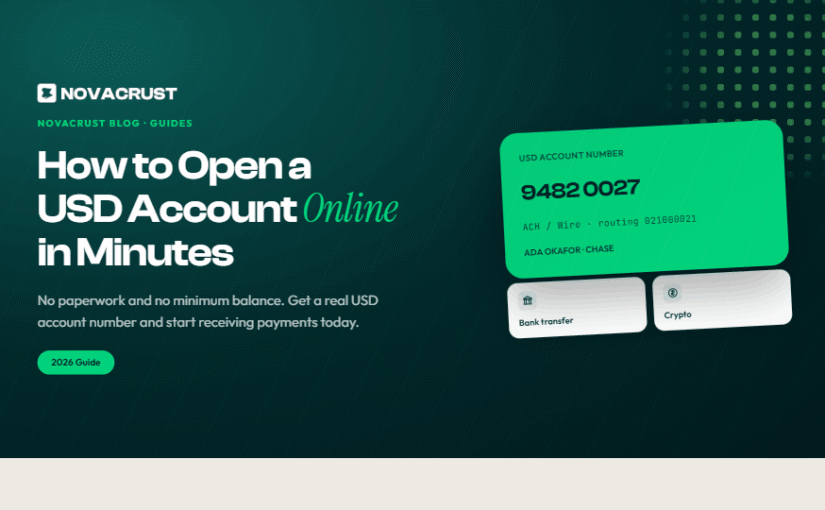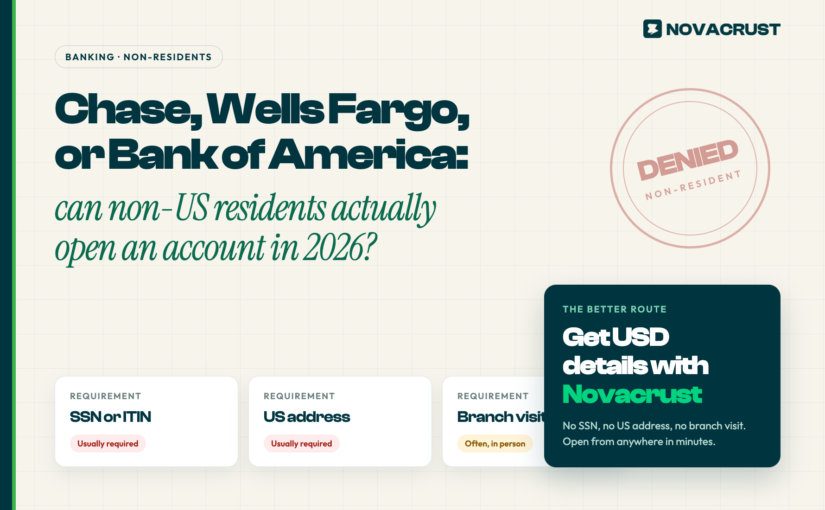
How to Open a USD Account Online in Minutes (2026 Guide)

Somewhere right now, a freelancer is standing in a bank queue with a folder of documents, two references, and a passport photo, trying to open a dollar account. And somewhere else, another freelancer just opened a USD account online from her phone in under ten minutes, got US account details in her own name, and sent them to her client before lunch.

Same goal. Wildly different experience. The difference is knowing that in 2026, you no longer need a traditional bank, a US address, or a plane ticket to own a dollar account.

This guide covers how to open a USD account online from anywhere in Africa, the Middle East, or Europe, what you can do with it, what to check before choosing a provider, and how to start receiving dollar payments the same week.

What Is a Virtual USD Account?

A virtual USD account is a dollar account you open and manage entirely online. It comes with real US account details in your name, an account number, and a routing number, with support for ACH, wire, and RTP transfers. To anyone paying you, it works exactly like a US bank account. To you, it is an app on your phone.

That single feature unlocks a lot. Clients and employers can pay you the way they pay anyone in America. Freelance platforms can deposit your earnings directly. And your money sits in USD, protected from local currency swings, until you decide to convert.

Who Needs a Dollar Account?

If any of these sound like you, a USD account is not optional; it is infrastructure:

  1. Freelancers and remote workers. You earn from clients in the US, UK, or Europe and need a clean way to receive dollar payments without losing a chunk to middlemen. A USD account for freelancers means you invoice in dollars and keep dollars.
  2. Creators. YouTube, sponsorships, digital product sales. Platform payouts land far more easily in a US account than through legacy transfer chains.
  3. Savers. When your local currency is volatile, holding part of your income in a dollar account is the simplest hedge available. You convert what you need when the rate favors you.
  4. Small businesses and SMEs. Paying international suppliers and receiving from international customers both get easier when you operate a dollar balance.

How to Open a USD Account Online with Novacrust

Here is the entire process, and why it answers the classic search: how to open a dollar account without visiting a bank.

Step 1: Sign up and verify your identity

Sign up on Novacrust, create your account, and complete identity verification with a valid government ID or passport. No branch visit, no references, no minimum deposit. Verification typically takes minutes, not days, and works across most countries in Africa and the wider EMEA region. This is also the answer to another high-intent search: a USD account without a US address. You do not need one. The account is in your name, at your address, wherever you live.

Step 2: Get your US account details

Once verified, you get your account number and routing number with ACH, wire, and RTP support. These are the same details any American would hand over to get paid.

Step 3: Start receiving dollar payments

Share your details with clients and employers, or plug them into platforms like Upwork, Fiverr, Toptal, Andela, Deel, Gusto, Rippling, and YouTube. If you have ever searched for a USD account to receive Upwork payments, this is the setup: withdraw from the platform straight into your own dollar account.

Step 4: Hold, spend, convert, or send

Your dollars are yours to manage. Hold them as savings. Spend them with a virtual USD card on subscriptions, tools, and ads. Convert to your local currency at a competitive rate. Or send money to a local bank account or mobile money wallet, yours or anyone else’s.

What to Check Before Choosing a USD Account Provider

Not every dollar account is built the same. Compare providers on these five points:

  1. Real US account details with ACH and wire support. Some apps only give you an internal wallet. You want an account number and routing number that any US employer can pay, which also covers the search dollar account with ACH and wire support.
  2. Receiving fees. The best providers charge little or nothing to receive ACH payments. Wire fees vary, so check both.
  3. Conversion rates. The exchange rate is the hidden fee. Compare what actually lands in your local currency, not the advertised rate.
  4. Withdrawal options. Look for direct withdrawal to local banks and mobile money in your market, whether that is naira, cedis, shillings, rand, or dirhams.
  5. Everything in one app. A USD account gets far more useful when it lives beside a virtual card, crypto conversion, and local transfers, so your money moves without app hopping. That is the Novacrust ecosystem in one sentence.

Virtual USD Account vs Traditional Foreign Currency Account

 Traditional bank dollar accountVirtual USD account (Novacrust)
Opening timeDays to weeks, branch visitMinutes, fully online
RequirementsReferences, paperwork, and sometimes a minimum balanceValid ID
Receiving a US wire$60 to $100 in combined feesLow, transparent fees
ACH supportRareYes, standard
WithdrawalBranch processesLocal bank or mobile money from the app
Best forLarge occasional transfersRegular international income

For most remote workers in Africa and EMEA, the comparison ends quickly. The best USD account for remote workers in Africa is the one that opens in minutes, receives ACH for little or nothing, and cashes out locally on your schedule.

Smart Ways to Use Your Dollar Account

  1. Split your income the moment it lands. A common freelancer formula: convert what you need for the month, hold the rest in USD as savings, and keep a small buffer on your virtual card for subscriptions.
  2. Time your conversions. Rates move. Because your money sits in dollars by default, you convert on the days that favor you, not the day your payment happens to arrive.
  3. Keep your payment history clean. Regular international income into an account in your own name builds a paper trail that helps with visa applications, apartment hunting, and credit.

Frequently Asked Questions

Can I open a USD account online without a US address?

Yes. Novacrust gives you US account details in your own name using your local identity documents. No US address, residency, or SSN required.

How long does it take to open a dollar account online?

Minutes. Sign up, verify your ID, and receive your account details, typically the same day.

Is a virtual USD account safe?

Reputable providers use identity verification, encryption, and regulated banking partners. Your account details work like standard US banking rails via ACH and wire.

Can I withdraw from my USD account to mobile money?

Yes, in supported markets, you can convert and withdraw funds directly to local banks or mobile money wallets through the app.

Does a USD account work for platform payouts?

Yes. Upwork, Fiverr, Toptal, Deel, YouTube, and many more can pay directly into your US account details.

The Bottom Line

A dollar account used to be a privilege that required the right passport or the patience for bank bureaucracy. Now it is a ten-minute setup. If you earn internationally, save seriously, or run a business across borders, opening a USD account online is the single upgrade that makes everything else about your finances simpler.

Open your Novacrust USD account in minutes and get US account details in your own name. No US address required.

The Best Way to Send Money Internationally in 2026

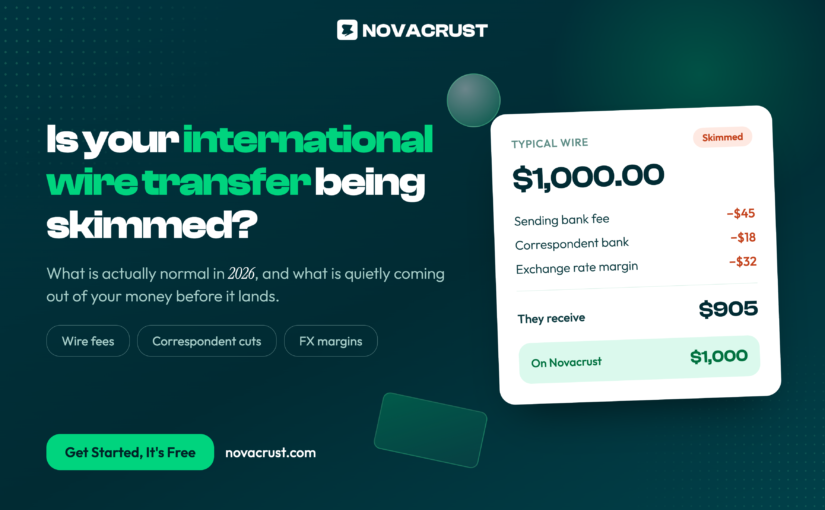
Here is a number that should make you angry: families and workers sending money across borders lose an average of 6 percent of every transfer to fees and exchange rate markups. Send $500 home every month, and that is over $360 a year, gone. Not to the person you love. To the middlemen in between.

It gets worse. Some services advertise zero fees, then quietly take their cut through a padded exchange rate. Others charge honestly but take three business days while your recipient waits. The best way to send money internationally is not about one flashy feature. It is about what actually lands on the other side, and how fast.

This guide breaks down how to send money online, locally, and globally, what transfers really cost in 2026, and how to stop donating a slice of every payment to the payment industry, regardless of where you are.

The Two Numbers That Decide Every Money Transfer

Every international money transfer has exactly two costs, and providers hope you only look at one:

The transfer fee. The visible number. Easy to compare, easy to advertise, easy to set to zero.

The exchange rate margin. The invisible number. The gap between the real mid-market rate and the rate you are given. A “zero fee” transfer with a 4 percent rate markup costs more than a $3 fee at an honest rate.

The only comparison that matters: how much local currency arrives per dollar sent. Judge every money transfer app by that single figure.

Sending Money Globally: Your Options Compared

Banks and traditional wires. Reliable for large sums, painful for everything else. International wires stack sending fees, correspondent bank fees, and receiving fees, often $40 to $100 total, and take days.

Cash pickup services. Western Union and MoneyGram reach almost everywhere, including recipients without bank accounts. You pay for that reach with some of the highest combined costs in the industry.

Money transfer apps. Wise, Remitly, LemFi, WorldRemit, and others have pushed prices down dramatically, especially on popular corridors into Africa. Strong options, though most only solve sending, not the rest of your financial life.

All-in-one platforms like Novacrust. If you already receive international income, the smartest move is to send from the same place your money lives. With Novacrust, your USD account, currency conversion, and transfers sit in one app: receive dollars from clients or family abroad, convert at a competitive rate shown upfront, and send to local bank accounts or mobile money wallets across supported markets in Africa and EMEA. No app hopping, no double conversion, no mystery rates.

How to Send Money with Novacrust, Step by Step

If you have ever searched for how to send money from a USD account to a local bank, this is the flow:

Step 1: Fund your account

Your balance might come from a client payment into your USD account, a crypto conversion, or a top-up. It all lands in one place.

Step 2: Choose your recipient

Send to a local bank account or mobile money wallet. Sending locally to a bank in your own country works from the same screen as sending across a border.

Step 3: See the rate before you commit

The exchange rate and what your recipient gets are shown upfront. If the numbers work, you send. If not, you wait for a better day. That transparency alone beats half the industry.

Step 4: Money arrives fast

Transfers to supported banks and mobile money wallets typically arrive within minutes to hours, not days. For anyone searching for the fastest way to send money internationally, speed plus an honest rate is the full answer.

Sending Money to Africa: What Actually Works

Remittances to Africa remain among the most expensive corridors in the world, which makes choosing well worth real money. What to know per use case:

Supporting family. For anyone searching to send money to family in Africa, prioritize mobile money delivery. In Kenya, Ghana, Tanzania, and much of East and West Africa, M-Pesa and MTN Mobile Money reach recipients who never visit a bank. A platform that sends directly to wallets saves your family the trip and the wait.

Paying suppliers or staff. Consistency beats everything. You want a platform where the rate is visible before every transfer and delivery times are predictable, so payroll never becomes an apology.

Cheapest way to send money to Nigeria, Kenya, or Ghana. The honest answer is always the same formula: compare the received amount, not the fee. On most corridors, app-based transfers from a held USD balance outperform cash services and banks by several percentage points.

Sending Money Locally

Global gets the headlines, but local transfers are the daily reality: rent, a vendor, your cousin’s school fees. The advantage of an all-in-one platform is that local sending uses the same balance as everything else. Convert exactly what you need from your USD balance and send it to any local bank account in minutes. Your dollars stay dollars until the moment they need to be anything else.

Six Rules for Never Overpaying on Transfers Again

  1. Compare received amounts, not fees. One number tells the truth.
  2. Beware “zero fee” marketing. The rate is where zero-fee services get paid.
  3. Hold your money in USD until you send. Converting on your schedule, not the provider’s, protects you from bad rate days.
  4. Use mobile money for the last mile in Africa. It is usually faster and reaches more people than bank deposits.
  5. Send larger amounts less often when costs are partly flat, since fixed fees hurt small transfers most.
  6. Keep receipts in one app. Scattered transfers across three services mean no clean record of what you sent and at what rate.

Frequently Asked Questions

What is the best way to send money internationally in 2026? Use a platform that shows the exchange rate upfront and delivers to local banks or mobile money quickly. Compare what the recipient receives, not the advertised fee.

What is the cheapest way to send money to Nigeria? Sending from a held USD balance through an app with transparent rates typically beats banks and cash services. Always compare the naira amount that arrives.

Can I send money directly to mobile money wallets? Yes. Novacrust supports sending to mobile money wallets in supported African markets, alongside bank transfers.

How fast do international transfers arrive? App-based transfers to supported banks and wallets usually arrive within minutes to hours. Traditional wires can take several days.

Can I send money locally and internationally from one app? Yes. With Novacrust, local and global transfers come from the same balance, next to your USD account, virtual cards, and crypto conversion.

The Bottom Line

Every transfer is a small negotiation, and the industry wins whenever you compare the wrong number. Look only at what arrives, keep your money in dollars until sending day, and use one platform for local and global so your finances live in one place.

CTA: Send money locally and globally with Novacrust. See the rate before you send, every time.

Money Management for Remote Workers and Digital Nomads: The Complete 2026 Guide

You sent the invoice three weeks ago. The client confirmed payment days ago. And yet your money is still floating somewhere between a foreign bank, an intermediary you have never heard of, and an exchange rate that quietly shaved off a chunk you will never get back. If you earn a living online and get paid from abroad, you know this feeling. The work is the easy part. Getting paid, keeping the value of what you earned, and spending it is where the real friction lives.

Money management for remote workers is not about budgeting apps or colour-coded spreadsheets. It is about something more basic: getting your money in quickly, holding it in the currency you earned, spending it anywhere, and moving it home at a fair rate, without losing time or money at every step. This guide covers how to get paid as a remote worker in 2026, how to keep more of what you earn, and how to choose a platform that handles the whole journey instead of forcing you to stitch five tools together.

Why money management for remote workers is harder than it looks

When you work for a local employer, money is simple. The salary lands in your local bank, in your local currency, and you spend it locally. Remote work breaks that loop.

Now your international clients might be in New York, your bank in Lagos or Cairo or London, your subscriptions billed in dollars, and your rent due in a currency none of those clients use. Every handoff between currencies and countries is a chance to lose money to fees, time to slow transfers, or value to a poor rate. Multiply that by every invoice, and the leak becomes a flood. The people who keep the most of what they earn are not the ones who hustle the hardest. They are the ones who fixed their setup once and stopped bleeding value on autopilot.

The four jobs your money setup needs to do

A strong setup does exactly four things: receive, hold, spend, and send money from one platform, instead of logging into a different service for each.

1. Receive international payments without the wait

Many remote workers still rely on slow transfers that pass through several banks, take five to seven working days, and arrive lighter because each bank took a cut. If you have ever searched for how to get paid as a freelancer with overseas clients, this is the problem you were trying to solve.

What you want is a multi-currency account for freelancers, a foreign currency account in your own name, that lets you receive dollars, pounds, or euros through familiar rails like ACH and wire transfer, so your international clients can pay you the way they pay anyone else. When a client can pay you with no extra effort, you get paid faster and look more professional doing it.

2. Hold your money in the currency you earned

Here is a costly mistake. You earn in dollars, the money lands, and it gets force converted into your local currency on arrival. Next week, you need dollars again for software or ads, so you convert back, losing a slice each way.

A proper setup lets you hold foreign currency as foreign currency. If your next expense is in dollars, the money should never detour through your local currency and back. Holding multiple currencies in one place means you convert only when you choose, at a moment you choose.

3. Spend globally without your card getting declined

You found the perfect setup, the money is in, and then your card is declined for a tool you need for work. Anyone paying for international subscriptions from outside the US or Europe has lived this. Local cards get rejected by global merchants constantly, and the ones that work often carry painful limits.

This is where a virtual dollar card changes your day-to-day life. A good one pays for the services you actually use, from streaming to design tools to advertising platforms, and lets you fund it from local currency, your dollar balance, or crypto you convert on the spot. No foreign bank account required, with limits high enough that you are not topping up every hour.

4. Convert and send money home at a fair rate

Eventually, you need some of that income in your local currency, for rent, for family, for life. Many platforms advertise zero fees and then bake their profit into a rate that sits well below the real market rate. You feel good about the no-fee headline while losing more than a fee ever would have cost you.

What you want is a transparent rate close to the real mid-market rate, so you see exactly what you get before you confirm. A fair rate on every conversion, across a year of income, is the difference between keeping your money and donating it to a spread you never agreed to.

Digital nomad banking: what changes when you move

If you are moving between countries, the stakes climb. Digital nomad banking has its own quirks. Your home bank may freeze a card it sees used in three countries in a month. Opening a local account in each new country is slow and often impossible on a tourist or nomad visa, which is why a traditional bank account for digital nomads is so hard to keep.

The countries courting nomads, the UAE chief among them, with its digital nomad visa, have pulled in a wave of location-independent earners and expats facing one question: how do I manage money without permanent residency anywhere? The answer is a digital nomad bank account that travels with you, holds multiple currencies, issues a card that works across borders, and does not panic when your spending map looks like a flight route. Sorting out your digital nomad visa finances before you land somewhere new saves you the scramble of fixing it once you are already abroad.

The mistakes that quietly cost remote workers the most

Four patterns show up again and again, and each is avoidable. The first is juggling too many tools, where every handoff costs a fee and a delay. The second is ignoring the exchange rate because the platform said “no fees,” when the rate is the fee. The third is force converting the income you will need again into the same currency. The fourth is staying with a slow, traditional channel out of habit. Changing is a one-time cost. The savings repeat every month for as long as you work.

How to choose the best fintech platform for remote workers

Judge each option against the four jobs. Run through this list:

  • Can you receive USD, GBP, and EUR into a foreign currency account in your own name, using ACH and wire transfer?
  • Can you hold more than one currency and convert only when you choose?
  • Does it issue a virtual dollar card that works with global merchants, with real limits?
  • Is the exchange rate transparent and close to the real market rate?
  • Does it cover the countries and corridors you actually live and work in, not just one market?

The best fintech platform for remote workers answers yes to all five, because that is the one that lets you stop managing money and get back to your work.

Bringing it together: one platform instead of five

This is the gap Novacrust was built to close. Instead of one tool to receive, another to hold, a third to spend, and a fourth to send, it brings the whole journey into a single platform. You can receive international payments through a USD account in your name with ACH and wire support, hold and manage multiple currencies, spend worldwide on a virtual dollar card you fund from local currency, dollars, or crypto you convert in app, and send money home at a transparent rate. For creators, freelancers, and remote workers tired of watching income leak across half a dozen services, that consolidation is the entire point.

Frequently asked questions

What is the best way to manage money as a remote worker?

Build your setup around four jobs: receiving payments, holding your money in the currency you earned, spending globally, and converting or sending money home at a fair rate. The fewer tools involved, the less you lose to fees and delays.

How do remote workers get paid by international clients?

The most reliable approach is a multi-currency account in your own name that supports ACH and wire transfers, so clients can pay you using rails they already know. This is faster than slow transfers that pass through several banks.

What is the best app to receive money from abroad?

Look past the label and judge on substance. The best option lets you receive money from abroad into an account in your own name, hold it in the currency you earned, spend it on a global card, and convert it at a transparent rate, all in one place. A platform that does the full journey beats a single-feature tool every time.

Do I need a foreign bank account to manage money as a digital nomad?

No. Modern platforms give you a digital nomad bank account that holds multiple currencies, receives international payments, and spends on a virtual card without opening a local bank account in each country.

How can I avoid losing money on currency conversion?

Hold foreign currency as foreign currency and convert only when you choose. Always compare the platform’s rate to the real market rate, because a “no fees” claim often hides its cost inside a poor exchange rate.

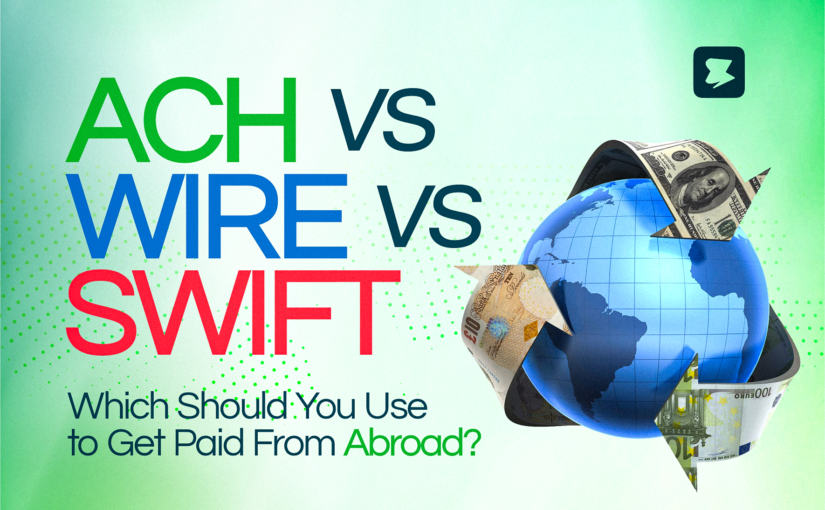
ACH vs Wire vs SWIFT: Which Should You Use to Get Paid From Abroad?

Mary closed her biggest design contract yet, a US client paying four figures a month. She invoiced, the client paid the same day, and she spent the week feeling like a professional who had finally made it. Then she waited. Six days later, the money landed, except it was short by $40 she could not explain, skimmed by a bank she had never agreed to deal with. The work had gone perfectly. The getting paid part was a mess, and nobody had ever taught her the difference between the options her client kept asking about.

That gap is what this guide closes. ACH, wire transfer, and SWIFT are the three ways most international payments move, and the difference between them is real money and real days. Understanding the ACH vs wire transfer question, and where SWIFT fits in, means you can tell a client exactly how to pay you, get your money faster, and stop losing a cut to fees you never needed to pay.

The short answer first

 ACHWire transferSWIFT
Best forRoutine US paymentsLarge or urgent paymentsPayments across borders
Speed1 to 3 business daysSame day to 1 day domestically1 to 5 business days
CostLow or freeHigher fixed feeHigher, often with intermediary fees
ReachWithin the USDomestic and internationalGlobal, bank-to-bank worldwide

If your client is in the US and the payment is routine, ACH is usually cheapest. If the payment is large or urgent, a wire is faster and more certain. If the money is crossing borders, SWIFT is the network doing the work behind the scenes. Now, let us make each one make sense.

What is an ACH payment?

ACH stands for Automated Clearing House. It is the network that moves money between banks inside the United States. If you have ever had a US salary deposited automatically, paid a US bill online, or received a refund into a US account, ACH did the work.

The appeal of ACH is cost. It is cheap, often free, which is why it is the default for recurring and everyday payments in the US. The trade-off is speed and reach. An ACH payment usually takes one to three business days to settle, and it only works within the US banking system. So if a US client is paying you and you hold a US-style account, ACH is the low-cost, no drama option for regular invoices.

How long does ACH take?

Most ACH payments clear in one to three business days. Some processes are same-day if the sender uses faster ACH options, but plan around the standard window. ACH does not move on weekends or US bank holidays, so a payment sent on a Friday may not land until the middle of the following week.

What is a wire transfer?

A wire transfer is a direct, bank-to-bank movement of money. Instead of being batched and processed in groups like ACH, a wire is sent individually and tends to settle much faster, often the same day for domestic transfers.

Wires are the tool of choice when speed and certainty matter, for example, a large project payment, a deposit, or anything where both sides want confirmation that the money has truly moved. The cost is the catch. Wires usually carry a fixed fee on the sending side, and sometimes on the receiving side too. For a small invoice, that fee feels heavy, but for a large or time-sensitive payment, the speed is worth it. To receive a wire transfer, you give the sender your account details and a routing number or equivalent, plus a few extra pieces of information for international wires.

What is SWIFT?

SWIFT is not a payment in the way ACH and a wire are. It is the messaging network banks around the world use to talk to each other and instruct international transfers. When money moves between a bank in one country and a bank in another, a SWIFT message usually coordinates it. This is why an international wire is often called a “SWIFT transfer.”

The strength of SWIFT is global reach. It connects thousands of banks worldwide, which is how a client in one country can pay a freelancer in another at all. The weakness is what happens along the way. An international SWIFT transfer can pass through one or more intermediary banks, and each can take a fee and add a day. This is the mystery slice that goes missing between the invoice amount and what finally lands in your account. It is exactly what cost Mary her forty dollars.

ACH vs wire vs SWIFT: the differences that affect you

Speed, cost, and reach are the three levers. ACH wins on cost but is slow and US only. A wire wins on speed and certainty but costs more per transfer. SWIFT is what makes an international wire transfer possible at all, with the widest reach but the highest chance of intermediary bank fees and delays.

For most freelancers, the practical reality looks like this. A US client paying a routine invoice reaches for ACH because it is cheap and easy on their end. A client sending a large payment, or one who wants it to land fast, uses a wire. And the moment that money travels from one country to another, SWIFT carries it, with the extra cost and time international hops add.

Which should you use when?

A few simple scenarios cover most situations:

  • Your client is in the US, and the invoice is routine. Ask for ACH. It is the cheapest and most reliable for regular work.
  • The payment is large, or you need it quickly and confirmed. Ask for a wire. The fee is worth the speed.
  • You and your client are in different countries. The payment travels over SWIFT, so build in a few extra days and expect possible intermediary fees.
  • You want the smoothest experience over time. Set yourself up to accept both ACH and wire, so a client can pay you the way that suits them rather than the way you are stuck with.

The catch for anyone outside the US

Here is the part most guides skip. ACH and US-style wires assume you have an account that can receive them, with a real account number and routing number in your name. For people living outside the US, that has long been the hard part. You can know everything about how to receive a wire transfer and still have nowhere for the money to land.

This is the gap modern financial platforms close. With a USD account in your own name that supports both ACH and wire transfers, you can hand a US client your details and let them pay you exactly as they would pay anyone local. Novacrust offers this kind of account, so you can receive international payments through familiar rails, hold the dollars you earn, and convert or spend them on your own terms rather than losing value the moment the money arrives. Once you have the right account, the ACH vs wire decision stops being a source of anxiety and becomes a quick, informed choice you make to get paid faster and keep more of what you earned. Mary switched to one after that first short payment, and her next invoice landed whole.

Frequently asked questions

What is the difference between an ACH and a wire transfer?

ACH moves money between US banks in batches, which makes it cheap but slower, usually one to three business days, and limited to the US. A wire transfer is sent individually and settles much faster, often the same day domestically, but carries a higher fee. ACH suits routine payments, and wires suit large or urgent ones.

Is SWIFT the same as a wire transfer?

Not exactly. A wire is the transfer itself, while SWIFT is the global messaging network banks use to coordinate international wires. An international wire usually travels over SWIFT, which is why the terms get used together.

How long does ACH take to arrive?

Typically, one to three business days. ACH does not process on weekends or US bank holidays, so timing depends on when the payment is sent.

Which is cheapest for receiving international payments?

ACH is usually cheapest when it is available, but it only works within the US. For payments across borders, you are often dealing with a SWIFT-based wire, where the key is an account that minimises intermediary bank fees and gives you a fair conversion rate once the money lands.

Keep reading

  • Money Management for Remote Workers and Digital Nomads: The Complete 2026 Guide

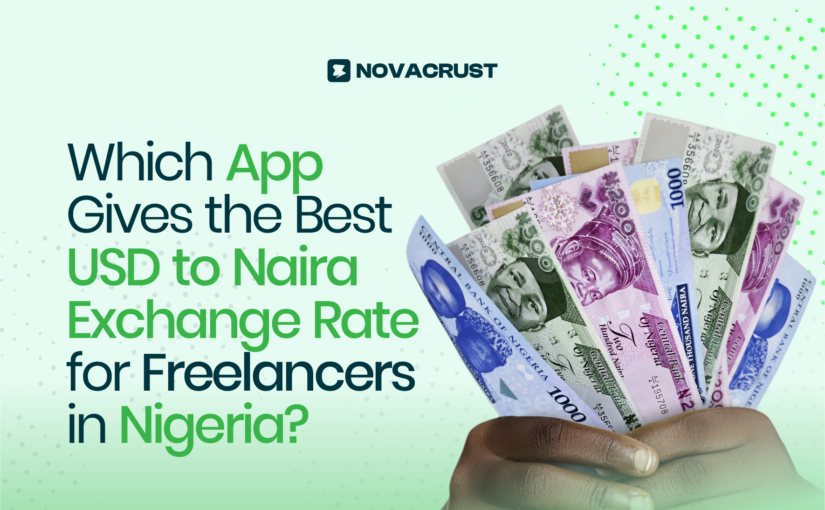
Which App Gives the Best USD to Naira Exchange Rate?

You received $500 from a client. By the time it hits your Nigerian bank account, it feels like you lost money without spending anything.

This is why thousands of freelancers and remote workers keep searching:

  • best usd to naira rate app
  • exchange usd to naira online
  • wise vs payoneer rate
  • grey rate today

The real problem is not getting paid in dollars. The real problem is how much of those dollars you keep after conversion.

Many African freelancers now use Novacrust because it allows them to receive USD, convert at competitive rates, and withdraw to their bank without the silent losses that happen across multiple platforms.

This guide breaks down how the most popular apps handle USD to NGN conversion and what actually gives you the best value.

Why USD to Naira conversion is where freelancers lose money

Most freelancers focus on receiving USD from clients. Very few pay attention to what happens during conversion.

Losses usually happen through:

  • Hidden exchange rate margins
  • Multiple conversion steps
  • Transfer and withdrawal fees
  • Delays that force you to convert at bad rates

This is why people keep comparing wise vs payoneer rate and checking grey rate today before converting.

How conversion typically works with popular platforms

Freelancers often receive USD using:

Each platform allows conversion, but the final naira amount you receive can differ significantly because of rate margins and processing structure.

What determines the amount you receive in naira

Your final payout depends on:

  1. The platform’s internal exchange rate
  2. Additional conversion or withdrawal charges
  3. Time delays before funds hit your bank
  4. Extra steps between USD wallet and local account

Even a small difference in rate becomes large when you convert hundreds or thousands of dollars monthly.

Example: Converting 1000 USD to Naira

Let us assume the market rate is 1500 NGN per dollar.

PlatformEffective Rate You GetNaira Received
WiseSlightly below marketLower payout
PayoneerIncludes marginLower payout
GreyCloser to marketBetter payout
NovacrustCompetitive rateHigher payout

This is why freelancers constantly search best usd to naira rate app before converting.

Why many freelancers now convert USD using Novacrust

Novacrust removes the long chain between receiving USD and converting to naira.

You can:

  • Receive USD directly
  • Convert at competitive rates inside the same platform
  • Withdraw to your Nigerian bank quickly

There are no multiple apps reducing your earnings at each step. This is what makes a real difference over time.

The mistake most freelancers make

They choose a platform based on how easy it is to receive USD, not how well it converts USD to NGN.

The real money is saved at the conversion stage, not the receiving stage.

How to choose the best app to exchange USD to Naira online

Look for a platform that:

  • Shows transparent rates
  • Minimizes steps between USD and NGN
  • Allows fast withdrawal to your bank
  • Is built with African freelancers in mind

This is where many traditional platforms fall short.

Final thoughts

Getting paid in dollars is only half the journey. Converting those dollars at a good rate is what protects your income.

The difference between platforms may look small per transaction, but over months of freelance work, it becomes significant.

Choosing the right app for USD to naira conversion is how you stop losing money silently.

Sign up to get started on Novacrust here.
Best Payment Platform for Upwork, Fiverr and Remote Jobs in Africa

You finished the job. The client paid. Now your money is sitting in USD online and getting it into naira, cedis, or shillings without losing a painful chunk to fees feels harder than the work you did.

This is why many African freelancers now use Novacrust to receive USD payments from Upwork, Fiverr, and remote clients, convert at better rates, and withdraw directly to their local bank or mobile money without stress.

If you have been searching for:

  • how to get paid from upwork nigeria
  • fiverr payment method africa
  • best payment platform for freelancers in africa
  • receive international payments africa

This guide shows why most people start with other platforms and why many eventually switch to a simpler route.

Why Novacrust works better for Upwork, Fiverr and remote jobs

Novacrust was built around the exact problems African freelancers complain about daily.

It allows you to:

  1. Receive USD payments easily from global platforms
  2. Convert to NGN, KES, or GHS at competitive rates
  3. Withdraw to your local bank or mobile money quickly
  4. Avoid the long chain of apps that reduce your earnings

Instead of combining multiple services, Novacrust handles the full journey from USD to your local account smoothly.

How freelancers usually get paid from Upwork in Nigeria and other African countries

A common method looks like this:

  1. Connect Upwork to a payment processor
  2. Receive USD into that account
  3. Convert to local currency
  4. Transfer to your bank
  5. Lose money in fees and exchange rates along the way

This is why so many people keep searching how to get paid from upwork nigeria because the process never feels efficient.

Fiverr payment method in Africa and why it becomes frustrating

Fiverr supports a few payout options that look simple on paper. In practice, freelancers often experience:

  1. Delays before funds arrive
  2. Exchange rates that reduce earnings
  3. Extra steps before money reaches their bank

This leads to constant searches for fiverr payment method africa and better alternatives.

Platforms freelancers commonly try first

Many freelancers rotate between these platforms:

  • Payoneer
  • Wise
  • Grey
  • Chipper Cash

Each one solves part of the problem. None solves the full journey from receiving USD to accessing local currency seamlessly.

What a good payment platform for remote jobs should provide

To truly work for African freelancers, a platform must:

  • Provide a real USD receiving account
  • Allow fast conversion to local currency
  • Offer strong exchange rates
  • Allow quick withdrawal to local banks or mobile money
  • Work smoothly with Upwork, Fiverr, and remote clients

Very few platforms check all these boxes in one place.

FeaturePayoneerWiseGreyChipper CashNovacrust
USD Receiving AccountYesYesYesLimitedYes
Works with UpworkYesYesYesNoYes
Works with FiverrYesYesYesNoYes
Strong NGN/KES/GHS ConversionVariesVariesBetterNot focusedStrong
Speed to Local BankSlowModerateFastFastFast
Built for African freelancersNoNoYesPartlyYes

Why this matters more as your freelance income grows

When you start earning more from remote jobs, poor exchange rates and hidden charges stop being small annoyances and start becoming real losses.

Choosing the best payment platform for freelancers in Africa directly affects how much of your USD earnings you actually keep.

Final thoughts

Freelancing gives you global earning power. Your payment method should not reduce that advantage.

The right system lets you receive international payments in Africa, convert at good rates, and access your money without delays.

That difference is what turns getting paid into actually enjoying what you earned.

Start enjoying the difference with Novacrust here.

How Freelancers in Africa Receive International Payments Easily

Imagine being able to earn in dollars while working from home in Lagos, Accra, or just about anywhere in Africa. Sounds amazing, right? The reality for many African freelancers, however, is often frustrating. Getting paid by international clients can be slow, expensive, and complicated. High fees, long processing times, and banking restrictions make accessing your hard-earned money stressful.

It doesn’t always have to be this way. African freelancers can receive payments quickly, securely, and with minimal fees if they use the right platforms. Here are the top solutions:

  1. Novacrust


Novacrust is a versatile platform designed not only for freelancers but also for businesses, crypto users, and anyone who needs a virtual dollar card for international transactions. With Novacrust, you can:

  • Create a USD account in minutes to receive payments directly from clients and platforms
  • Fund your account through USDT or USDC and convert instantly to Naira
  • Use a virtual USD card to pay for subscriptions, online services, or gift cards
  • Access priority customer support and exclusive perks if you transact regularly
  • Enjoy fast, low-cost conversions and first access to new features

Novacrust gives you complete control over your international earnings and spending, helping you avoid delays, high fees, and complicated processes.

  1. Chipper Cash


Chipper Cash is a popular cross-border payments platform in Africa. Freelancers and small businesses can receive payments from international clients and withdraw directly to local banks or mobile wallets. It is known for fast transfers, low fees, and ease of use, making it a convenient choice for many professionals.

  1. PayPal


PayPal remains one of the most widely recognized global payment platforms. Freelancers can invoice clients worldwide and receive payments instantly. While withdrawals to African banks often carry high fees and slower processing, it remains a trusted solution for freelancers working with international clients.

  1. Payoneer

Payoneer allows freelancers and businesses to receive international payments directly into local bank accounts. It is widely used on freelance marketplaces like Upwork and Fiverr and supports multiple currencies, prepaid cards, and business accounts. Currency conversion and withdrawal fees can apply, but it remains a reliable choice for global transactions.

  1. Wise (formerly TransferWise)


Wise is ideal for freelancers who want transparent, low-cost international transfers. You can receive payments in multiple currencies and convert them at real exchange rates. While very affordable and fast, withdrawals to some African banks may not always be instant.

  1. Grey


Grey is an emerging payment platform in Africa focused on freelancers and small businesses. It allows users to receive payments from international clients, manage multiple currencies, and access funds in local banks. Grey emphasizes low fees and simple account management, helping freelancers handle global payments efficiently.

  1. Flutterwave


Flutterwave offers virtual accounts and cards that make it easy for freelancers and businesses to receive international payments. It works well for invoice-based payments, online marketplaces, and small business transactions. Fees and processing times vary depending on the client’s payment method, but it is a widely trusted platform across Africa.

The Solution
Freelancers, businesses, crypto users, and anyone needing a virtual USD card no longer need to struggle with payment delays, high fees, or complicated processes. Platforms like Novacrust make it simple to receive international payments, convert crypto or USD to Naira instantly, and even spend globally through a virtual card. Combined with other trusted platforms like Chipper Cash, Grey, Payoneer, and Wise, accessing your international funds has never been easier.

Start Receiving and Using International Payments Today
Sign up on Novacrust, create your USD account, fund it through USDT or USDC, and start receiving payments from clients, paying for subscriptions, or converting crypto with ease. Take control of your money and experience fast, secure, and hassle-free global transactions today.