Understanding the US Banking System: A Guide for Immigrants, Freelancers, and Non-Residents

The US has more than 4,000 chartered banks. Almost none of them will open an account for someone with no Social Security number and no US address. That single requirement is why so many freelancers, business owners, and diaspora workers outside the US spend hours filling out bank applications only to get rejected at the last step.

If you get paid in dollars, or want to, understanding how the US banking system actually works, and where it shuts non-residents out, saves you that wasted time. Here is what the system looks like from outside, and the faster way in.

The Three Accounts Everyone Means When They Say “US Bank Account”

Checking accounts. Built for daily use: receiving deposits, paying bills, spending with a debit card. This is the account most freelancers actually need.

Savings accounts. Built to hold money and earn a small amount of interest. Most banks pair a savings account with a checking account, not instead of one.

Credit unions. Member-owned instead of shareholder-owned, often with lower fees, but membership usually requires a US address, employer, or local affiliation, which rules most non-residents out immediately.

What Actually Blocks Non-Residents

Four things stop most applications before they start:

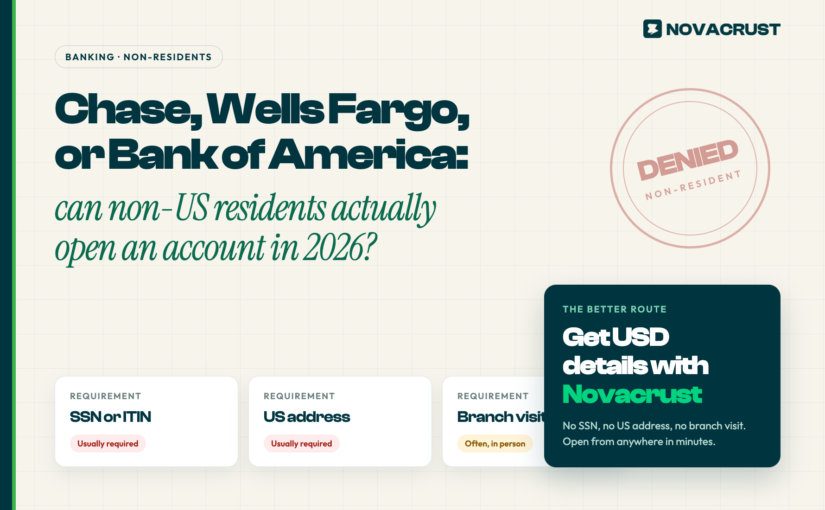
A Social Security Number or ITIN. Chase, Bank of America, and Wells Fargo all ask for one on the standard application. Without it, some branches will still open an account in person; most online applications reject you automatically.

A US address. Banks mail debit cards, statements, and tax forms. No US address usually means no account, even if every other requirement is met.

An in-person visit. Many banks still require you to walk into a branch with a physical ID to finish verification, which is not realistic if you live in Lagos, Nairobi, or Accra.

Minimum deposits and monthly fees. Traditional accounts often carry $10 to $25 monthly fees unless you maintain a minimum balance, on top of the paperwork.

Big Banks vs Online Banks vs Neobanks

Big banks (Chase, Bank of America, Wells Fargo) have the most name recognition and the strictest requirements for non-residents. A handful of branches make exceptions with extra documentation, but this varies by location and isn’t something you can rely on.

Online-only banks loosen some requirements but most still ask for an SSN or ITIN, since they are still bound by the same federal rules as physical banks.

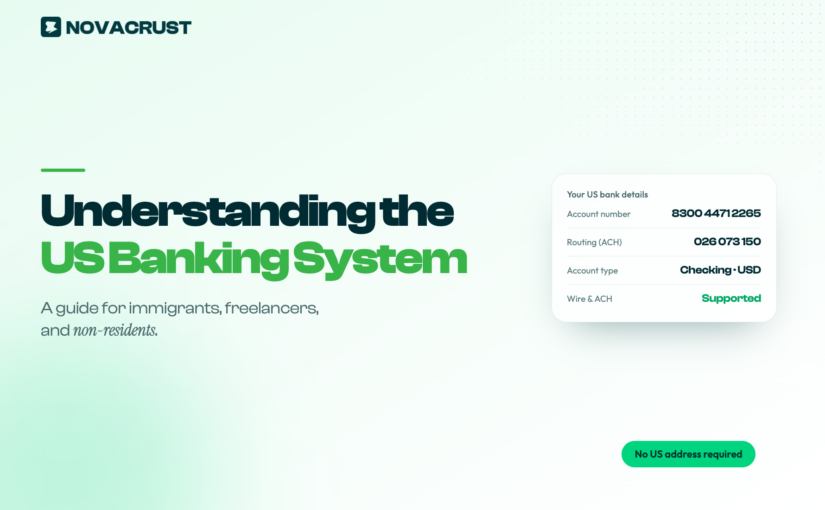
Fintech platforms with USD Accounts work differently. Instead of opening a bank account in the traditional sense, you get real US account and routing numbers issued through a banking partner, without needing an SSN, ITIN, or US address yourself. This is the category Novacrust’s USD Account falls into.

The Vocabulary Worth Knowing

Three terms come up constantly once money starts moving into and out of a US account:

Routing number. Identifies the bank. Every US account has one.

Account number. Identifies you specifically within that bank.

ACH, wire, and SWIFT. The three ways money actually moves. ACH is the standard, low-cost domestic transfer method. Wires move faster and cost more. SWIFT handles international transfers between banks in different countries.

The Faster Way In: A USD Account Built for Non-Residents

You do not need to become a customer of a traditional US bank to receive dollars like one. With Novacrust, your USD Account gives you a real US account and routing number in your name, so clients on Upwork, Fiverr, or direct contracts can pay you exactly like they would pay someone based in the US.

No SSN. No US address. No branch visit. You open it from your phone, and it works alongside your crypto wallet, virtual card, and transfers to 50+ countries in the same account.

Frequently Asked Questions

Can a non-US resident open a US bank account? Rarely through a traditional bank without an SSN, ITIN, or US address. Fintech platforms offering USD Accounts solve this without requiring US residency.

Do I need a Social Security Number to receive USD payments? No. A USD Account from Novacrust gives you US account and routing numbers without an SSN.

What’s the difference between a checking account and a USD Account? A checking account is issued directly by a US bank to US residents. A USD Account is issued through a fintech platform’s banking partner and works the same way for receiving and sending dollars, without the residency requirements.

Can I withdraw or convert the dollars I receive? Yes. With Novacrust, dollars in your USD Account convert to your local currency at a competitive rate, or move on as crypto, whenever you choose.

Is a USD Account the same as a domiciliary account? No. A domiciliary account is held at a bank in your own country and usually still requires branch visits. A USD Account gives you a real US account number directly.

The Bottom Line

The US banking system was not built with non-residents in mind. You don’t need to fight it. Get the parts that matter, a real US account and routing number, without the SSN, the address, or the branch visit.

CTA: Get Started — It’s Free. Open your Novacrust USD Account and get paid in dollars from anywhere.

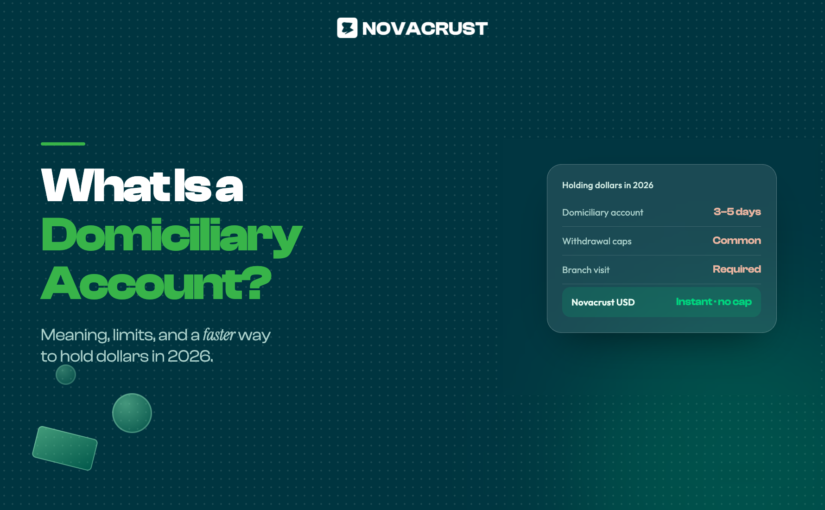
What Is a Domiciliary Account? Meaning, Limits, and a Faster Way to Hold Dollars in 2026

In 2026, the Central Bank of Nigeria rewrote the rules on domiciliary accounts, lifting the withdrawal caps that frustrated dollar savers for years. On paper, you can now withdraw up to $10,000 a day. In practice, cash from an inbound transfer is still capped at around $200, and anything above that has to move through your bank account instead of your hand.

If you have ever searched “what is a domiciliary account” or “domiciliary account meaning,” you are probably trying to figure out one thing: does this account actually solve your problem, or does it just move the paperwork somewhere else? Here is what a domiciliary account really does, where it still falls short, and a faster way to hold and receive dollars.

What is a domiciliary account?

A domiciliary account is a foreign-currency account opened at a Nigerian bank, GTBank, Zenith, Access, First Bank, and UBA all offer one, that lets you hold, save, and transact in US dollars, pounds, or euros instead of naira.

You open it in person, usually with a valid ID, proof of address, and a reference letter. Once it is active, you can receive foreign currency deposits, hold them without automatic conversion to naira, and withdraw or wire the funds out under the bank’s rules.

What a domiciliary account is actually good for

  • Holding savings in dollars. Your balance sits in USD, protected from naira devaluation, until you decide to convert.
  • Receiving occasional large transfers. Family remittances, inheritance, or a one-off payment from abroad land cleanly, in dollars, in an account you already trust.
  • Working inside a bank relationship you already have. No new provider to vet, no new app to learn.

Where a domiciliary account falls short in 2026

  1. It is a Nigerian bank account, not a US account. There is no US routing number attached to it, so Upwork, Fiverr, Deel, and most freelance platforms cannot pay you directly into it. You still need a separate way to receive USD platform payouts.
  2. Cash from an inbound transfer is capped near $200. Anything above that has to be paid into your account instead of handed to you as cash, so a “$10,000 daily withdrawal” headline does not mean $10,000 in your pocket the same day.
  3. Opening one takes a branch visit. ID, proof of address, and often a reference letter, so it is days, not minutes.
  4. Large cash movements can carry real fees. Processing charges on bulk cash transactions have been reported as high as 5% for corporates moving large sums.
  5. The exchange rate is whatever your bank quotes. You are not shopping it against anyone else’s rate.

Domiciliary account vs virtual USD account

 Domiciliary account (Nigerian bank)Virtual USD Account (Novacrust)
Opening timeBranch visit, daysMinutes, fully online
RequirementsID, proof of address, often a reference letterValid ID
Receiving platform payouts (Upwork, Fiverr, Deel)Not supported directlyYes, direct to your account
US account and routing numberNoYes, ACH, wire, and RTP support
Cash accessCapped near $200 per inbound transfer, rest via accountWithdraw to local bank or mobile money anytime
Exchange rateSet by your bankCompetitive, shown upfront
Best forLong-term dollar savings, occasional large transfersRegular international income

A domiciliary account and a virtual USD account are not competing for the same job. One is a savings vault for dollars you already have. The other is built to receive dollars regularly, from clients and platforms, the same week you start using it.

Get a USD account that actually takes freelance and platform payments

Opening a Novacrust USD account takes three steps:

  1. Sign up and verify your identity with a valid government ID. No branch visit, no reference letter.
  2. Get your US account and routing number, the same details any American would hand over to get paid.
  3. Start receiving dollar payments from clients, employers, or platforms like Upwork, Fiverr, Deel, and YouTube, then withdraw to your local bank or mobile money whenever you want.

Frequently asked questions

Is a domiciliary account the same as a USD account?

No. A domiciliary account is a foreign-currency account at a Nigerian bank. A virtual USD account like Novacrust’s gives you real US account and routing details, so it works for direct international payments, not just savings.

Can I receive Upwork or Fiverr payments into a domiciliary account?

No. Domiciliary accounts do not carry a US routing number, so most freelance platforms cannot pay into them directly. A virtual USD account can.

What is the daily withdrawal limit on a domiciliary account in 2026?

Up to $10,000 a day via transfer, under the CBN’s 2026 Foreign Exchange Manual. Cash from an inbound transfer is still capped at around $200, with the rest paid into your account.

Do I still need a domiciliary account in 2026?

If you are saving a lump sum in dollars long-term, it still works well. If you need to receive regular international income, a virtual USD account is faster and built for that job.

The bottom line

A domiciliary account is a real, legitimate way to hold dollars in Nigeria, and 2026’s rule changes made it easier to use. But it was built for savings, not for receiving international income on a regular basis. If you are getting paid from abroad every month, you need an account built for that.

Open your Novacrust USD account in minutes and get real US account details in your own name. No branch visit required.

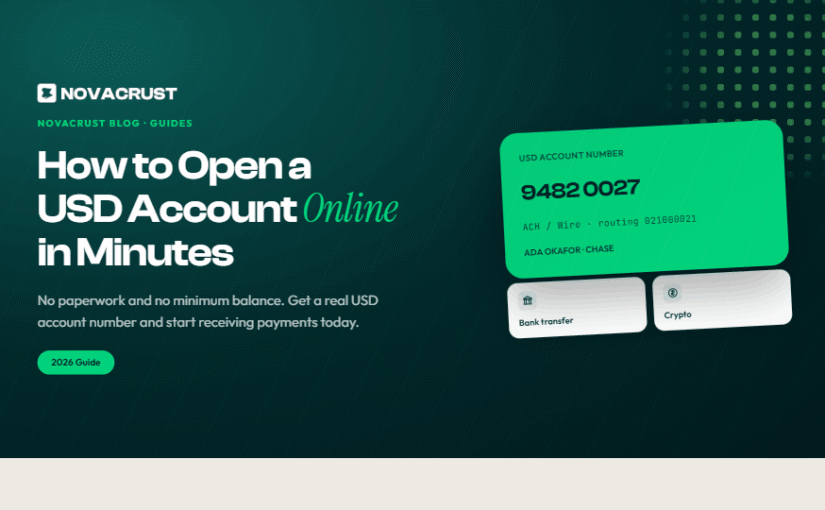
How to Open a USD Account Online in Minutes (2026 Guide)

Somewhere right now, a freelancer is standing in a bank queue with a folder of documents, two references, and a passport photo, trying to open a dollar account. And somewhere else, another freelancer just opened a USD account online from her phone in under ten minutes, got US account details in her own name, and sent them to her client before lunch.

Same goal. Wildly different experience. The difference is knowing that in 2026, you no longer need a traditional bank, a US address, or a plane ticket to own a dollar account.

This guide covers how to open a USD account online from anywhere in Africa, the Middle East, or Europe, what you can do with it, what to check before choosing a provider, and how to start receiving dollar payments the same week.

What Is a Virtual USD Account?

A virtual USD account is a dollar account you open and manage entirely online. It comes with real US account details in your name, an account number, and a routing number, with support for ACH, wire, and RTP transfers. To anyone paying you, it works exactly like a US bank account. To you, it is an app on your phone.

That single feature unlocks a lot. Clients and employers can pay you the way they pay anyone in America. Freelance platforms can deposit your earnings directly. And your money sits in USD, protected from local currency swings, until you decide to convert.

Who Needs a Dollar Account?

If any of these sound like you, a USD account is not optional; it is infrastructure:

  1. Freelancers and remote workers. You earn from clients in the US, UK, or Europe and need a clean way to receive dollar payments without losing a chunk to middlemen. A USD account for freelancers means you invoice in dollars and keep dollars.
  2. Creators. YouTube, sponsorships, digital product sales. Platform payouts land far more easily in a US account than through legacy transfer chains.
  3. Savers. When your local currency is volatile, holding part of your income in a dollar account is the simplest hedge available. You convert what you need when the rate favors you.
  4. Small businesses and SMEs. Paying international suppliers and receiving from international customers both get easier when you operate a dollar balance.

How to Open a USD Account Online with Novacrust

Here is the entire process, and why it answers the classic search: how to open a dollar account without visiting a bank.

Step 1: Sign up and verify your identity

Sign up on Novacrust, create your account, and complete identity verification with a valid government ID or passport. No branch visit, no references, no minimum deposit. Verification typically takes minutes, not days, and works across most countries in Africa and the wider EMEA region. This is also the answer to another high-intent search: a USD account without a US address. You do not need one. The account is in your name, at your address, wherever you live.

Step 2: Get your US account details

Once verified, you get your account number and routing number with ACH, wire, and RTP support. These are the same details any American would hand over to get paid.

Step 3: Start receiving dollar payments

Share your details with clients and employers, or plug them into platforms like Upwork, Fiverr, Toptal, Andela, Deel, Gusto, Rippling, and YouTube. If you have ever searched for a USD account to receive Upwork payments, this is the setup: withdraw from the platform straight into your own dollar account.

Step 4: Hold, spend, convert, or send

Your dollars are yours to manage. Hold them as savings. Spend them with a virtual USD card on subscriptions, tools, and ads. Convert to your local currency at a competitive rate. Or send money to a local bank account or mobile money wallet, yours or anyone else’s.

What to Check Before Choosing a USD Account Provider

Not every dollar account is built the same. Compare providers on these five points:

  1. Real US account details with ACH and wire support. Some apps only give you an internal wallet. You want an account number and routing number that any US employer can pay, which also covers the search dollar account with ACH and wire support.
  2. Receiving fees. The best providers charge little or nothing to receive ACH payments. Wire fees vary, so check both.
  3. Conversion rates. The exchange rate is the hidden fee. Compare what actually lands in your local currency, not the advertised rate.
  4. Withdrawal options. Look for direct withdrawal to local banks and mobile money in your market, whether that is naira, cedis, shillings, rand, or dirhams.
  5. Everything in one app. A USD account gets far more useful when it lives beside a virtual card, crypto conversion, and local transfers, so your money moves without app hopping. That is the Novacrust ecosystem in one sentence.

Virtual USD Account vs Traditional Foreign Currency Account

 Traditional bank dollar accountVirtual USD account (Novacrust)
Opening timeDays to weeks, branch visitMinutes, fully online
RequirementsReferences, paperwork, and sometimes a minimum balanceValid ID
Receiving a US wire$60 to $100 in combined feesLow, transparent fees
ACH supportRareYes, standard
WithdrawalBranch processesLocal bank or mobile money from the app
Best forLarge occasional transfersRegular international income

For most remote workers in Africa and EMEA, the comparison ends quickly. The best USD account for remote workers in Africa is the one that opens in minutes, receives ACH for little or nothing, and cashes out locally on your schedule.

Smart Ways to Use Your Dollar Account

  1. Split your income the moment it lands. A common freelancer formula: convert what you need for the month, hold the rest in USD as savings, and keep a small buffer on your virtual card for subscriptions.
  2. Time your conversions. Rates move. Because your money sits in dollars by default, you convert on the days that favor you, not the day your payment happens to arrive.
  3. Keep your payment history clean. Regular international income into an account in your own name builds a paper trail that helps with visa applications, apartment hunting, and credit.

Frequently Asked Questions

Can I open a USD account online without a US address?

Yes. Novacrust gives you US account details in your own name using your local identity documents. No US address, residency, or SSN required.

How long does it take to open a dollar account online?

Minutes. Sign up, verify your ID, and receive your account details, typically the same day.

Is a virtual USD account safe?

Reputable providers use identity verification, encryption, and regulated banking partners. Your account details work like standard US banking rails via ACH and wire.

Can I withdraw from my USD account to mobile money?

Yes, in supported markets, you can convert and withdraw funds directly to local banks or mobile money wallets through the app.

Does a USD account work for platform payouts?

Yes. Upwork, Fiverr, Toptal, Deel, YouTube, and many more can pay directly into your US account details.

The Bottom Line

A dollar account used to be a privilege that required the right passport or the patience for bank bureaucracy. Now it is a ten-minute setup. If you earn internationally, save seriously, or run a business across borders, opening a USD account online is the single upgrade that makes everything else about your finances simpler.

Open your Novacrust USD account in minutes and get US account details in your own name. No US address required.

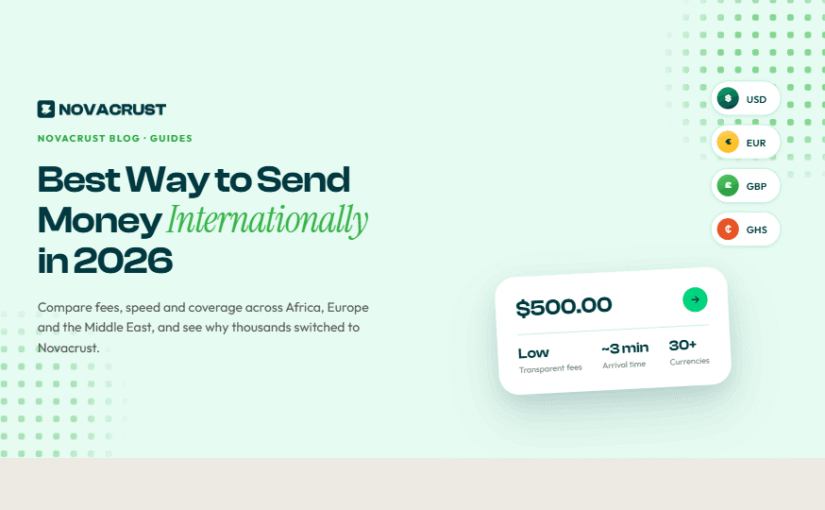
The Best Way to Send Money Internationally in 2026

Here is a number that should make you angry: families and workers sending money across borders lose an average of 6 percent of every transfer to fees and exchange rate markups. Send $500 home every month, and that is over $360 a year, gone. Not to the person you love. To the middlemen in between.

It gets worse. Some services advertise zero fees, then quietly take their cut through a padded exchange rate. Others charge honestly but take three business days while your recipient waits. The best way to send money internationally is not about one flashy feature. It is about what actually lands on the other side, and how fast.

This guide breaks down how to send money online, locally, and globally, what transfers really cost in 2026, and how to stop donating a slice of every payment to the payment industry, regardless of where you are.

The Two Numbers That Decide Every Money Transfer

Every international money transfer has exactly two costs, and providers hope you only look at one:

The transfer fee. The visible number. Easy to compare, easy to advertise, easy to set to zero.

The exchange rate margin. The invisible number. The gap between the real mid-market rate and the rate you are given. A “zero fee” transfer with a 4 percent rate markup costs more than a $3 fee at an honest rate.

The only comparison that matters: how much local currency arrives per dollar sent. Judge every money transfer app by that single figure.

Sending Money Globally: Your Options Compared

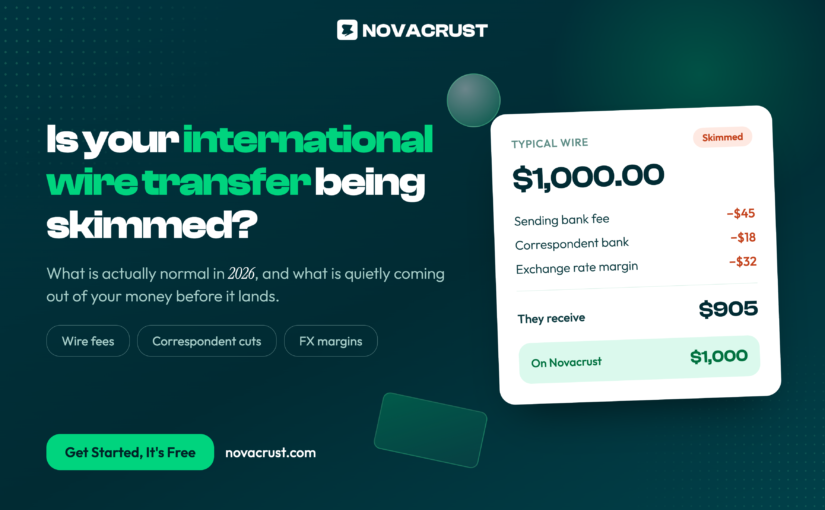
Banks and traditional wires. Reliable for large sums, painful for everything else. International wires stack sending fees, correspondent bank fees, and receiving fees, often $40 to $100 total, and take days.

Cash pickup services. Western Union and MoneyGram reach almost everywhere, including recipients without bank accounts. You pay for that reach with some of the highest combined costs in the industry.

Money transfer apps. Wise, Remitly, LemFi, WorldRemit, and others have pushed prices down dramatically, especially on popular corridors into Africa. Strong options, though most only solve sending, not the rest of your financial life.

All-in-one platforms like Novacrust. If you already receive international income, the smartest move is to send from the same place your money lives. With Novacrust, your USD account, currency conversion, and transfers sit in one app: receive dollars from clients or family abroad, convert at a competitive rate shown upfront, and send to local bank accounts or mobile money wallets across supported markets in Africa and EMEA. No app hopping, no double conversion, no mystery rates.

How to Send Money with Novacrust, Step by Step

If you have ever searched for how to send money from a USD account to a local bank, this is the flow:

Step 1: Fund your account

Your balance might come from a client payment into your USD account, a crypto conversion, or a top-up. It all lands in one place.

Step 2: Choose your recipient

Send to a local bank account or mobile money wallet. Sending locally to a bank in your own country works from the same screen as sending across a border.

Step 3: See the rate before you commit

The exchange rate and what your recipient gets are shown upfront. If the numbers work, you send. If not, you wait for a better day. That transparency alone beats half the industry.

Step 4: Money arrives fast

Transfers to supported banks and mobile money wallets typically arrive within minutes to hours, not days. For anyone searching for the fastest way to send money internationally, speed plus an honest rate is the full answer.

Sending Money to Africa: What Actually Works

Remittances to Africa remain among the most expensive corridors in the world, which makes choosing well worth real money. What to know per use case:

Supporting family. For anyone searching to send money to family in Africa, prioritize mobile money delivery. In Kenya, Ghana, Tanzania, and much of East and West Africa, M-Pesa and MTN Mobile Money reach recipients who never visit a bank. A platform that sends directly to wallets saves your family the trip and the wait.

Paying suppliers or staff. Consistency beats everything. You want a platform where the rate is visible before every transfer and delivery times are predictable, so payroll never becomes an apology.

Cheapest way to send money to Nigeria, Kenya, or Ghana. The honest answer is always the same formula: compare the received amount, not the fee. On most corridors, app-based transfers from a held USD balance outperform cash services and banks by several percentage points.

Sending Money Locally

Global gets the headlines, but local transfers are the daily reality: rent, a vendor, your cousin’s school fees. The advantage of an all-in-one platform is that local sending uses the same balance as everything else. Convert exactly what you need from your USD balance and send it to any local bank account in minutes. Your dollars stay dollars until the moment they need to be anything else.

Six Rules for Never Overpaying on Transfers Again

  1. Compare received amounts, not fees. One number tells the truth.
  2. Beware “zero fee” marketing. The rate is where zero-fee services get paid.
  3. Hold your money in USD until you send. Converting on your schedule, not the provider’s, protects you from bad rate days.
  4. Use mobile money for the last mile in Africa. It is usually faster and reaches more people than bank deposits.
  5. Send larger amounts less often when costs are partly flat, since fixed fees hurt small transfers most.
  6. Keep receipts in one app. Scattered transfers across three services mean no clean record of what you sent and at what rate.

Frequently Asked Questions

What is the best way to send money internationally in 2026? Use a platform that shows the exchange rate upfront and delivers to local banks or mobile money quickly. Compare what the recipient receives, not the advertised fee.

What is the cheapest way to send money to Nigeria? Sending from a held USD balance through an app with transparent rates typically beats banks and cash services. Always compare the naira amount that arrives.

Can I send money directly to mobile money wallets? Yes. Novacrust supports sending to mobile money wallets in supported African markets, alongside bank transfers.

How fast do international transfers arrive? App-based transfers to supported banks and wallets usually arrive within minutes to hours. Traditional wires can take several days.

Can I send money locally and internationally from one app? Yes. With Novacrust, local and global transfers come from the same balance, next to your USD account, virtual cards, and crypto conversion.

The Bottom Line

Every transfer is a small negotiation, and the industry wins whenever you compare the wrong number. Look only at what arrives, keep your money in dollars until sending day, and use one platform for local and global so your finances live in one place.

CTA: Send money locally and globally with Novacrust. See the rate before you send, every time.

ACH vs Wire vs SWIFT: Which Should You Use to Get Paid From Abroad?

Mary closed her biggest design contract yet, a US client paying four figures a month. She invoiced, the client paid the same day, and she spent the week feeling like a professional who had finally made it. Then she waited. Six days later, the money landed, except it was short by $40 she could not explain, skimmed by a bank she had never agreed to deal with. The work had gone perfectly. The getting paid part was a mess, and nobody had ever taught her the difference between the options her client kept asking about.

That gap is what this guide closes. ACH, wire transfer, and SWIFT are the three ways most international payments move, and the difference between them is real money and real days. Understanding the ACH vs wire transfer question, and where SWIFT fits in, means you can tell a client exactly how to pay you, get your money faster, and stop losing a cut to fees you never needed to pay.

The short answer first

 ACHWire transferSWIFT
Best forRoutine US paymentsLarge or urgent paymentsPayments across borders
Speed1 to 3 business daysSame day to 1 day domestically1 to 5 business days
CostLow or freeHigher fixed feeHigher, often with intermediary fees
ReachWithin the USDomestic and internationalGlobal, bank-to-bank worldwide

If your client is in the US and the payment is routine, ACH is usually cheapest. If the payment is large or urgent, a wire is faster and more certain. If the money is crossing borders, SWIFT is the network doing the work behind the scenes. Now, let us make each one make sense.

What is an ACH payment?

ACH stands for Automated Clearing House. It is the network that moves money between banks inside the United States. If you have ever had a US salary deposited automatically, paid a US bill online, or received a refund into a US account, ACH did the work.

The appeal of ACH is cost. It is cheap, often free, which is why it is the default for recurring and everyday payments in the US. The trade-off is speed and reach. An ACH payment usually takes one to three business days to settle, and it only works within the US banking system. So if a US client is paying you and you hold a US-style account, ACH is the low-cost, no drama option for regular invoices.

How long does ACH take?

Most ACH payments clear in one to three business days. Some processes are same-day if the sender uses faster ACH options, but plan around the standard window. ACH does not move on weekends or US bank holidays, so a payment sent on a Friday may not land until the middle of the following week.

What is a wire transfer?

A wire transfer is a direct, bank-to-bank movement of money. Instead of being batched and processed in groups like ACH, a wire is sent individually and tends to settle much faster, often the same day for domestic transfers.

Wires are the tool of choice when speed and certainty matter, for example, a large project payment, a deposit, or anything where both sides want confirmation that the money has truly moved. The cost is the catch. Wires usually carry a fixed fee on the sending side, and sometimes on the receiving side too. For a small invoice, that fee feels heavy, but for a large or time-sensitive payment, the speed is worth it. To receive a wire transfer, you give the sender your account details and a routing number or equivalent, plus a few extra pieces of information for international wires.

What is SWIFT?

SWIFT is not a payment in the way ACH and a wire are. It is the messaging network banks around the world use to talk to each other and instruct international transfers. When money moves between a bank in one country and a bank in another, a SWIFT message usually coordinates it. This is why an international wire is often called a “SWIFT transfer.”

The strength of SWIFT is global reach. It connects thousands of banks worldwide, which is how a client in one country can pay a freelancer in another at all. The weakness is what happens along the way. An international SWIFT transfer can pass through one or more intermediary banks, and each can take a fee and add a day. This is the mystery slice that goes missing between the invoice amount and what finally lands in your account. It is exactly what cost Mary her forty dollars.

ACH vs wire vs SWIFT: the differences that affect you

Speed, cost, and reach are the three levers. ACH wins on cost but is slow and US only. A wire wins on speed and certainty but costs more per transfer. SWIFT is what makes an international wire transfer possible at all, with the widest reach but the highest chance of intermediary bank fees and delays.

For most freelancers, the practical reality looks like this. A US client paying a routine invoice reaches for ACH because it is cheap and easy on their end. A client sending a large payment, or one who wants it to land fast, uses a wire. And the moment that money travels from one country to another, SWIFT carries it, with the extra cost and time international hops add.

Which should you use when?

A few simple scenarios cover most situations:

  • Your client is in the US, and the invoice is routine. Ask for ACH. It is the cheapest and most reliable for regular work.
  • The payment is large, or you need it quickly and confirmed. Ask for a wire. The fee is worth the speed.
  • You and your client are in different countries. The payment travels over SWIFT, so build in a few extra days and expect possible intermediary fees.
  • You want the smoothest experience over time. Set yourself up to accept both ACH and wire, so a client can pay you the way that suits them rather than the way you are stuck with.

The catch for anyone outside the US

Here is the part most guides skip. ACH and US-style wires assume you have an account that can receive them, with a real account number and routing number in your name. For people living outside the US, that has long been the hard part. You can know everything about how to receive a wire transfer and still have nowhere for the money to land.

This is the gap modern financial platforms close. With a USD account in your own name that supports both ACH and wire transfers, you can hand a US client your details and let them pay you exactly as they would pay anyone local. Novacrust offers this kind of account, so you can receive international payments through familiar rails, hold the dollars you earn, and convert or spend them on your own terms rather than losing value the moment the money arrives. Once you have the right account, the ACH vs wire decision stops being a source of anxiety and becomes a quick, informed choice you make to get paid faster and keep more of what you earned. Mary switched to one after that first short payment, and her next invoice landed whole.

Frequently asked questions

What is the difference between an ACH and a wire transfer?

ACH moves money between US banks in batches, which makes it cheap but slower, usually one to three business days, and limited to the US. A wire transfer is sent individually and settles much faster, often the same day domestically, but carries a higher fee. ACH suits routine payments, and wires suit large or urgent ones.

Is SWIFT the same as a wire transfer?

Not exactly. A wire is the transfer itself, while SWIFT is the global messaging network banks use to coordinate international wires. An international wire usually travels over SWIFT, which is why the terms get used together.

How long does ACH take to arrive?

Typically, one to three business days. ACH does not process on weekends or US bank holidays, so timing depends on when the payment is sent.

Which is cheapest for receiving international payments?

ACH is usually cheapest when it is available, but it only works within the US. For payments across borders, you are often dealing with a SWIFT-based wire, where the key is an account that minimises intermediary bank fees and gives you a fair conversion rate once the money lands.

Keep reading

  • Money Management for Remote Workers and Digital Nomads: The Complete 2026 Guide

Which App Gives the Best USD to Naira Exchange Rate?

You received $500 from a client. By the time it hits your Nigerian bank account, it feels like you lost money without spending anything.

This is why thousands of freelancers and remote workers keep searching:

  • best usd to naira rate app
  • exchange usd to naira online
  • wise vs payoneer rate
  • grey rate today

The real problem is not getting paid in dollars. The real problem is how much of those dollars you keep after conversion.

Many African freelancers now use Novacrust because it allows them to receive USD, convert at competitive rates, and withdraw to their bank without the silent losses that happen across multiple platforms.

This guide breaks down how the most popular apps handle USD to NGN conversion and what actually gives you the best value.

Why USD to Naira conversion is where freelancers lose money

Most freelancers focus on receiving USD from clients. Very few pay attention to what happens during conversion.

Losses usually happen through:

  • Hidden exchange rate margins
  • Multiple conversion steps
  • Transfer and withdrawal fees
  • Delays that force you to convert at bad rates

This is why people keep comparing wise vs payoneer rate and checking grey rate today before converting.

How conversion typically works with popular platforms

Freelancers often receive USD using:

Each platform allows conversion, but the final naira amount you receive can differ significantly because of rate margins and processing structure.

What determines the amount you receive in naira

Your final payout depends on:

  1. The platform’s internal exchange rate
  2. Additional conversion or withdrawal charges
  3. Time delays before funds hit your bank
  4. Extra steps between USD wallet and local account

Even a small difference in rate becomes large when you convert hundreds or thousands of dollars monthly.

Example: Converting 1000 USD to Naira

Let us assume the market rate is 1500 NGN per dollar.

PlatformEffective Rate You GetNaira Received
WiseSlightly below marketLower payout
PayoneerIncludes marginLower payout
GreyCloser to marketBetter payout
NovacrustCompetitive rateHigher payout

This is why freelancers constantly search best usd to naira rate app before converting.

Why many freelancers now convert USD using Novacrust

Novacrust removes the long chain between receiving USD and converting to naira.

You can:

  • Receive USD directly
  • Convert at competitive rates inside the same platform
  • Withdraw to your Nigerian bank quickly

There are no multiple apps reducing your earnings at each step. This is what makes a real difference over time.

The mistake most freelancers make

They choose a platform based on how easy it is to receive USD, not how well it converts USD to NGN.

The real money is saved at the conversion stage, not the receiving stage.

How to choose the best app to exchange USD to Naira online

Look for a platform that:

  • Shows transparent rates
  • Minimizes steps between USD and NGN
  • Allows fast withdrawal to your bank
  • Is built with African freelancers in mind

This is where many traditional platforms fall short.

Final thoughts

Getting paid in dollars is only half the journey. Converting those dollars at a good rate is what protects your income.

The difference between platforms may look small per transaction, but over months of freelance work, it becomes significant.

Choosing the right app for USD to naira conversion is how you stop losing money silently.

Sign up to get started on Novacrust here.