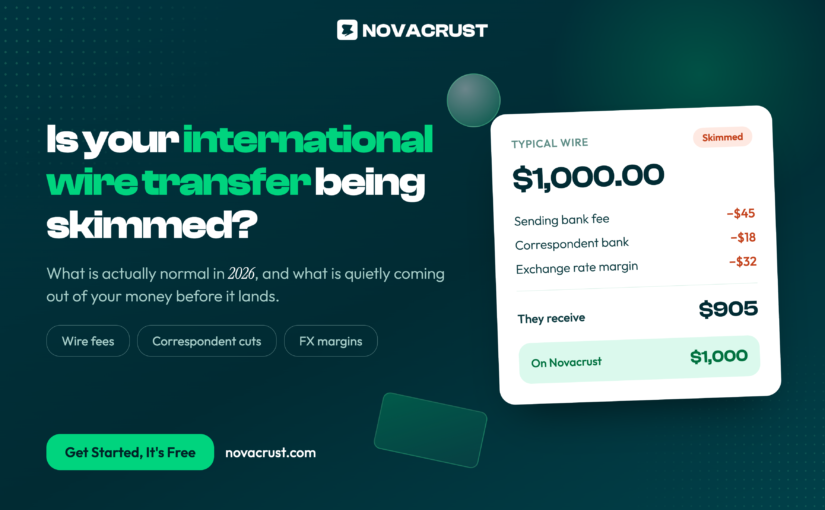
Send a $10,000 international wire and your recipient might see $9,930 land in their account. That missing $70 didn’t disappear by accident, and it usually isn’t fraud either. It went to banks neither of you chose, sitting quietly in the middle of the route your money took to get there.
If you’ve ever stared at a wire confirmation and wondered why the number doesn’t match what you sent, you’re not imagining things, and you’re not necessarily being scammed. Here’s what’s actually normal with international wires, what genuinely is a red flag, and how to stop losing money to banks you’ll never see on a statement.
Why wires shrink in transit
An international wire rarely travels directly from your bank to your recipient’s bank. It usually passes through one or more intermediary or correspondent banks along the way, banks that exist purely to move money between institutions that don’t have a direct relationship. Each one is entitled to take a “lifting fee,” typically $15 to $50 per bank, before passing the rest along.
Neither the sender nor the recipient picks which correspondent banks a wire routes through. That’s decided by the sending bank’s existing banking relationships, which is exactly why the same $10,000 transfer can lose $30 one month and $90 the next, with no explanation on either statement beyond a smaller final number.
Is this normal, or were you scammed?
A wire arriving a little short of what was sent is normal. It’s the standard cost of the SWIFT network, not a sign anyone did anything wrong. What isn’t normal, and is worth actually investigating, is different:
- A wire that never arrives at all. A missing wire after several business days needs a trace request from your sending bank, not a shrug.
- A deduction far larger than a few intermediary fees would explain. If tens of percent of the transfer vanished, that’s a rate or fee problem worth escalating, not routine lifting fees.
- Being asked to pay a “release fee” directly to unblock funds. Legitimate correspondent bank deductions happen automatically before the money arrives. Nobody legitimate asks the recipient to wire money separately to release a stuck wire.
For the difference between the transfer rails themselves, our guide to ACH vs wire vs SWIFT breaks down which one your sender is actually using and why that decides both the speed and the fee.
How to avoid losing money to correspondent banks
The most reliable fix isn’t negotiating with your bank about fees you can’t see coming. It’s avoiding the international correspondent chain entirely when you can. A US-issued account and routing number lets a US-based client or employer pay you through the domestic ACH or wire network instead of an international SWIFT transfer, which means no correspondent banks sit in the middle taking their own cut.
That’s the gap a Novacrust USD Account closes. You get a real US account and routing number without needing an SSN or a US address, so anyone paying you from inside the US can send it as a domestic transfer instead of an international one. If you haven’t set one up yet, our guide to understanding the US banking system as a non-resident covers exactly what unlocks that access.
FAQ
Why did I receive less money than what was wired to me?
Correspondent banks in the middle of the transfer route each deduct a small “lifting fee,” usually $15 to $50 per bank, before the funds reach you. This is standard for international SWIFT wires and isn’t a sign of fraud on its own.
How many banks can a wire pass through?
It varies by route and depends on the sending bank’s existing relationships. Neither the sender nor the recipient chooses which correspondent banks are involved.
Can I avoid intermediary bank fees entirely?
Yes, by using a domestic transfer rail instead of an international one. A US account and routing number lets US-based senders pay you through ACH or a domestic wire, which doesn’t route through international correspondent banks.
Is it a scam if my wire arrives short?
Usually not, if the shortfall is a small amount consistent with one or two intermediary bank fees. It becomes a real concern if a large percentage is missing, the wire never arrives, or you’re asked to pay separately to “release” it.
What’s the difference between a USD Account and a regular bank account for receiving wires?
A USD Account issued through a platform like Novacrust still gives you a real US account and routing number, but without requiring US residency to open it, which is what lets you receive domestic-rail payments instead of only international ones.
The bottom line
A wire arriving a little short of what was sent is usually just the cost of the correspondent banking system doing its job. The real fix isn’t chasing down fees after the fact. It’s routing payments so those banks never get a chance to take a cut in the first place.
Sign up to get started on Novacrust here.