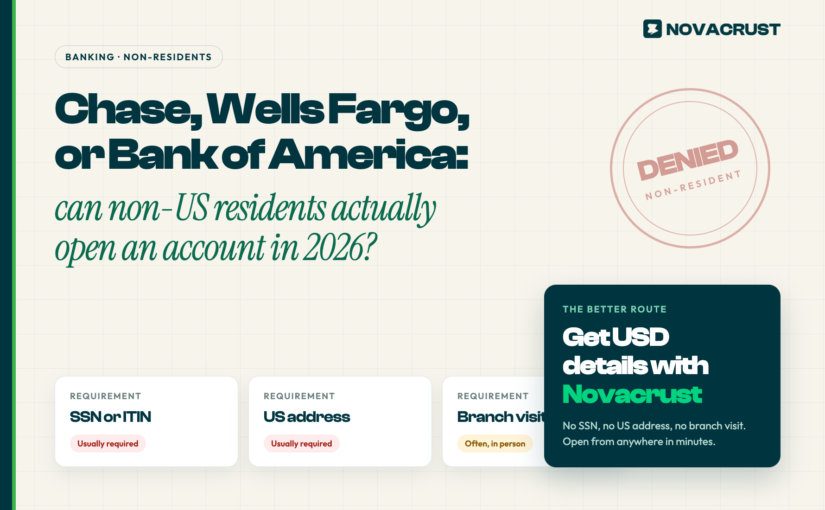
US federal law does not require a Social Security number to open a bank account. Under the Treasury Department’s Customer Identification Program rule, a foreign passport number and its country of issuance are legally enough to verify a non-US person. Walk into a Chase, Wells Fargo, or Bank of America branch with just a passport, though, and the experience usually tells a very different story.
That gap, between what the law technically allows and what each bank actually asks for, is where most non-resident account applications stall. Here is what each of the three biggest US banks really requires in 2026, and a faster route that skips the gap entirely.
What the law actually says
The Customer Identification Program rule, part of the Bank Secrecy Act, sets the federal floor for what a bank must collect before opening an account. For a non-US person, it accepts a taxpayer identification number, a passport number and country of issuance, an alien identification card number, or another government-issued document that shows nationality or residence and carries a photo. An SSN is one option on that list, not the only one.
In practice, individual banks are free to ask for more than the legal minimum, and Chase, Wells Fargo, and Bank of America all do.
Chase: an ITIN can stand in for an SSN, but you still need a US address
Chase accepts an Individual Taxpayer Identification Number as a substitute for an SSN on the application. Beyond that, it asks for official government-issued photo ID, which can be a passport, and proof of address such as a utility bill, a pay stub, or an employer letter dated within the last 60 days. Some Chase branches make exceptions for non-residents with extra documentation, but that varies by location and isn’t something you can count on walking in cold. Chase itself recommends confirming requirements with your specific branch before applying.
Bank of America: a scheduled conversation, not a self-serve form
Bank of America runs a dedicated path for international customers, split between international professionals and international students, but neither is a simple online signup. Both route you to book an appointment or a consultation with a specialist who confirms your eligibility and the documents you’ll need before you open anything. If you were hoping to finish this on your phone in ten minutes, that isn’t the process Bank of America has built for non-residents.
Wells Fargo: SSN or ITIN online, ID alone in a branch
Wells Fargo is the most specific of the three about what it will and won’t accept. To open an Everyday Checking account online, it asks for an SSN or ITIN, a US mailing address, and a mobile phone number. Without a US tax ID number, Wells Fargo’s own account-opening page states that non-US citizens can instead provide a government-issued ID that shows nationality or residence, but that path runs through a branch with two forms of identification, not the online application.
Read the fine print on all three banks and a pattern shows up fast: the identification rules have real flexibility, but the US address and the branch visit usually don’t.
The real wall isn’t the ID rule. It’s the address and the branch.
Every bank above technically allows a passport in place of an SSN somewhere in its process. None of them make that path a simple online form for someone who has never lived in the US. You need a US mailing address to receive statements and a debit card, and in most cases you need to show up in person, whether that’s a branch teller or a scheduled call with a specialist.
For freelancers, remote workers, and anyone getting paid in dollars from outside the US, that combination rules out the option entirely, not because the law says no, but because the paperwork does.
A USD Account that skips the address and the branch visit
A Novacrust USD Account gives you a real US account and routing number without a Social Security number, an ITIN, a US address, or a branch appointment. You open it from your phone, and it works the same way clients on Upwork, Fiverr, or a direct contract already expect: they send dollars to a US account number, and it lands in yours. For the fuller picture of how the traditional system treats non-residents and where Novacrust fits in, our guide to the US banking system for non-residents covers the rest of it.
If you’re a freelancer specifically weighing this against a traditional bank, a USD Account built for freelancers walks through how payouts from clients actually land, and opening one takes minutes, not a scheduled appointment.
FAQ
Do non-US residents legally need a Social Security number to open a US bank account?
No. Federal identification rules accept a foreign passport number and country of issuance as a valid alternative. Individual banks can still ask for more, and most do.
Can I open a Chase account without an SSN?
Chase accepts an ITIN as a substitute for an SSN on the application, but you’ll still need government photo ID and proof of a US address, and requirements can vary by branch.
Does Bank of America let non-residents open an account online?
Not as a simple self-serve form. Bank of America routes international professionals and international students through a scheduled appointment or consultation with a specialist first.
What does Wells Fargo accept if I don’t have an SSN or ITIN?
Wells Fargo’s online application requires an SSN or ITIN. Without one, its own guidance points non-US citizens to a branch visit with a government-issued ID showing nationality or residence, plus a second form of ID.
Is there a faster way to get a US account number without going through a traditional bank?
Yes. A Novacrust USD Account gives you a real US account and routing number from your phone, with no SSN, ITIN, US address, or branch visit required.
Sign up to get started on Novacrust here.