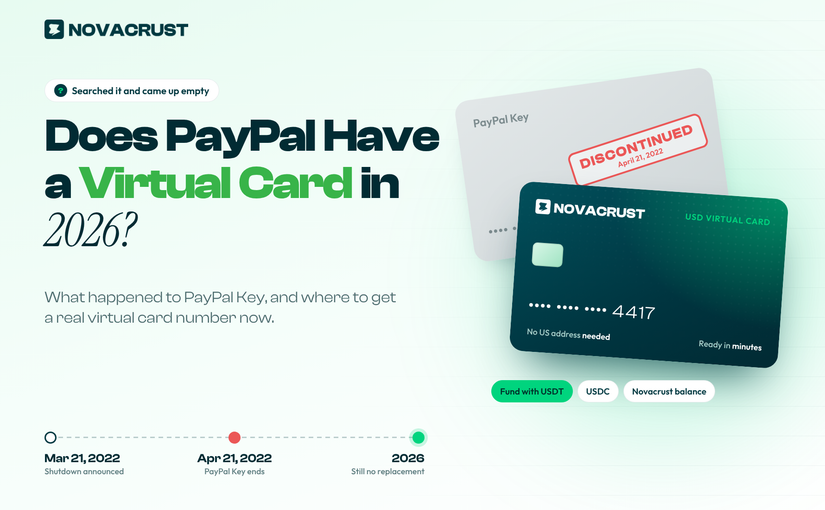
On April 21, 2022, PayPal shut down the one feature that gave you a real virtual card number, and nearly four years later, it still hasn’t brought one back. If you’ve searched “does PayPal have a virtual card” and come up empty, that’s not a search problem. PayPal genuinely doesn’t offer one anymore.
What people actually mean by “virtual card”
A true virtual card number is a masked set of digits that stands in for your real card at checkout. You can generate a fresh one for a single purchase, lock it to one merchant, cap its spending limit, and delete it the moment you’re done with it. If it ever leaks in a breach, you kill that number and your underlying account never gets touched. It’s disposable by design.
That’s what PayPal used to offer, and it’s what a lot of people still assume PayPal offers today.
What happened to PayPal Key
PayPal Key was exactly that: a virtual card system that generated a unique number backed by whatever card or balance you had in your PayPal account. PayPal announced it was ending the service on March 21, 2022, and shut it down for good one month later, on April 21, 2022, according to Doctor of Credit’s coverage of the shutdown. PayPal never announced a direct replacement, and it hasn’t launched one since.
That gap is why “paypal virtual card” and “paypal key” still pull in a steady stream of searches every month. People remember the feature existed. They just don’t realize it’s gone.
What PayPal offers instead
PayPal’s current answer is the PayPal Debit Mastercard, a card linked directly to your PayPal Balance account. When you sign up, PayPal issues you a digital card instantly for online use, with a physical card available on request. That sounds close to a virtual card number, but it isn’t the same thing.
The PayPal Debit Card’s “digital card” is just a digital copy of one fixed card number tied to your balance. You can’t spin up a new number per purchase, lock one to a single site, or burn a single leaked number without closing the whole card. It also requires a PayPal Balance account with ID verification, which in practice means a US-based PayPal account. If your PayPal is tied to an account outside the US, or you don’t want your balance and your checkout number to be the same 16 digits, this doesn’t solve the problem either.
Where you can actually get a real virtual card number
Three real paths exist right now, and each has a catch.
- Your existing US bank, if it’s the right one. Citi and Capital One are among the few major US issuers that still generate true virtual numbers, the way we broke down when we checked whether Chase or Bank of America offer the same thing. Both said no. This path only works if you already hold a card with one of the banks that says yes.
- Privacy.com. A dedicated virtual card tool built for exactly this use case: unlimited disposable numbers, per-merchant locks, spend caps. The catch is funding. Privacy.com’s own support documentation confirms it only accepts checking accounts and debit cards from US banks or credit unions, no credit cards, and no funding source from outside the US.
- A Novacrust USD Virtual Card. This is the option that doesn’t route through a US bank at all. Fund it from your Novacrust balance, USDT, USDC, or another supported crypto, and you get a card number for online spending that isn’t your main account number, generated in minutes with no US address or Social Security number required.
Notice what the first two paths have in common: both assume you already have a foot inside the US banking system. If you don’t, PayPal’s dead end and Privacy.com’s funding requirement land you in the exact same spot.
Which one actually fits you
If you already bank with Citi or Capital One, check whether your existing card already includes virtual numbers before looking anywhere else. If you have a US bank account but no card with virtual numbers built in, Privacy.com is a solid dedicated tool. If neither applies, because you’re outside the US, don’t have a US bank account, or just don’t want your spending tied to a PayPal balance that also holds your savings, a Novacrust USD Virtual Card is built for exactly that gap. For a look at what separates a good virtual card provider from a risky one, our rundown of the security features worth checking is worth reading before you fund any of them. And if you’re comparing several providers side by side rather than just PayPal’s alternatives, our breakdown of how the major USD virtual card options stack up covers that in more detail.
FAQ
Does PayPal have a virtual card number in 2026?
No. PayPal Key, its virtual card number feature, was discontinued on April 21, 2022, and PayPal hasn’t replaced it with an equivalent product.
Isn’t the PayPal Debit Card a virtual card?
Not in the way most people mean it. It’s a digital copy of one fixed card number tied to your PayPal Balance account, not a tool for generating disposable, merchant-locked numbers.
Can I still get PayPal Key somehow?
No. The service is fully shut down for both new and existing users. There’s no waitlist or grandfathered access.
What’s the fastest way to get a real virtual card number without a US bank account?
A Novacrust USD Virtual Card. It’s funded from your Novacrust balance or supported crypto instead of a US bank, so there’s no US address or Social Security number required to get one.
Is a virtual card the same as a prepaid card?
No. A prepaid card is loaded with a fixed balance. A virtual card number is tied to an underlying account and generated specifically to mask your real card details at checkout, which is what a Novacrust USD Virtual Card does.
Sign up to get started on Novacrust here.