Every month, more than 2,400 people search “virtual card number,” hoping for an extra layer of protection before they type a real card into an unfamiliar checkout page. A large share of them search for it by bank name first: “chase virtual card number,” “bank of america virtual card number.” Here’s what most of them find out the hard way: neither bank actually gives you one.
What a virtual card number actually is
A virtual card number is a masked set of digits that stands in for your real card at checkout. It usually comes with its own spending limit, an expiration date you control, and the option to lock it to a single merchant. If the number ever leaks in a data breach, you shut it down and your real card stays untouched. It’s the same idea as a temporary lock on your front door: useful precisely because it’s disposable.
The confusion starts because two of the biggest banks in the US are the ones people search for most, and neither currently offers the feature.
Why “chase virtual card number” doesn’t lead anywhere
Chase has never issued true virtual card numbers. What Chase does offer is called Spend Instantly: once you’re approved for a Chase card, you can add it to a digital wallet like Apple Pay before the physical card arrives in the mail. That protects the plastic in transit, but it isn’t a disposable number you can generate and delete, and it only works if you already have a Chase account in the first place.
Bank of America used to be the other name people searched, thanks to a feature called ShopSafe. Bank of America discontinued ShopSafe on September 20, 2019, pointing to newer digital wallet security as the replacement. Today, only a handful of major US issuers, Citi and Capital One among them, still generate true virtual numbers for their existing cardholders.
Notice the pattern: every option on that list still requires you to already hold a card with that specific bank. If you don’t bank with Chase, Bank of America, Citi, or Capital One, or if you don’t have a US address and Social Security number to open one of those accounts at all, the search ends in a dead end.
The problem is bigger than one bank’s product page
Card-not-present fraud, the kind that happens when someone has your 16 digits but never touches your physical card, has been climbing for years. The Federal Reserve Bank of Kansas City, which tracks fraud rates separately for card-present and card-not-present transactions, found that card-not-present fraud rates rose across major US card networks between 2021 and 2023, even as fraud on in-person, chip-based transactions stayed comparatively flat. Typing your real card number into every subscription, marketplace, and one-time checkout page is exactly the exposure that trend is measuring.
That’s a real reason to want a virtual card number. It just isn’t a reason to be stuck waiting on a US bank to offer you one.
A virtual USD card that doesn’t require a US bank account
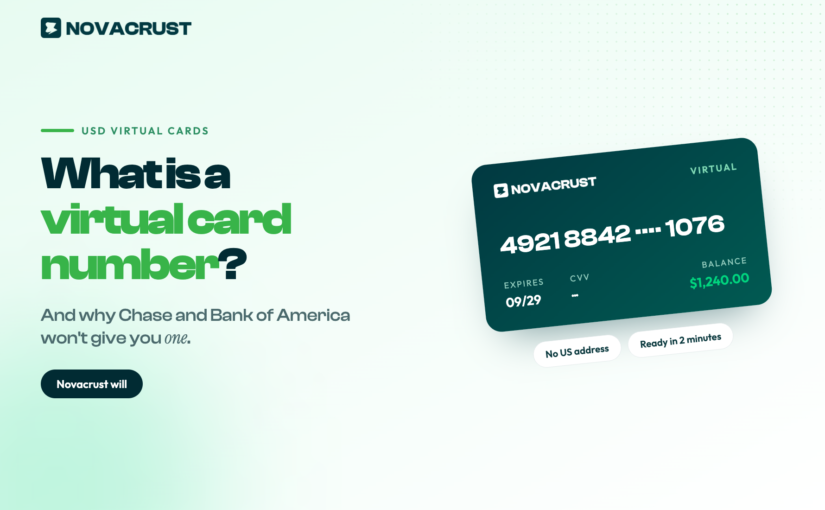
A Novacrust USD Virtual Card works the way people assumed Chase or Bank of America would: you get a number for online spending that isn’t your main account number, and you don’t need a US address, SSN, or existing US bank relationship to get one. Fund it from your Novacrust balance, USDT, USDC, or another supported crypto, and use it anywhere Visa or Mastercard is accepted online. For the mechanics of what to look for in any virtual card’s security, our rundown of the security features that actually matter is worth reading before you fund one.
This matters most for the people who get boxed out of the US banking system entirely: freelancers billing international clients, remote workers paid in USD from abroad, and anyone who needs to pay for a US-priced subscription or tool without a US card to their name. If that’s you, see how freelancers outside the US typically get paid for the full picture, and if recurring charges are the main use case, our guide to covering international subscriptions with a virtual card covers that specifically.
FAQ
Does Chase offer a virtual card number?
No. Chase’s Spend Instantly feature lets you add an approved physical card to a digital wallet before it arrives, but it doesn’t generate a disposable virtual number, and it still requires an existing Chase account.
Does Bank of America offer a virtual card number?
Not anymore. Bank of America discontinued its ShopSafe virtual card number feature on September 20, 2019.
Which US banks still offer real virtual card numbers?
Citi and Capital One are among the few major issuers that still generate true virtual numbers, but only for people who already hold a card with them.
Can I get a virtual card without a US bank account or SSN?
Yes. A Novacrust USD Virtual Card is funded from your Novacrust balance or supported crypto, not a US bank account, so it doesn’t require a US address or Social Security number to open.
Is a virtual card the same thing as a prepaid card?
Not quite. A prepaid card is a physical or digital card loaded with a fixed balance. A virtual card number is usually tied to an underlying account or balance and generated specifically to mask your real card details at checkout, which is exactly what a Novacrust USD Virtual Card does.
Sign up to get started on Novacrust here.