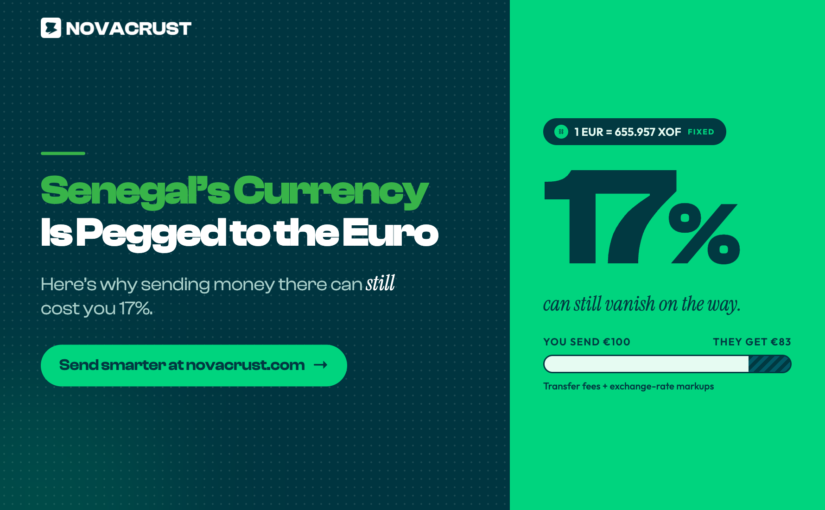
Senegal’s diaspora sent home $3.6 billion in 2025, close to 10% of the country’s entire GDP, up from just $218 million in 2000. Send $500 of that home today, and depending on which provider you use, up to 17% of it can vanish before it lands, even though the currency it’s converting to has a fixed exchange rate.
That last part trips people up. The West African CFA franc (XOF), Senegal’s currency, is pegged to the euro at a rate that never moves. A fixed peg sounds like it should mean a fixed cost. It doesn’t, and the gap between what you’re told and what actually lands is exactly where providers make their money.
Why a “fixed” exchange rate doesn’t mean a fixed cost
The XOF-to-euro rate is set by monetary agreement, not by the market, so it genuinely doesn’t fluctuate. The problem is that most senders aren’t converting euros. They’re converting US dollars or British pounds, and that leg of the trade still runs through an open market rate a provider controls entirely.
A comparison of US to Senegal transfers found real total costs ranging from about -0.6% (a rate slightly better than mid-market) to 17% depending on the provider, even on the exact same $500 transfer. One widely used provider offered a “free” transfer with no upfront fee, then applied an exchange rate 14.8% worse than the mid-market rate, the entire cost hidden inside the number on the screen rather than listed as a fee.
It’s the same trick that shows up in international bank wires that arrive short of what was sent: no visible fee line, just a quietly worse number on the other end.
Where the money actually lands
Once a transfer clears, it can reach a recipient in Senegal three ways: a bank account (Ecobank, La Poste du Senegal, and Orabank are the most commonly supported), a mobile money wallet, or cash pickup at a physical location.
Mobile money is where most everyday transfers actually end up. Wave has grown into the most widely used mobile wallet in Senegal on the strength of low fees, with Orange Money still one of the country’s largest digital payment providers and Tigo Cash also in the mix. Which wallet your recipient already uses matters more than most senders realize, since not every transfer provider pays out to every wallet, and payout speed can differ by network.
Six ways to check you’re not the one losing 17%
- Compare the amount received, not the fee. A $0 fee with a bad rate can cost more than a $5 fee with a fair one. Always check the final XOF number.
- Check the rate against the mid-market rate. You can look up the real EUR-XOF peg and USD-EUR rate in seconds and compare it to what you’re being offered.
- Confirm the payout method before you send. If your recipient uses Wave, sending to a provider that only pays out to Orange Money means an extra step and possibly an extra fee on their end.
- Be wary of “free transfer” marketing. A transfer service rarely moves money for nothing. If there’s no visible fee, the cost is almost always sitting inside the exchange rate.
- Use a platform that shows the number before you confirm. If you can’t see exactly how much your recipient will get before you send, you’re trusting the provider to be honest about a number you can’t check.
- Send a small test amount first. Especially the first time you use a new provider, sending $20 and confirming your recipient got the expected amount costs you almost nothing and confirms the math before you send more.
The same peg confusion plays out across the region. Cameroon’s currency runs on a nearly identical CFA franc peg to the euro, and senders there hit the same gap between a “fixed” currency and a variable transfer cost. If you’re sending anywhere in West or Central Africa, the same math applies: check the euro leg, not just the local one.
How sending to Senegal works on Novacrust
Novacrust shows you the exact amount your recipient will get in XOF before you confirm anything, so there’s no gap between what you’re quoted and what lands. You can send money to Senegal and 50+ other countries from your Novacrust balance, with the rate and payout amount visible upfront every time.
If you’re comparing Senegal against other corridors, the same rate-transparency issue shows up sending to Ghana, just with a floating cedi instead of a pegged franc. Different currency, same rule: see the number before you send it.
FAQ
Is the CFA franc really fixed to the euro?
Yes. The West African CFA franc (XOF) has been pegged to the euro under a long-standing monetary agreement, and that specific exchange rate doesn’t move day to day the way the naira or cedi does.
If the rate is fixed, why do transfer costs still vary so much?
Because most senders aren’t starting in euros. Converting from US dollars or British pounds into XOF still passes through an open-market rate that each provider sets itself, and that’s where the markup hides.
Should my recipient use a bank account or a mobile wallet?
Whichever they already use day to day. Mobile wallets like Wave and Orange Money tend to be faster and are widely accepted for everyday spending in Senegal, while a bank account makes more sense for larger amounts or savings.
Is Wave cheaper than Orange Money for receiving transfers?
Wave built its reputation on low fees and has become Senegal’s most widely used mobile wallet partly because of it, but the fee your recipient sees also depends on which transfer provider you send through, not just which wallet they hold.
How much does Novacrust charge to send money to Senegal?
You see the exact rate and the exact amount your recipient will receive before you confirm the transfer, with no hidden markup added afterward.
Sign up to get started on Novacrust here.