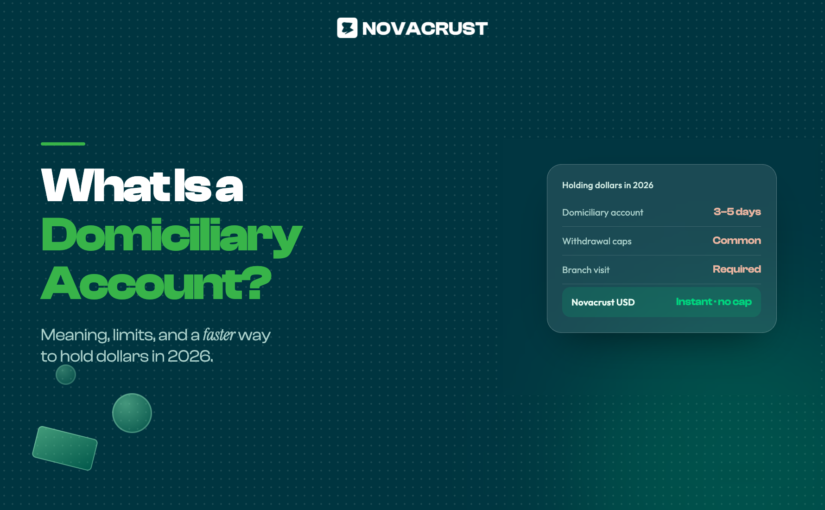
In 2026, the Central Bank of Nigeria rewrote the rules on domiciliary accounts, lifting the withdrawal caps that frustrated dollar savers for years. On paper, you can now withdraw up to $10,000 a day. In practice, cash from an inbound transfer is still capped at around $200, and anything above that has to move through your bank account instead of your hand.
If you have ever searched “what is a domiciliary account” or “domiciliary account meaning,” you are probably trying to figure out one thing: does this account actually solve your problem, or does it just move the paperwork somewhere else? Here is what a domiciliary account really does, where it still falls short, and a faster way to hold and receive dollars.
What is a domiciliary account?
A domiciliary account is a foreign-currency account opened at a Nigerian bank, GTBank, Zenith, Access, First Bank, and UBA all offer one, that lets you hold, save, and transact in US dollars, pounds, or euros instead of naira.
You open it in person, usually with a valid ID, proof of address, and a reference letter. Once it is active, you can receive foreign currency deposits, hold them without automatic conversion to naira, and withdraw or wire the funds out under the bank’s rules.
What a domiciliary account is actually good for
- Holding savings in dollars. Your balance sits in USD, protected from naira devaluation, until you decide to convert.
- Receiving occasional large transfers. Family remittances, inheritance, or a one-off payment from abroad land cleanly, in dollars, in an account you already trust.
- Working inside a bank relationship you already have. No new provider to vet, no new app to learn.
Where a domiciliary account falls short in 2026
- It is a Nigerian bank account, not a US account. There is no US routing number attached to it, so Upwork, Fiverr, Deel, and most freelance platforms cannot pay you directly into it. You still need a separate way to receive USD platform payouts.
- Cash from an inbound transfer is capped near $200. Anything above that has to be paid into your account instead of handed to you as cash, so a “$10,000 daily withdrawal” headline does not mean $10,000 in your pocket the same day.
- Opening one takes a branch visit. ID, proof of address, and often a reference letter, so it is days, not minutes.
- Large cash movements can carry real fees. Processing charges on bulk cash transactions have been reported as high as 5% for corporates moving large sums.
- The exchange rate is whatever your bank quotes. You are not shopping it against anyone else’s rate.
Rates matter more than most people realize. See Which App Gives the Best USD to Naira Exchange Rate? for how bank rates compare to app rates.
Domiciliary account vs virtual USD account
| Domiciliary account (Nigerian bank) | Virtual USD Account (Novacrust) | |
|---|---|---|
| Opening time | Branch visit, days | Minutes, fully online |
| Requirements | ID, proof of address, often a reference letter | Valid ID |
| Receiving platform payouts (Upwork, Fiverr, Deel) | Not supported directly | Yes, direct to your account |
| US account and routing number | No | Yes, ACH, wire, and RTP support |
| Cash access | Capped near $200 per inbound transfer, rest via account | Withdraw to local bank or mobile money anytime |
| Exchange rate | Set by your bank | Competitive, shown upfront |
| Best for | Long-term dollar savings, occasional large transfers | Regular international income |
A domiciliary account and a virtual USD account are not competing for the same job. One is a savings vault for dollars you already have. The other is built to receive dollars regularly, from clients and platforms, the same week you start using it.
Get a USD account that actually takes freelance and platform payments
Opening a Novacrust USD account takes three steps:
- Sign up and verify your identity with a valid government ID. No branch visit, no reference letter.
- Get your US account and routing number, the same details any American would hand over to get paid.
- Start receiving dollar payments from clients, employers, or platforms like Upwork, Fiverr, Deel, and YouTube, then withdraw to your local bank or mobile money whenever you want.
Full walkthrough here: How to Open a USD Account Online in Minutes (2026 Guide)
Frequently asked questions
Is a domiciliary account the same as a USD account?
No. A domiciliary account is a foreign-currency account at a Nigerian bank. A virtual USD account like Novacrust’s gives you real US account and routing details, so it works for direct international payments, not just savings.
Can I receive Upwork or Fiverr payments into a domiciliary account?
No. Domiciliary accounts do not carry a US routing number, so most freelance platforms cannot pay into them directly. A virtual USD account can.
What is the daily withdrawal limit on a domiciliary account in 2026?
Up to $10,000 a day via transfer, under the CBN’s 2026 Foreign Exchange Manual. Cash from an inbound transfer is still capped at around $200, with the rest paid into your account.
Do I still need a domiciliary account in 2026?
If you are saving a lump sum in dollars long-term, it still works well. If you need to receive regular international income, a virtual USD account is faster and built for that job.
The bottom line
A domiciliary account is a real, legitimate way to hold dollars in Nigeria, and 2026’s rule changes made it easier to use. But it was built for savings, not for receiving international income on a regular basis. If you are getting paid from abroad every month, you need an account built for that.
Open your Novacrust USD account in minutes and get real US account details in your own name. No branch visit required.