Most banks charge up to 3% in foreign transaction fees on every swipe you make outside your home country, then flag the same charge as suspicious and block it anyway. If you get paid from abroad and spend on tools billed in dollars, that combination, the fee and the decline, is the real cost of remote work that nobody puts in a job posting. A virtual USD card fixes both problems at once: it is issued in dollars, so foreign merchants stop seeing it as foreign, and it is built for the spending pattern remote workers actually have.
This guide breaks down what a good virtual USD card needs to do, compares the platforms remote workers and freelancers actually use in 2026, and shows where each one falls short for this specific job.
Why remote workers need a different kind of card
A local debit card is built for local spending. It expects you to buy groceries, pay rent, and swipe at a restaurant, all in your home currency, all inside your home country. The moment you subscribe to a US-billed tool, pay for ads on a platform that only charges in dollars, or book a flight from a country your bank has never seen you in, that card starts working against you.
Remote workers and freelancers need a card that assumes the opposite pattern: income in one currency, spending across a dozen merchants billing in a currency you may not hold locally, from a location that changes more than a typical customer’s. A virtual USD card, funded directly from what you earn, removes the conversion step, the decline risk, and the fee that a local card adds to every international charge.
What a bad card setup actually costs you
Run the math on a single month. A $50 ad platform charge, a $20 design tool subscription, and a $15 app store bill add up to $85, and a foreign transaction fee on top of a marked-up conversion rate can quietly take another $6 to $8 before you even count the decline that forces you to retry the payment on a different card, or the day it takes support to unblock your account. Multiply that across a year of subscriptions and client tools, and the “convenience” of using whatever card you already have becomes one of the most expensive habits in a remote worker’s budget. It’s a smaller version of the same mistake covered in our guide to money management for remote workers and digital nomads: the fee you don’t see costs more than the one you do.
What to look for in a virtual USD card
Not every “dollar card” does the same job. Before picking one, check it against five rules.
- Instant issuance. You should get card details in minutes, not after a physical card ships across a border.
- Funding flexibility. A card that only accepts a wire transfer isn’t built for freelancers. Look for one you can fund from a local bank transfer, a USD balance, or crypto you convert on the spot.
- Global merchant acceptance. The card needs to work with the specific tools you use: ad platforms, SaaS subscriptions, app stores, and marketplaces that only bill in dollars.
- Transparent fees. A card with no monthly fee but a poor exchange rate on funding still costs you money. Compare the full cost, not just the sticker price.
- No US address or SSN required. If you’re outside the US, the card should not assume you have either.
Comparing virtual USD card options for remote workers in 2026
Here’s how the platforms freelancers and remote workers actually compare on those five rules.
Wise gives you a multi-currency debit card tied to balances you hold in its app, and its mid-market exchange rate is genuinely competitive. The catch for many remote workers outside the US, UK, and EU: opening a Wise account often still asks for proof of address in a supported country, and the card leans on physical delivery for full functionality rather than instant virtual issuance.
Payoneer is built around receiving payments from marketplaces and platforms like Upwork or Amazon, and it issues a card against that balance. It’s a reasonable fit if your income already flows through Payoneer’s partner platforms, but it’s less useful if your clients pay by direct invoice or bank transfer, and withdrawal and card-loading fees can chip away at a freelancer’s margin.
Revolut issues virtual cards quickly and supports multiple currencies, but full features and higher limits sit behind a paid plan, and account opening is still restricted to a specific list of countries. If you’re not in one of them, Revolut isn’t an option no matter how good the card looks on paper.
Grey built its name specifically around freelancers and remote workers in Africa needing a USD account and card without a US address, and its dollar card is a genuine option in that market. It’s a strong comparison point for anyone weighing Novacrust against Africa-focused fintechs specifically.
Where Novacrust’s Virtual USD Card fits
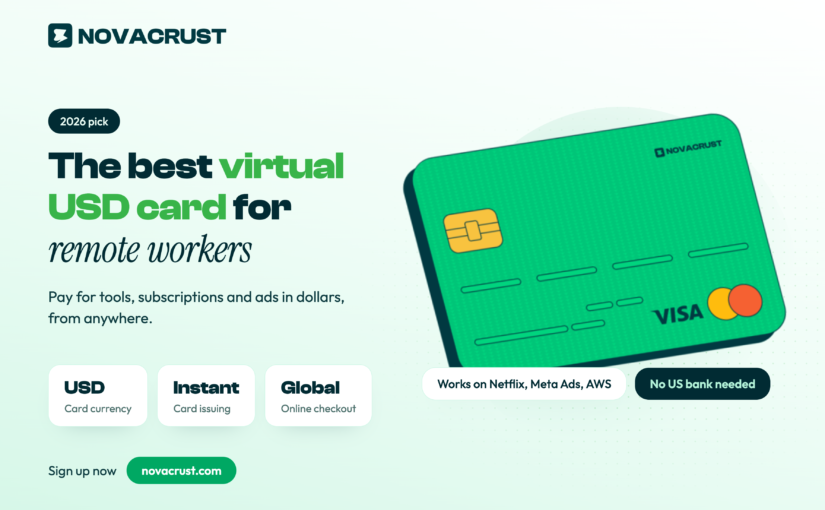
Novacrust issues a Virtual USD Card instantly, no US address or SSN required, and funds it from your local currency, your USD Account balance, or crypto you convert in the same app. That last part matters if you get paid in USDT or USDC directly from international clients or platforms: you don’t need a separate wallet, a separate exchange, and a separate card provider. It’s one balance you can receive into, hold, spend from, and send home, without stitching four services together to do the job one should.
Your Novacrust card works with the tools remote work actually requires: ad platforms, SaaS subscriptions, app store billing, and marketplaces that only charge in dollars, at a transparent rate you can check before you fund it. If you’re weighing a card on its own against a full USD Account for freelancers, the short version is that you don’t have to choose. Both come from the same balance.
Frequently asked questions
What is the best virtual USD card for remote workers in 2026?
The best option depends on where you’re based and how you get paid. If you need instant issuance, no US address requirement, and the ability to fund from local currency or crypto, Novacrust’s Virtual USD Card is built for exactly that setup.
Can I get a USD virtual card without a US address or SSN?
Yes. Novacrust issues a Virtual USD Card to freelancers and remote workers outside the US without requiring a US address or Social Security Number.
Why does my local debit card get declined for international subscriptions?
Banks often flag charges from foreign merchants as suspicious, especially recurring ones billed in a currency you don’t hold locally. A card issued directly in USD avoids that flag because the merchant no longer sees it as a foreign transaction.
How fast can I get a virtual USD card as a freelancer?
With Novacrust, your Virtual USD Card is issued instantly in the app. No physical shipping, no waiting period before you can start spending.
Can I fund a virtual USD card with crypto?
Yes, with Novacrust. Convert USDT, USDC, or other crypto you’re paid in directly to your card balance in the same app, without routing through a separate exchange first.
Is a virtual USD card better than Wise or Payoneer for freelancers?
It depends on how you get paid and where you’re based. Wise suits freelancers already inside its supported countries who want a mid-market rate. Payoneer suits freelancers paid through its partner marketplaces. If you want instant issuance with no US address requirement and the option to fund from crypto or local currency, Novacrust is built for that specific case.
Get a Virtual USD Card built for how remote workers actually get paid. Get Started. It’s Free.