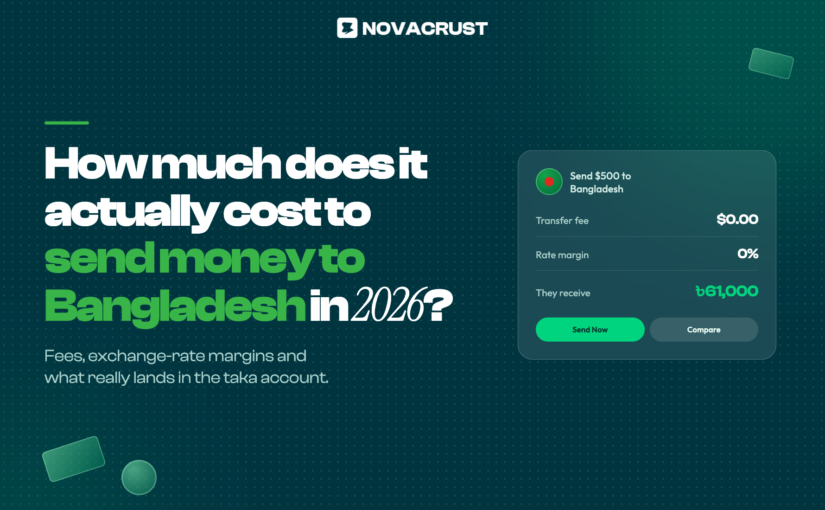
Bangladesh pulled in a record $35.56 billion in remittances in the fiscal year that just closed, up roughly 17.2 percent from $30.33 billion the year before, according to Bangladesh Bank data. The UAE, the US, the UK, and Saudi Arabia are the biggest sources, and most of that money is wired, walleted, or wired again before a single taka reaches a family’s hands. Every one of those steps has a price tag, and it is rarely the one advertised on the homepage.
The World Bank tracks exactly what senders pay on this corridor, and the numbers are not close. Here is what it actually costs to send $100, $500, and $1,000 to Bangladesh in 2026, where the fee hides, and the one government incentive that can put money back in your recipient’s pocket.
Where a transfer to Bangladesh quietly loses value
Three things chip away at the amount your family actually receives:
- A marked-up exchange rate. This is where most providers make their real money. A transfer advertised as “no fee” can still cost more than one with a small, honest fee if the rate is padded underneath it.
- A flat sending fee. Banks and card-funded transfers tend to charge the most here, sometimes stacked on top of the rate markup, not instead of it.
- Cash pickup or agent markups. Picking up taka in cash instead of a direct bank or mobile wallet deposit usually costs more, since the provider is pricing in a physical agent network.
We walk through this same pattern across every corridor Novacrust supports in our guide to choosing the best way to send money internationally. The rule holds here too: judge a provider by what lands in Bangladesh, not by what it claims to charge.
What it actually costs to send money to Bangladesh
The World Bank’s Remittance Prices Worldwide database puts the average total cost of sending $200 from the United States to Bangladesh at 7.61 percent. The cheapest option it tracked, a bank-account-to-bank-account transfer, came in at 5.17 percent. The most expensive, a credit-card-funded transfer, ran 12.41 percent for the same amount and a slower delivery window.
| Amount sent | Cheapest method tracked (5.17%) | Corridor average (7.61%) | Priciest method tracked (12.41%) |
|---|---|---|---|
| $100 | $5.17 | $7.61 | $12.41 |
| $500 | $25.85 | $38.05 | $62.05 |
| $1,000 | $51.70 | $76.10 | $124.10 |
Send $500 a month at the corridor average instead of the cheapest tracked method, and that gap alone runs over $145 a year. None of that ever reaches Bangladesh. It just funds whichever provider you picked.
The 2.5 percent incentive most senders miss
Bangladesh’s government pays a 2.5 percent cash incentive on remittances sent through formal, legally recognized banking and mobile financial service channels, and it confirmed the incentive continues in 2026. That money is credited on top of the exchange rate your recipient gets, but only when the transfer moves through a licensed provider, not an informal courier or an unregistered exchange. Sending $500 through a formal channel can mean an extra $12.50 landing in your recipient’s account for doing nothing differently except picking a legitimate provider.
It is the same principle we cover in our breakdown of what it costs to send money to Pakistan: the fastest way to lose value on a transfer is routing it through a channel that was never built to be transparent in the first place.
Bank account, bKash, or Nagad: what your recipient should use
Most Bangladeshi recipients now receive money one of two ways: straight into a bank account, or into a mobile financial service wallet like bKash or Nagad. Mobile wallets tend to win on speed and reach, since they do not require a recipient to visit a branch, but confirm your provider actually supports a direct wallet deposit before assuming it does. A transfer that has to route through an intermediary bank before reaching a wallet adds a step, and every extra step is another place a fee can hide.
The same tradeoff shows up whenever a large diaspora sends money home through a mix of banks and mobile wallets. Our guide to sending money to India covers a similar split between bank-linked transfers and app-based delivery, and the math for choosing between them is nearly identical.
A cheaper way to send to Bangladesh
A Novacrust account lets you hold US dollars and send to Bangladesh, or to 50+ other countries, without juggling a bank, a card, and a separate remittance app. You see the exchange rate before you confirm, and any fee is shown separately instead of buried in a padded rate. That matters most on a corridor like this one, where the gap between the cheapest and priciest method tracked by the World Bank is more than double.
FAQ
What’s the cheapest way to send money to Bangladesh?
A direct bank-account-to-bank-account transfer through a formal, licensed channel usually beats cash pickup and card-funded options, and it also qualifies for the government’s 2.5 percent incentive.
Can I send money directly to bKash or Nagad?
Many providers support direct deposits to mobile financial service wallets like bKash and Nagad. Confirm your provider offers a direct deposit rather than a routed transfer, since routed transfers usually take longer and cost more.
What is Bangladesh’s 2.5 percent remittance incentive?
It is a government cash incentive paid on top of the exchange rate for remittances sent through formal banking and mobile financial service channels. Bangladesh’s government confirmed it continues in 2026, and it does not apply to informal or unregistered transfer channels.
How long does a transfer to Bangladesh take?
Bank wires typically take one to three business days. Digital apps built for cross-border transfers, including Novacrust, usually settle in minutes once your funds are confirmed.
Final thoughts
With $35.56 billion already moving through official channels and growing every year, the provider you pick decides how much of that money actually does its job. Compare the real exchange rate before you send, confirm the channel qualifies for the 2.5 percent incentive, and treat a low advertised fee as the start of the question, not the answer.
Sign up to get started on Novacrust here.