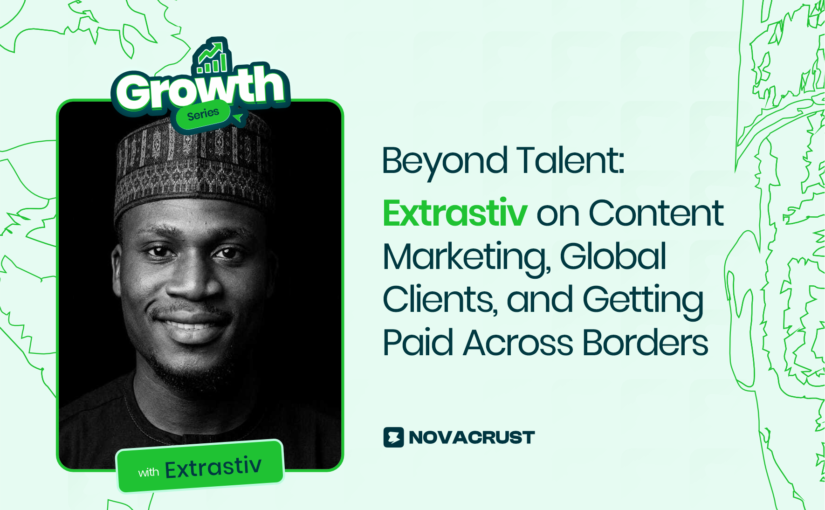
For many people, the internet is a place to consume content. For others, it’s a place to build opportunities. For Extrastiv, it became the foundation of an entire career.
What began as hours spent learning digital skills online eventually evolved into a thriving career in content marketing, writing, and education. Today, he works with brands across different industries, teaches aspiring writers how to monetize their skills, and shares the stories of freelancers and entrepreneurs through his newsletters.
But like many African freelancers working with international clients, the journey has involved more than mastering a skill. It has required learning how to build credibility, navigate global opportunities, overcome payment barriers, and stay consistent through periods of uncertainty.
In this conversation, Extrastiv shares the lessons he’s learned from building a career online, the realities of working with international clients, and why reliable payment infrastructure remains one of the most important pieces of the freelance ecosystem.
Can you briefly introduce yourself and tell us what you do?
My name is Extrastiv. I’m a content marketer and writer with over five years of professional experience. I’ve worked with B2B and B2C brands like Storipod, Gamms, Cleva, etc.
Beyond client work, I teach content marketing and run a writing course called Get Paid To Write, where I help writers transition into content marketing and start earning from their skills.
I run two newsletters. One is called CREATORS DIARY, where I profile freelancers, entrepreneurs, and creators by sharing their real stories the wins, the struggles, and the lessons in between. The other is a personal newsletter on Substack called Extrastiv Notes.
How did your journey into the digital or creative space begin?
My journey started from curiosity and survival at the same time. I was constantly online learning different digital skills and trying to understand how people were making money from the internet. Writing stood out to me because I enjoyed communicating ideas and storytelling. What started as learning online eventually became a career path.
What first inspired you to start building your career online?
Freedom and possibility. I saw people building careers online regardless of where they lived, and that opened my mind. As someone growing up in Nigeria, the internet felt like a bridge to opportunities that normally wouldn’t be accessible. I wanted to prove that talent and consistency could create global opportunities.
What were some of the biggest challenges you faced when starting out, especially working internationally?
The first challenge was just being taken seriously. When you’re starting out with no portfolio and no case studies, every pitch is essentially you asking someone to bet on potential.
But beyond visibility and credibility, the more frustrating challenge was infrastructure, specifically getting paid. Working with international clients sounds exciting until you realize that the systems built for receiving global payments aren’t exactly designed with African freelancers in mind. There were limitations, restrictions, and more than a few moments where money I had earned was simply out of reach.
Did you ever face issues receiving payments from international clients? How did that impact your growth?
Yes, several times. I’ve had situations where clients struggled to pay because the available payment options were either unavailable in Nigeria, too expensive, or unreliable.
It affects confidence and workflow because after delivering quality work, the last thing you want is uncertainty around payment. It also slows growth because freelancers need smooth systems to operate professionally.
What was your very first international payment experience like?
It was a mix of excitement and anxiety. The excitement of earning in a foreign currency for the first time is something most freelancers never forget, it feels like a milestone.
But there was also this underlying anxiety about whether the money would actually land, how long it would take, and what fees would eat into it. That first experience taught me that getting the client is only half the job. Knowing how to receive what you’ve earned without friction is just as important.
How did you handle the payment challenges at the time?
I had to rely on different alternatives, ask fellow freelancers for recommendations, and sometimes even use third-party options. It wasn’t always convenient, but it taught me the importance of having reliable financial tools as a freelancer working globally.
In your opinion, how important is having a reliable dollar payment account for freelancers and digital creators?
It’s extremely important. For freelancers and creators, payment infrastructure is not just a convenience, it’s part of the business. A reliable dollar payment account helps you work confidently with international clients, receive payments faster, and operate more professionally without unnecessary delays or limitations.
Was there a particular breakthrough moment that changed your trajectory?
There have been several, but the one I always enjoy sharing is my very first paid writing gig. I got it through Facebook, someone posted that they needed a writer and I responded. The pay was five thousand naira.
By most standards, that’s a small amount. But to me, in that moment, it was proof that this was real. Someone had looked at my words and decided they were worth paying for. That felt enormous. It gave me the morale to keep going, to pitch more, to take the craft seriously, and to start thinking of writing as a legitimate career rather than a side interest.
What skills or mindset helped you grow the most in your career?
Consistency helped me the most. A lot of people underestimate how powerful showing up consistently can be.
I also focused heavily on communication, adaptability, and learning how to market myself not just my skill.
What lessons would you share with African freelancers looking to work with global clients today?
Lead with your thinking, not just your execution. A lot of African freelancers undersell themselves because they’ve been conditioned to compete on price. But global clients aren’t just buying deliverables, they’re buying perspective, strategy, and reliability. Show them you understand their business.
Also, sort out your financial infrastructure early. Don’t wait until you’ve landed a big client to figure out how you’re going to receive the payment. That should be ready before you even send the first pitch.
How do you stay consistent and motivated even during slow or challenging periods?
I remind myself that every career has seasons. Slow periods are usually opportunities to learn, improve systems, and build better positioning.
I also focus less on motivation and more on discipline because consistency is what compounds over time.
What is one honest truth about building a global career that nobody tells young African creators and freelancers?
Talent alone is not enough. You also need visibility, communication skills, patience, and systems.
A lot of people think success online happens quickly, but most sustainable careers are built quietly over time through consistency and resilience.
Novacrust is a platform that makes receiving international payments fast, simple, and secure. How do you think having access to a solution like this could help freelancers like you?
It would remove one of the most consistent friction points in the freelance journey. When I think about what held me back in my early years and what still creates unnecessary stress for many freelancers today, payment infrastructure is near the top of the list.
A platform that makes receiving international payments fast, simple, and secure means freelancers can focus their energy where it belongs: on the work, on the clients, on building their reputation.
It also lowers the barrier to pitching global clients, because you’re no longer privately anxious about whether the payment will actually come through cleanly. That kind of peace of mind is worth a lot.
Would you consider signing up for a platform like Novacrust to make getting paid from international clients easier? Why or why not?
Of course. Any platform that genuinely makes international payments faster, simpler, and more reliable is valuable for freelancers and digital creators.
Smooth payment systems improve trust, workflow, and overall business experience when working with global clients.
Outro
Extrastiv’s journey highlights the evolving reality of building a creative career in today’s digital economy.
Beyond writing skills and content strategy, his story reflects what it truly takes to succeed globally, consistency, positioning, adaptability, and the ability to navigate systems that often determine how far talent can go.
For many African freelancers and creators, his experience is a reminder that opportunity is not only about ability, but also about access, structure, and persistence. And while the path is rarely linear, it remains open to those willing to keep building, learning, and showing up.