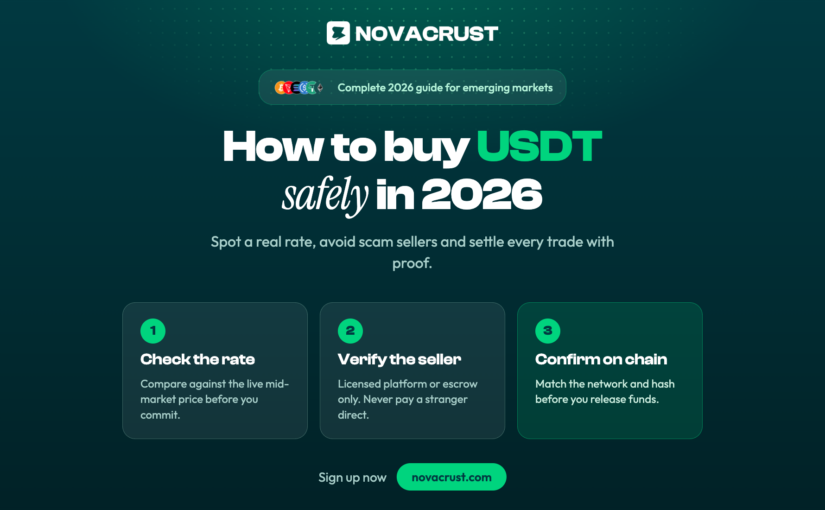
Search “buy USDT in Malawi” or “how to buy USDT in Maldives” and most of the first page isn’t a licensed exchange. It’s Telegram groups, Facebook posts, and P2P forums where you send money to a stranger first and hope the USDT shows up after. That gap between demand and safe supply is exactly why so many people in Cameroon, Zambia, Nepal, Botswana, and dozens of other markets still buy USDT the hard way.
USDT (Tether) is the most widely used stablecoin in the world, pegged 1:1 to the US dollar. That peg is the whole appeal: your money holds its value in dollars without you needing a US bank account. But “widely used” doesn’t mean “widely available through safe channels” everywhere. This guide covers how USDT actually gets bought and sold, where the real risk sits, and how to buy it in minutes instead of hours.
Why buying USDT is harder than it should be
In markets with limited USD liquidity, mainstream banks, weak local exchange infrastructure, or currency controls, three things usually happen:
- Local exchanges either don’t exist or don’t support your country
- Peer-to-peer (P2P) trading fills the gap, which means you’re trusting a stranger, not a platform
- Rates vary wildly between sellers, and the “cheap” price sometimes hides a scam
None of that is a reason to avoid USDT. It’s a reason to be specific about how you buy it.
How the common USDT scams actually work
Most P2P USDT scams follow the same pattern: a seller offers a rate slightly better than everyone else’s, asks for payment via bank transfer or mobile money first, and then either sends less USDT than agreed, sends it to the wrong network, or disappears entirely. Group admins in Telegram or Facebook communities rarely offer any real recourse once that happens; you’re left with a screenshot and no way to reverse the transfer. This is the exact gap a licensed platform closes: your payment and the USDT release happen inside one system, not across two separate, unconnected steps.
Novacrust vs. P2P groups and other exchanges
Binance P2P, Busha, and Breet.io all let you buy USDT, and each works differently. Binance P2P connects you with individual traders directly, so you’re still trusting a stranger, just inside an app instead of a Telegram group. Busha and Breet.io operate as licensed exchanges in select markets, which is safer than open P2P, but neither pairs USDT buying with a USD Account or virtual card the way Novacrust does. If you want to buy USDT and also hold, spend, or convert dollars from the same wallet, that combination is where Novacrust differs most.
Six rules for buying USDT safely
- Use a platform that holds your funds in escrow, not a stranger’s word. If a seller asks you to pay first and “trust the process,” that’s not a platform, that’s a bet.
- Check the live rate before you commit. Rates can move within minutes. A platform that locks your rate for a short window protects you from last-second changes.
- Confirm the network before you send anything. USDT exists on multiple networks (TRC20, ERC20, and others). Sending to the wrong network address can mean losing your funds permanently.
- Avoid sellers who won’t verify their identity. Anonymity on your side is fine. Anonymity on the seller’s side, with no recourse if something goes wrong, isn’t.
- Start small the first time. Test any new platform or seller with a small amount before moving your full balance.
- Keep your funding trail traceable. Bank transfer or mobile money, not cash handoffs, so you have a record if a dispute comes up.
How to buy USDT on Novacrust
Novacrust lets you buy USDT (along with USDC, BTC, ETH, SOL, and more) directly, with the rate and network shown upfront before you confirm.
- Create your account. Sign up in a couple of minutes. No US address or SSN required.
- Fund your wallet. Pay via bank transfer, mobile money, or an existing crypto wallet.
- Buy USDT at the live rate. The rate you see is the rate you get, with no last-minute markup.
- Confirm the network. Novacrust shows you the correct network before you send, so your funds land in the right place the first time.
- Hold, spend, or convert. Keep it as USDT, convert to your local currency, or move it into your USD Account.
The whole flow runs on one platform, so there’s no handing money to a stranger and waiting to see what shows up.
Buying USDT in Malawi, Maldives, Cameroon, Zambia, Botswana, and Nepal
Country-specific USDT demand is real, and the friction looks similar everywhere: thin local exchange support, P2P groups filling the gap, and rates that shift depending on who you ask.
- Malawi and Zambia: Local exchanges are limited, so most buyers rely on P2P sellers found through Telegram or Facebook, often paying via mobile money. A licensed platform removes the guesswork around whether the seller will actually deliver.
- Maldives: Tourism-driven cash flow means many residents and workers want a stable way to hold dollars without going through a traditional bank. USDT fills that role, but only if the buying process is verified.
- Cameroon: Mobile money is the dominant payment rail, and USDT buyers here need a platform that accepts it directly rather than routing through a third-party wallet first.
- Botswana and Nepal: Both have smaller but growing USDT demand, usually from freelancers and remote workers who want to hold part of their income in dollars.
The country changes. The core problem doesn’t: buy from a platform that shows its rate and holds funds securely, not from a stranger’s word.
What buying USDT should actually cost
A fair USDT purchase has two costs: the network fee (small, fixed by the blockchain, not the seller) and the platform’s spread (the difference between the live market rate and what you’re quoted). Watch for sellers who bundle in a third, invisible cost: a marked-up rate disguised as a “discount.” If a rate looks meaningfully better than everyone else’s, ask why before you ask how.
USDT vs. other ways to hold dollars
If your goal is simply holding value in USD, USDT isn’t your only option. A Novacrust USD Account gives you a real US account number in your name, no crypto step required. Some people use both: USDT for speed and portability, a USD Account for a bank-like balance they can receive ACH and wire transfers into. Compare what you actually need before picking one.
FAQ
Is it legal to buy USDT in Malawi, Cameroon, Zambia, Botswana, Nepal, or the Maldives?
Rules vary by country and change over time, so check your local regulations. In most of these markets, buying and holding USDT through a licensed platform is legal; the risk is usually with unregulated P2P sellers, not the asset itself.
How long does it take to buy USDT?
On Novacrust, a purchase completes in minutes once your wallet is funded. P2P trades can take much longer, since you’re waiting on another person to respond and confirm.
Can I buy USDT with mobile money?
Yes, on Novacrust you can fund your wallet with mobile money in supported countries and buy USDT directly from that balance.
Is USDT the same as a US dollar?
No. USDT is a stablecoin designed to track the US dollar’s value 1:1, but it’s a crypto asset, not a bank deposit. It moves like crypto and settles fast, which is the main reason people use it instead of, or alongside, traditional banking.
What’s the minimum amount of USDT I can buy?
This depends on the platform. Novacrust supports small first purchases, so you can test the process before committing a larger amount.
Buy USDT without the guesswork
You shouldn’t have to trust a stranger’s screenshot to hold dollars. Buy USDT on Novacrust with a live rate, a verified network, and funds that move in minutes, not hours.
Get Started. It’s Free.