Crypto theft hit $3.4 billion in 2025, and the FBI puts crypto related fraud losses at a record $11.4 billion for the same year. Most of that money didn’t disappear because blockchains got hacked. It disappeared because someone lost control of a private key, trusted the wrong app, or sent funds to a wallet with no recovery option. The question of who actually holds your keys, you or a platform, is the single biggest safety decision you make when you buy or sell crypto.
That question has a name: custodial versus non-custodial. Here’s what each one actually means, and how to decide which one fits how you use crypto.
What “custodial” and “non-custodial” actually mean
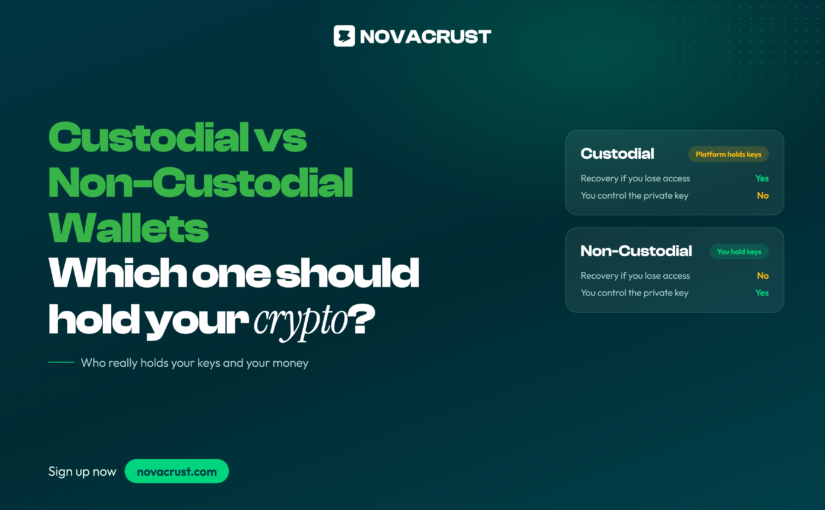
A custodial wallet is one where a platform holds your private keys on your behalf, the same way a bank holds your cash. You log in with a password, and the platform moves funds for you. A non-custodial wallet is one where you hold your own private keys, usually as a 12 or 24 word recovery phrase, and no company can freeze, recover, or move your funds without you.
The crypto community sums up the tradeoff in one phrase: not your keys, not your coins. It’s a fair warning, but it’s not the whole story. Self custody removes a third party from the equation. It also removes the safety net that third party provides. Ledger’s academy breaks down the mechanics in more depth if you want the full technical picture.
Six rules for picking the right type of wallet
- Match the wallet to how often you trade. If you’re buying and selling regularly, a custodial platform with fast, in-app execution beats moving funds to a separate wallet every time.
- Match it to how much you’re holding. Small, active balances are fine in a custodial account. Large amounts you don’t plan to touch for months are usually safer under your own keys, split across secure backups.
- Know what happens if you forget your password or phrase. A custodial platform can usually help you recover account access. A lost recovery phrase on a non-custodial wallet is gone for good. There’s no support line that gets it back.
- Check who’s actually licensed. A custodial platform with clear regulatory standing gives you recourse if something goes wrong. An anonymous wallet provider or unregulated exchange gives you none.
- Never store your recovery phrase digitally. Not in a notes app, not in a photo, not in an email draft. Screenshots and cloud backups are exactly what attackers search for.
- Test with a small amount first. Whether you’re trying a new custodial platform or setting up your first non-custodial wallet, send a small amount through before you commit your full balance.
Custodial vs non-custodial, side by side
| Factor | Custodial | Non-custodial |
| Who holds the keys | The platform | You |
| Account recovery | Usually possible | Not possible without your phrase |
| Speed for buying/selling | Fast, in-app | Slower, needs a transfer step |
| Best for | Active trading, everyday use | Long-term storage, large balances |
| Biggest risk | Platform gets hacked or mismanaged | You lose your phrase or get phished |
Where Novacrust fits
Novacrust runs as a custodial platform. When you buy or sell USDT, USDC, BTC, ETH, SOL, and more, your funds sit in your Novacrust wallet, and the platform handles the key management and network security behind the scenes. That’s the same tradeoff every custodial exchange makes: convenience and recovery options, in exchange for trusting the platform’s security.
If you’re actively trading, converting to local currency, or moving funds between crypto and a USD Account, a custodial setup like Novacrust removes the extra step of managing your own keys for every transaction. We’ve covered how to avoid the P2P scams that catch people buying USDT the hard way, and how the major buy/sell apps compare if you’re still choosing a platform.
When a non-custodial wallet still makes sense
If you’re holding a large balance for months or years, want direct interaction with decentralized apps, or simply don’t want any third party able to freeze your funds, a non-custodial wallet is the right tool. Many people run both: a custodial platform for active buying, selling, and spending, and a non-custodial wallet for savings they don’t touch often. If you move funds between the two, always double check the network before you send. Sending USDT on the wrong network is one of the most common ways people lose funds that has nothing to do with hacking at all, which is why picking the right network matters as much as picking the right wallet.
FAQ
Is Coinbase a custodial or non-custodial wallet?
The main Coinbase exchange account is custodial. Coinbase Wallet, a separate app, is non-custodial and gives you your own keys.
Is Trust Wallet custodial or non-custodial?
Trust Wallet is non-custodial. You control the recovery phrase, and no company can restore access if you lose it.
Are non-custodial wallets safer than custodial ones?
Neither is universally safer. Non-custodial wallets remove platform risk but add personal responsibility for keeping your keys secure. Custodial platforms remove that responsibility but concentrate risk on the platform’s own security.
What happens if I lose my non-custodial wallet’s recovery phrase?
Your funds become permanently inaccessible. There’s no password reset and no support team that can recover it, which is why backing up your phrase correctly matters more than almost anything else in crypto.
Can I move funds between a custodial platform and a non-custodial wallet?
Yes. Most people do exactly this: buy or sell on a custodial platform like Novacrust, then withdraw to a non-custodial wallet for longer-term storage. Just confirm the network matches on both ends before you send.
Buy and sell crypto without managing your own keys
Novacrust handles the custody, security, and network checks so you can buy, sell, and hold USDT, USDC, BTC, ETH, SOL, and more without setting up a separate wallet first. Sign up to get started on Novacrust here.