How to Check If a Money Transfer or Mobile Money App Is Actually Licensed in Ghana

In July 2026, the Bank of Ghana revoked Zeepay’s e-money licence over e-money violations, separately from an earlier Bank of Ghana notice fining and suspending Zeepay’s forex licence. A Ghanaian court also ordered Zeepay and its CEO to pay $11.6 million to a customer in a separate case. Zeepay had been one of Ghana’s best-known fintechs. That is the point: being popular, or even licensed once, does not mean a provider stays safe to hold your money in.

If you send or receive money through a mobile money wallet or a money transfer app in Ghana, here is how to actually check who is holding your funds, not just who has the nicest app.

Why this matters more than it used to

Mobile money and e-money apps in Ghana operate under licences issued and supervised by the Bank of Ghana (BoG), most commonly as a Dedicated Electronic Money Issuer (DEMI) or in partnership with a licensed bank. That licence is supposed to mean your balance is backed 1:1 by real money held in a regulated account, not just a number in an app.

Zeepay’s licence was pulled because BoG found its e-money balances were not fully backed. Users who held a balance in the app were exposed the moment that gap became public. A working app and a familiar brand name told them nothing about whether their money was actually there.

Six checks before you trust an app with your money

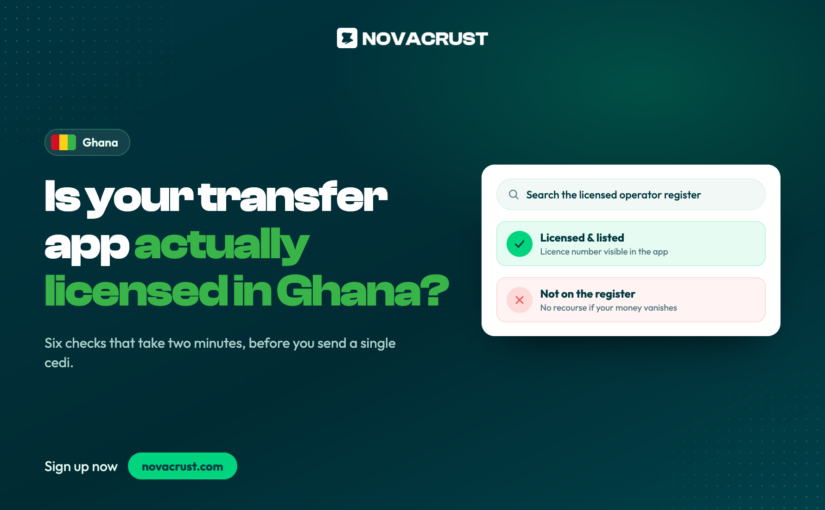
1. Confirm the licence directly with the Bank of Ghana, not the app’s own claims. BoG publishes its list of licensed payment service providers and e-money issuers. An “as regulated by BoG” badge on a website is not proof; the regulator’s own published list is.

2. Check when the licence was issued, and whether it has been suspended, fined, or revoked. BoG posts enforcement actions, fines, and licence suspensions publicly. A provider can be licensed today and sanctioned next month. Check the date on whatever you find.

3. Ask where your balance is actually held. A backed e-money model means your cedis, dollars, or other balance sits in a real bank account or trust account, ring-fenced from the company’s own operating funds. If a provider cannot explain this in plain language, that is itself an answer.

4. Look for a physical, verifiable business address and a real complaints process. Legitimate providers list a registered office and a way to escalate a dispute beyond an in-app chat bot. A provider with no traceable address is a provider you cannot hold accountable.

5. Read what happens if the company fails. BoG’s framework for e-money issuers requires customer funds to be protected even if the issuer collapses, but the practical experience of getting your money back during a wind-down still varies. Zeepay users found this out directly when the licence was revoked and the company’s operations ground to a halt.

6. Diversify where your money sits. Don’t let your entire float for the month sit in one mobile money wallet or one app’s balance, especially not in the days after any negative news about that provider. Keep dollars you need to hold onto in a proper USD Account rather than a single local e-wallet balance, and keep a card that works even if one provider has a bad week.

FAQ

Is my mobile money automatically unsafe if my provider is licensed?
No. A valid, current BoG licence is a real signal, not a guarantee. Keep checking it, and keep an eye on BoG’s public enforcement notices, not just the provider’s marketing.

What actually happened with Zeepay?
Two separate actions happened close together. The Bank of Ghana fined and suspended Zeepay’s forex licence, then went on to revoke its e-money licence over unbacked e-money balances. A Ghanaian court also ordered Zeepay and its CEO to pay $11.6 million to a customer in an unrelated case. All three are publicly documented, either directly by BoG or by Ghanaian fintech outlets reporting on the rulings.

Does holding money in a USD Account instead of a mobile money wallet remove all risk?
No option removes all risk, but a USD Account with real account and routing numbers, backed 1:1 in dollars, gives you a second place to hold savings so one provider’s problems don’t touch everything you have.

How often should I recheck a provider’s licence status?
Whenever there is news about the company, and at least once every few months if you keep a meaningful balance with them. BoG’s enforcement notices are the fastest way to catch a problem early.

Keep your money somewhere you can verify

Checking a licence takes ten minutes. Losing access to your balance takes a lot longer to fix. If you want a second place to hold dollars you can verify and move on your own terms, see how to open a USD Account online in minutes and compare it against the best way to send money internationally in 2026. Get Started. It’s Free.
How to Send Money to Nigeria From Abroad (2026 Guide)

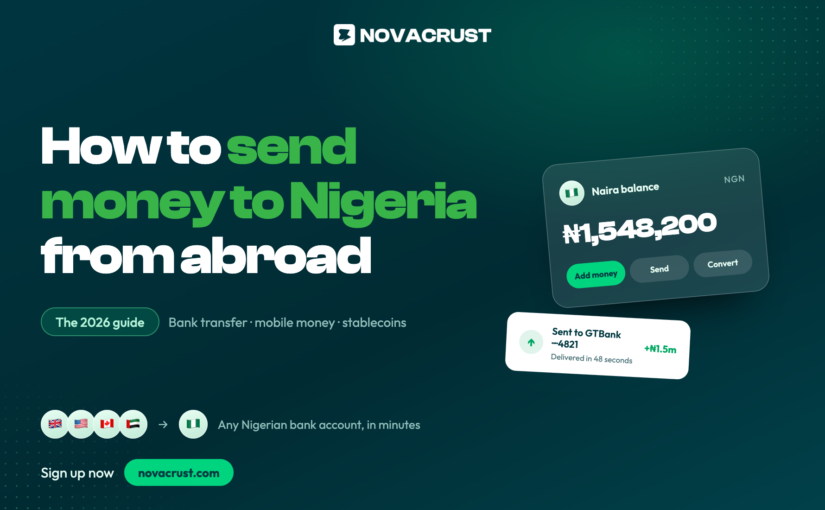
On May 1, 2026, a new Central Bank of Nigeria directive took effect: every international money transfer operator must settle diaspora remittances through naira accounts held with authorized Nigerian banks. Nigerians received $21.8 billion from abroad in 2025, and the CBN wants a bigger share of that flowing through official channels it can track and price fairly, with a stated goal of $1 billion in monthly remittances by the end of 2026.

If you send money to Nigeria regularly, or you’re doing it for the first time, that policy shift changes what “the best way to send money” actually means right now. This guide covers what changed, where transfers quietly lose value, and how the popular options compare.

This is why so many people keep searching:

  • how to send money to Nigeria from abroad
  • best app to send money to Nigeria
  • send money to Nigeria from the US or UK
  • cheapest way to send money to a Nigerian bank account

What changed for Nigeria in 2026

Before this year, some transfer operators could pay recipients out in foreign currency or route funds outside formal naira settlement. The CBN’s March 2026 directive closed that gap: as of May 1, every licensed money transfer operator must process inflows, beneficiary payouts, and related settlements through naira accounts at authorized dealer banks. The stated aim is more transparency, better price discovery in the foreign exchange market, and fewer remittances slipping through informal, unregulated routes.

For everyday senders, the practical effect is simple: recipients get paid in naira, at a rate the transfer operator sets, through an accountable banking channel. That makes the exchange rate you’re quoted, and the margin baked into it, the single biggest factor in how much your recipient actually walks away with.

Where a transfer to Nigeria quietly loses value

According to World Bank Remittance Prices Worldwide data, the average cost of sending money from the UK to Nigeria sits around 1.96 percent once fees and exchange rate margins are combined. That number sounds small until you notice it rarely tells the whole story. Four things usually eat into the total:

  • A marked-up exchange rate that’s presented as “the rate,” with no separate fee line
  • A flat sending fee on top of that already-marked-up rate
  • Delays of one to three business days, during which the naira can move against you
  • Extra charges for cash pickup versus direct bank or mobile money deposit

We cover the same pattern in more depth in our guide to choosing the best way to send money internationally: whoever quotes the number closest to the real market rate, not the flashiest app, is the one protecting your money.

How the popular options compare

Most people sending money to Nigeria end up choosing between a bank wire, Western Union, LemFi, Chipper Cash, or a Novacrust account. They all get naira into a Nigerian bank account or mobile money wallet eventually. What differs is the rate, the fee, and how long it takes.

OptionTypical speedWhere it loses money
Bank wire1 to 3 business daysHigh flat fee plus a weaker exchange rate
Western UnionMinutes to hours (cash pickup)Cash pickup fees stack on top of the rate
LemFiMinutesCompetitive, but rate varies by corridor and volume
Chipper CashMinutesBest for smaller, peer-to-peer amounts
NovacrustMinutesCompetitive rate with no cash pickup markup

Example: sending $500 to a Nigerian bank account

Say the market exchange rate values $500 at a certain naira amount. A transfer with a 4 to 6 percent all-in margin, common across banks and several apps, quietly removes $20 to $30 of that before it lands. Add a flat fee of $5 to $15, and the gap between “what you sent” and “what they received” grows fast, especially if you’re sending every month.

This is also where the exchange rate itself matters beyond the transfer fee. If you’re regularly comparing naira quotes, our breakdown of which app gives the best USD to naira exchange rate walks through how to tell a fair quote from a padded one.

Why freelancers and diaspora senders use Novacrust

A Novacrust account lets you hold US dollars and send to Nigeria, or to 50+ other countries, without stacking a separate bank, card, and remittance app on top of each other. You can:

  • Receive USD directly from international clients, Upwork, Fiverr, or a US employer
  • Convert to naira at a competitive rate, in the same account
  • Send to a Nigerian bank account or mobile money wallet in minutes

If you don’t have a US dollar account set up yet, our guide to opening a USD Account online in minutes covers what you need before your first transfer, no US address required.

Other ways dollars reach Nigeria

A bank transfer isn’t the only route into naira. Two worth knowing:

  • Gift cards. If you’re paid in US gift cards, or received one as a gift, selling gift cards for naira in Nigeria turns that value into cash without a wire transfer at all.
  • Stablecoins. Some senders convert USDT or USDC to naira directly, skipping the traditional banking rail entirely. Our guide on converting crypto to naira covers how that works end to end.

FAQ: sending money to Nigeria in 2026

Do Nigerians receive remittances in dollars or naira now?

As of May 1, 2026, licensed money transfer operators must settle remittances through naira accounts at authorized Nigerian banks. In practice, that means recipients are paid out in naira rather than foreign currency cash.

What’s the cheapest way to send money to Nigeria?

The cheapest option is usually whichever one quotes an exchange rate closest to the real market rate and charges a transparent, separate fee rather than folding its margin into the rate itself. Direct bank or mobile money deposit is almost always cheaper than cash pickup.

How long does a transfer to a Nigerian bank account take?

Bank wires typically take one to three business days. Apps built for cross-border transfers, including Novacrust, usually settle in minutes once the sender’s funds are confirmed.

Is it safe to send money to Nigeria through an app instead of a bank?

Licensed transfer operators now settle through naira accounts at authorized dealer banks under CBN oversight, so a regulated app is not inherently less safe than a bank wire. Check that any provider you use is licensed for the corridor you’re sending through.

Can I still send money to Nigeria in US dollars?

You can send from a USD account or balance, but under the 2026 rules the recipient is paid out in naira through the receiving bank. Holding dollars in your own account and converting only when you’re ready to send is still a valid way to manage timing.

Final thoughts

The 2026 naira settlement rule makes one thing clearer than before: the exchange rate you’re quoted, not the brand name on the app, decides how much of your money actually reaches Nigeria. With $21.8 billion in diaspora remittances already flowing through official channels in 2025, and the CBN pushing for more, comparing the real rate before you send is worth the extra minute every time.

Sign up to get started on Novacrust here.

How to Receive Gumroad Payouts Outside the US (Without Losing Money to Fees)

Gumroad does not let you add a payout method if your country is not on its supported list, and that list leaves out most of Africa, plus large parts of Asia and Latin America. Creators in Nigeria, Kenya, Ghana, Pakistan, and dozens of other countries hit the same wall: sales pile up in their Gumroad balance with nowhere to send them.

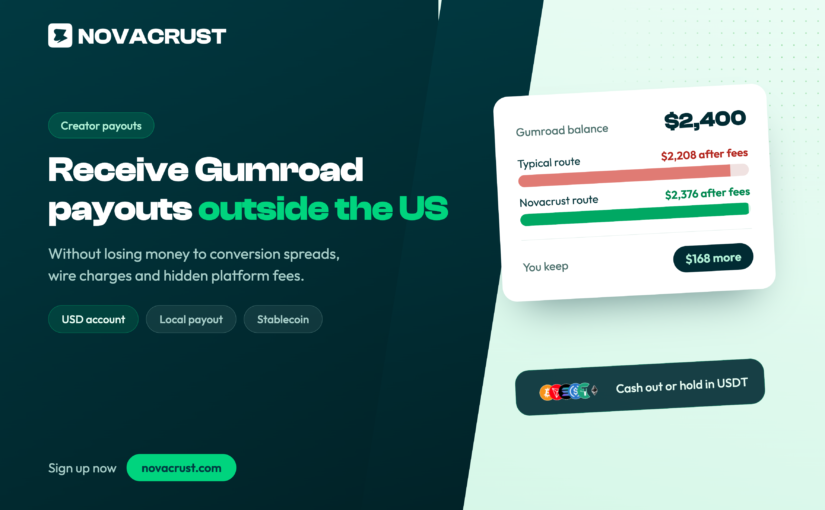
The usual workaround, routing payouts through a US-based friend’s PayPal or a forwarding service, costs 3 to 8 percent in fees and conversion spread on every payout. On a $500 month, that is $15 to $40 gone before the money even reaches you.

Why Gumroad payouts fail for so many creators

Per Gumroad’s own payout documentation, Gumroad pays out two ways: PayPal, or direct deposit to a US bank account. PayPal is only available in a limited set of countries, and even where it works, PayPal’s own conversion rates run 3 to 4 percent above the mid-market rate. Direct deposit needs a real US bank account with a routing and account number, which is exactly what most creators outside the US do not have.

That second option, direct deposit, is actually the cheaper and faster path. You just need the US account to plug into it.

The fix: a USD Account with a real routing number

A Novacrust USD Account gives you a US account number and routing number you can add directly to Gumroad’s payout settings, the same way a creator living in Ohio would. Gumroad pays out via ACH straight into your account. No PayPal, no forwarding service, no friend holding your money. If you want the mechanics of how ACH payouts actually work, see ACH vs Wire vs SWIFT.

Here is the setup:

  1. Create a Novacrust account and open a USD Account. It takes minutes and needs no US address or Social Security number.
  2. Copy your account and routing number from your Novacrust dashboard.
  3. In Gumroad, go to Settings, then Payments, and add your Novacrust USD Account as a bank payout method.
  4. Set your payout schedule. Gumroad sends funds via ACH, which typically lands in 1 to 3 business days.

Once your dollars land, spend them with a Novacrust USD Virtual Card, convert to naira, cedis, shillings, or another local currency at competitive rates, or send to 50+ countries. You keep the payout in dollars for as long as you want and move it only when you are ready.

It is not just Gumroad

The same routing and account number works for any platform that pays out via US direct deposit or ACH: Upwork, Fiverr, Patreon, Payhip, Podia, and most US-based marketplaces and ad networks. Set it up once on your Novacrust USD Account, and you can add it as a payout method everywhere you get paid. This is the same setup covered in our guide to the US banking system for non-residents, if you want the fuller picture of how a US account number works without a US address.

This is the difference between chasing a payout workaround for every platform and having one dollar account that plugs into all of them.

What this actually saves you

A creator earning $800 a month through Gumroad, routing payouts through PayPal or a forwarding service at a 5 percent blended cost, loses about $40 a month, or $480 a year. Routing the same $800 through a USD Account cuts that to Novacrust’s standard conversion rate, only charged when you actually convert to local currency, and only on the portion you convert.

FAQ

Can I add a Novacrust USD Account to Gumroad if I do not live in the US?
Yes. The USD Account comes with a real US account and routing number that works in Gumroad’s bank payout settings regardless of where you live.

How long does a Gumroad payout take once I switch to direct deposit?
Gumroad sends ACH payouts on your chosen schedule, and funds typically arrive in your Novacrust USD Account within 1 to 3 business days.

Do I need a US address or Social Security number to open a USD Account?
No. Novacrust’s USD Account is built for freelancers and creators outside the US and does not require either.

Can I use the same USD Account for Upwork, Fiverr, or Patreon payouts?
Yes. Any platform that supports US bank direct deposit or ACH can pay out to the same Novacrust USD Account.

What can I do with the dollars once they land?
Hold them in USD, spend them with a Novacrust USD Virtual Card, convert to your local currency at competitive rates, or send to 50+ countries.

Stop losing 5 percent of every Gumroad payout to a workaround. Get Started. It’s Free. Open your Novacrust USD Account in minutes and add it as your payout method today.

How to Send Money to Ethiopia From Abroad (2026 Guide)

The World Bank’s Remittance Prices Worldwide data puts the average cost of sending money to Sub-Saharan Africa at over 7 percent of the transfer, among the highest remittance fees anywhere in the world. Send $500 to Ethiopia through the wrong channel and $35 or more never reaches your recipient. It disappears into a wire fee, a bad exchange rate, or both.

Ethiopia adds its own wrinkle: birr access is tightly controlled, and not every international transfer service pays out directly to a bank account or Telebirr wallet inside the country. This guide covers what actually determines the cost of sending money to Ethiopia, which payout method gets your recipient paid fastest, and how the process works on Novacrust.

Why Sending Money to Ethiopia Costs More Than It Should

Three things drive up the cost of a transfer to Ethiopia specifically: a marked-up exchange rate instead of the real one, a payout network that routes through a correspondent bank before it reaches Ethiopia, and a fee structure that hides part of its cut inside the rate instead of the receipt.

Traditional bank wires are usually the worst offender. A wire from a US or UK bank to Ethiopia can take 3 to 5 business days and cost $25 to $45 in fees before the exchange rate markup is even factored in. Western Union and similar cash-pickup services move faster, but the rate they quote is rarely the mid-market rate, and that gap is where a chunk of your money goes. For a broader look at how transfer costs stack up across methods, see our guide to the best way to send money internationally.

Five Rules for Sending Money to Ethiopia Without Losing Value

  1. Check the live exchange rate before you send. A transfer that looks cheap on fees alone can still cost more than a competitor with a better birr rate. Compare the total amount your recipient gets, not the fee line item.
  2. Confirm the payout method before you commit. Bank deposit to Commercial Bank of Ethiopia, Awash, or Dashen works for most recipients. Telebirr mobile money is faster for recipients without a bank account nearby.
  3. Avoid services that route through multiple correspondent banks. Every extra bank in the chain adds a day and a fee. A platform that pays out directly moves faster and costs less. This is the same routing problem we cover in ACH vs Wire vs SWIFT.
  4. Send in local currency terms your recipient understands. Confirm the birr amount landing on their end, not just the dollar or pound amount you’re sending.
  5. Keep the confirmation. A transfer reference number and payout confirmation are the only things that help if a transfer is delayed on the Ethiopian side.

How to Send Money to Ethiopia on Novacrust in 4 Steps

Step 1: Sign in and select your destination

Sign in to your novacrust.com account, tap Send Money, and choose Ethiopia from the list of 50+ supported countries.

Step 2: Choose bank deposit or Telebirr

Enter your recipient’s bank details or Telebirr mobile number. Both payout options are supported.

Step 3: Confirm the rate and amount

Novacrust shows you the exact birr amount your recipient gets, at the live rate, before you confirm anything.

Step 4: Send

Once you confirm, the transfer is on its way. Most transfers to Ethiopia land within minutes, not days.

Novacrust vs Other Ways to Send Money to Ethiopia

Bank wire Western Union Novacrust
Speed 3-5 business days Minutes to hours for cash pickup Minutes, straight to bank or Telebirr
Rate visibility Often unclear until it lands Marked-up rate, shown late Live rate shown before you send
Fees $25-$45 plus markup Flat fee plus rate markup Transparent fee, shown upfront
Payout options Bank only Mostly cash pickup Bank deposit or Telebirr

Lemfi is a reasonable option for sending to Ethiopia too, with its own dedicated transfer corridor. What changes the decision is what else you can do with your money afterward. On Novacrust, the same account handles crypto, a USD Account, Gift Cards, and a virtual dollar card, not just this one transfer corridor.

Frequently Asked Questions

How long does it take to send money to Ethiopia?
On Novacrust, most transfers land within minutes. A traditional bank wire can take 3 to 5 business days.

Can I send money to a Telebirr wallet directly?
Yes. Novacrust supports payout directly to Telebirr, alongside bank deposit to major Ethiopian banks.

What’s the cheapest way to send money to Ethiopia?
The cheapest option is the one where the total birr amount landing with your recipient is highest, after fees and exchange rate. Always compare that number directly, not just the advertised fee.

Do I need a Telebirr account or Ethiopian bank account to receive money?
Your recipient needs either a Telebirr wallet or an account at a supported Ethiopian bank. Novacrust pays out to both.

The Bottom Line

Sending money to Ethiopia doesn’t have to cost 7 percent of every transfer or take a week to land. A platform that shows you the real rate upfront and pays out directly to a bank account or Telebirr wallet gets your money there faster, for less.

Send money to Ethiopia on Novacrust. Get Started. It’s Free.

USD Account for Freelancers: Get Paid in Dollars, No US Address Needed

Freelancers who invoice US clients through PayPal or a marketplace wallet lose money twice: once on currency conversion, and again on withdrawal fees. PayPal’s own fee guide confirms that cross-border currency conversion markups above the mid-market rate commonly run from 1% to 12% industry-wide, and Payoneer’s pricing lists a further fee of up to 3% on non-local currency withdrawals. On a $2,000 invoice, that can mean $60 to $100 gone before you ever touch the money. A USD account in your own name closes that gap: clients pay you like any other US-based freelancer, and you decide when and how to convert.

What a USD account actually is

A USD Account gives you real US account and routing numbers, in your name, without a US address or Social Security number. Clients, marketplaces, and platforms pay it exactly like a domestic US bank account. With Novacrust, you can open one, get your account details, and receive your first ACH transfer the same day.

Why freelancers and creators need one, specifically

  • Direct clients. Send an invoice with US account and routing numbers instead of a PayPal link, and skip PayPal’s cross-border conversion markup.
  • Upwork, Fiverr, and Deel. Route payouts straight to your USD Account instead of a marketplace wallet that charges to withdraw. See our full guide to getting paid from Upwork and Fiverr.
  • Creators on Gumroad, Patreon, and YouTube. Platform payouts land in a real US account instead of a workaround built for freelancers only. See how to receive Gumroad payouts without losing money to fees.
  • Multiple currencies. Hold dollars until the exchange rate moves in your favor, instead of converting the moment a payment lands.
  • One record. Every payment lands in one account you can track, instead of split across PayPal, Payoneer, and a local bank.

How it compares to Payoneer, Wise, and Grey

Payoneer and Wise both offer USD receiving accounts, and Grey does too. All three are solid options freelancers already use. Here’s where they differ in practice:

  • Payoneer charges a 2% fee on marketplace withdrawals (Upwork, Fiverr) on top of its conversion spread.
  • Wise has low, transparent fees but requires more verification steps to open a USD account without a US address.
  • Grey is built for a similar audience, freelancers and remote workers receiving dollars, and is a fair comparison if you’re deciding where to hold your USD.
  • Novacrust gives you a USD Account plus a Virtual Dollar Card and crypto conversion in the same app, so you’re not juggling three logins to receive, spend, and send.

How to open a USD account for freelance income

  1. Sign up on Novacrust and verify your identity. It takes about 2 minutes.
  2. Open your USD Account to get US account and routing numbers in your name. Need the full walkthrough? Read how to open a USD account online in minutes.
  3. Share those details with your client, or add them as your payout method on Upwork, Fiverr, Deel, Gumroad, or Patreon.
  4. Receive ACH or wire transfers directly. No PayPal link, no marketplace withdrawal fee.
  5. Convert to naira, cedis, shillings, or your local currency whenever the rate works for you, or spend straight from your Virtual Dollar Card.

Is this the same as a US bank account?

Not quite. A USD Account gives you real US account and routing numbers without going through the traditional US bank account-opening process. For the fuller picture of how non-residents and immigrants can bank in the US, read our guide to the US banking system for non-residents. If you’re in Nigeria and weighing this against a domiciliary account at your local bank, see what a domiciliary account is and how it differs from a USD Account.

FAQ

Can I get a USD account without a US address or SSN?

Yes. Novacrust’s USD Account works with your identity verification alone. No US address, no Social Security number, no US-based co-signer.

Will Upwork or Fiverr pay directly into a USD account?

Yes. Both platforms accept direct deposit to a US bank account. Add your Novacrust USD Account details as your payout method and skip the marketplace’s own withdrawal fee.

Can creators on Gumroad or Patreon use a USD account too?

Yes. A Novacrust USD Account works the same way for creator platform payouts as it does for freelance marketplaces: add your account and routing number as your payout method and receive dollars directly.

Is a USD account the same as a virtual dollar card?

No. A USD Account receives money (ACH and wire transfers, in your name). A Virtual Dollar Card spends money (online purchases, subscriptions). Novacrust gives you both in one app.

How fast can I receive money after opening the account?

Most ACH transfers land within 1-3 business days, the same timeline you’d get with any US bank account. Wire transfers are typically faster.

Does Novacrust charge a fee to receive payments?

Opening and receiving into your USD Account is free. You only pay a small, transparent fee if and when you choose to convert or transfer out.

What is the best USD account for freelancers outside the US?

The best option gives you real ACH and wire support, no US address or SSN requirement, and lets you hold, spend, or convert your dollars in the same app. Novacrust’s USD Account covers all three, alongside a Virtual Dollar Card and crypto conversion.

Get paid like a US freelancer, from anywhere

Stop losing money to PayPal’s conversion markup or a slow local bank. Open a USD Account on Novacrust, get real US account details in your name, and start receiving from clients and marketplaces today.

Get Started. It’s Free.

Understanding the US Banking System: A Guide for Immigrants, Freelancers, and Non-Residents

The US has more than 4,000 chartered banks. Almost none of them will open an account for someone with no Social Security number and no US address. That single requirement is why so many freelancers, business owners, and diaspora workers outside the US spend hours filling out bank applications only to get rejected at the last step.

If you get paid in dollars, or want to, understanding how the US banking system actually works, and where it shuts non-residents out, saves you that wasted time. Here is what the system looks like from outside, and the faster way in.

The Three Accounts Everyone Means When They Say “US Bank Account”

Checking accounts. Built for daily use: receiving deposits, paying bills, spending with a debit card. This is the account most freelancers actually need.

Savings accounts. Built to hold money and earn a small amount of interest. Most banks pair a savings account with a checking account, not instead of one.

Credit unions. Member-owned instead of shareholder-owned, often with lower fees, but membership usually requires a US address, employer, or local affiliation, which rules most non-residents out immediately.

What Actually Blocks Non-Residents

Four things stop most applications before they start:

A Social Security Number or ITIN. Chase, Bank of America, and Wells Fargo all ask for one on the standard application. Without it, some branches will still open an account in person; most online applications reject you automatically.

A US address. Banks mail debit cards, statements, and tax forms. No US address usually means no account, even if every other requirement is met.

An in-person visit. Many banks still require you to walk into a branch with a physical ID to finish verification, which is not realistic if you live in Lagos, Nairobi, or Accra.

Minimum deposits and monthly fees. Traditional accounts often carry $10 to $25 monthly fees unless you maintain a minimum balance, on top of the paperwork.

Big Banks vs Online Banks vs Neobanks

Big banks (Chase, Bank of America, Wells Fargo) have the most name recognition and the strictest requirements for non-residents. A handful of branches make exceptions with extra documentation, but this varies by location and isn’t something you can rely on.

Online-only banks loosen some requirements but most still ask for an SSN or ITIN, since they are still bound by the same federal rules as physical banks.

Fintech platforms with USD Accounts work differently. Instead of opening a bank account in the traditional sense, you get real US account and routing numbers issued through a banking partner, without needing an SSN, ITIN, or US address yourself. This is the category Novacrust’s USD Account falls into.

The Vocabulary Worth Knowing

Three terms come up constantly once money starts moving into and out of a US account:

Routing number. Identifies the bank. Every US account has one.

Account number. Identifies you specifically within that bank.

ACH, wire, and SWIFT. The three ways money actually moves. ACH is the standard, low-cost domestic transfer method. Wires move faster and cost more. SWIFT handles international transfers between banks in different countries.

The Faster Way In: A USD Account Built for Non-Residents

You do not need to become a customer of a traditional US bank to receive dollars like one. With Novacrust, your USD Account gives you a real US account and routing number in your name, so clients on Upwork, Fiverr, or direct contracts can pay you exactly like they would pay someone based in the US.

No SSN. No US address. No branch visit. You open it from your phone, and it works alongside your crypto wallet, virtual card, and transfers to 50+ countries in the same account.

Frequently Asked Questions

Can a non-US resident open a US bank account? Rarely through a traditional bank without an SSN, ITIN, or US address. Fintech platforms offering USD Accounts solve this without requiring US residency.

Do I need a Social Security Number to receive USD payments? No. A USD Account from Novacrust gives you US account and routing numbers without an SSN.

What’s the difference between a checking account and a USD Account? A checking account is issued directly by a US bank to US residents. A USD Account is issued through a fintech platform’s banking partner and works the same way for receiving and sending dollars, without the residency requirements.

Can I withdraw or convert the dollars I receive? Yes. With Novacrust, dollars in your USD Account convert to your local currency at a competitive rate, or move on as crypto, whenever you choose.

Is a USD Account the same as a domiciliary account? No. A domiciliary account is held at a bank in your own country and usually still requires branch visits. A USD Account gives you a real US account number directly.

The Bottom Line

The US banking system was not built with non-residents in mind. You don’t need to fight it. Get the parts that matter: a real US account and routing number, without the SSN, the address, or the branch visit.

CTA: Get Started. It’s Free. Open your Novacrust USD Account and get paid in dollars from anywhere.

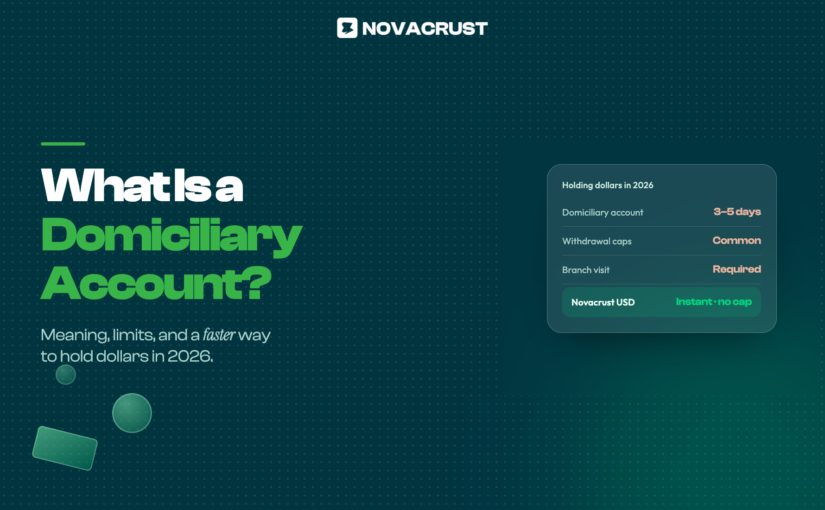
What Is a Domiciliary Account? Meaning, Limits, and a Faster Way to Hold Dollars in 2026

In 2026, the Central Bank of Nigeria rewrote the rules on domiciliary accounts, lifting the withdrawal caps that frustrated dollar savers for years. On paper, you can now withdraw up to $10,000 a day. In practice, cash from an inbound transfer is still capped at around $200, and anything above that has to move through your bank account instead of your hand.

If you have ever searched “what is a domiciliary account” or “domiciliary account meaning,” you are probably trying to figure out one thing: does this account actually solve your problem, or does it just move the paperwork somewhere else? Here is what a domiciliary account really does, where it still falls short, and a faster way to hold and receive dollars.

What is a domiciliary account?

A domiciliary account is a foreign-currency account opened at a Nigerian bank, GTBank, Zenith, Access, First Bank, and UBA all offer one, that lets you hold, save, and transact in US dollars, pounds, or euros instead of naira.

You open it in person, usually with a valid ID, proof of address, and a reference letter. Once it is active, you can receive foreign currency deposits, hold them without automatic conversion to naira, and withdraw or wire the funds out under the bank’s rules.

What a domiciliary account is actually good for

  • Holding savings in dollars. Your balance sits in USD, protected from naira devaluation, until you decide to convert.
  • Receiving occasional large transfers. Family remittances, inheritance, or a one-off payment from abroad land cleanly, in dollars, in an account you already trust.
  • Working inside a bank relationship you already have. No new provider to vet, no new app to learn.

Where a domiciliary account falls short in 2026

  1. It is a Nigerian bank account, not a US account. There is no US routing number attached to it, so Upwork, Fiverr, Deel, and most freelance platforms cannot pay you directly into it. You still need a separate way to receive USD platform payouts.
  2. Cash from an inbound transfer is capped near $200. Anything above that has to be paid into your account instead of handed to you as cash, so a “$10,000 daily withdrawal” headline does not mean $10,000 in your pocket the same day.
  3. Opening one takes a branch visit. ID, proof of address, and often a reference letter, so it is days, not minutes.
  4. Large cash movements can carry real fees. Processing charges on bulk cash transactions have been reported as high as 5% for corporates moving large sums.
  5. The exchange rate is whatever your bank quotes. You are not shopping it against anyone else’s rate.

Domiciliary account vs virtual USD account

 Domiciliary account (Nigerian bank)Virtual USD Account (Novacrust)
Opening timeBranch visit, daysMinutes, fully online
RequirementsID, proof of address, often a reference letterValid ID
Receiving platform payouts (Upwork, Fiverr, Deel)Not supported directlyYes, direct to your account
US account and routing numberNoYes, ACH, wire, and RTP support
Cash accessCapped near $200 per inbound transfer, rest via accountWithdraw to local bank or mobile money anytime
Exchange rateSet by your bankCompetitive, shown upfront
Best forLong-term dollar savings, occasional large transfersRegular international income

A domiciliary account and a virtual USD account are not competing for the same job. One is a savings vault for dollars you already have. The other is built to receive dollars regularly, from clients and platforms, the same week you start using it.

Get a USD account that actually takes freelance and platform payments

Opening a Novacrust USD account takes three steps:

  1. Sign up and verify your identity with a valid government ID. No branch visit, no reference letter.
  2. Get your US account and routing number, the same details any American would hand over to get paid.
  3. Start receiving dollar payments from clients, employers, or platforms like Upwork, Fiverr, Deel, and YouTube, then withdraw to your local bank or mobile money whenever you want.

Frequently asked questions

Is a domiciliary account the same as a USD account?

No. A domiciliary account is a foreign-currency account at a Nigerian bank. A virtual USD account like Novacrust’s gives you real US account and routing details, so it works for direct international payments, not just savings.

Can I receive Upwork or Fiverr payments into a domiciliary account?

No. Domiciliary accounts do not carry a US routing number, so most freelance platforms cannot pay into them directly. A virtual USD account can.

What is the daily withdrawal limit on a domiciliary account in 2026?

Up to $10,000 a day via transfer, under the CBN’s 2026 Foreign Exchange Manual. Cash from an inbound transfer is still capped at around $200, with the rest paid into your account.

Do I still need a domiciliary account in 2026?

If you are saving a lump sum in dollars long-term, it still works well. If you need to receive regular international income, a virtual USD account is faster and built for that job.

The bottom line

A domiciliary account is a real, legitimate way to hold dollars in Nigeria, and 2026’s rule changes made it easier to use. But it was built for savings, not for receiving international income on a regular basis. If you are getting paid from abroad every month, you need an account built for that.

Open your Novacrust USD account in minutes and get real US account details in your own name. No branch visit required.

How to Open a USD Account Online in Minutes (2026 Guide)

Somewhere right now, a freelancer is standing in a bank queue with a folder of documents, two references, and a passport photo, trying to open a dollar account. And somewhere else, another freelancer just opened a USD account online from her phone in under ten minutes, got US account details in her own name, and sent them to her client before lunch.

Same goal. Wildly different experience. The difference is knowing that in 2026, you no longer need a traditional bank, a US address, or a plane ticket to own a dollar account.

This guide covers how to open a USD account online from anywhere in Africa, the Middle East, or Europe, what you can do with it, what to check before choosing a provider, and how to start receiving dollar payments the same week.

What Is a Virtual USD Account?

A virtual USD account is a dollar account you open and manage entirely online. It comes with real US account details in your name, an account number, and a routing number, with support for ACH, wire, and RTP transfers. To anyone paying you, it works exactly like a US bank account. To you, it is an app on your phone.

That single feature unlocks a lot. Clients and employers can pay you the way they pay anyone in America. Freelance platforms can deposit your earnings directly. And your money sits in USD, protected from local currency swings, until you decide to convert.

Who Needs a Dollar Account?

If any of these sound like you, a USD account is not optional; it is infrastructure:

  1. Freelancers and remote workers. You earn from clients in the US, UK, or Europe and need a clean way to receive dollar payments without losing a chunk to middlemen. A USD account for freelancers means you invoice in dollars and keep dollars.
  2. Creators. YouTube, sponsorships, digital product sales. Platform payouts land far more easily in a US account than through legacy transfer chains.
  3. Savers. When your local currency is volatile, holding part of your income in a dollar account is the simplest hedge available. You convert what you need when the rate favors you.
  4. Small businesses and SMEs. Paying international suppliers and receiving from international customers both get easier when you operate a dollar balance.

How to Open a USD Account Online with Novacrust

Here is the entire process, and why it answers the classic search: how to open a dollar account without visiting a bank.

Step 1: Sign up and verify your identity

Sign up on Novacrust, create your account, and complete identity verification with a valid government ID or passport. No branch visit, no references, no minimum deposit. Verification typically takes minutes, not days, and works across most countries in Africa and the wider EMEA region. This is also the answer to another high-intent search: a USD account without a US address. You do not need one. The account is in your name, at your address, wherever you live.

Step 2: Get your US account details

Once verified, you get your account number and routing number with ACH, wire, and RTP support. These are the same details any American would hand over to get paid.

Step 3: Start receiving dollar payments

Share your details with clients and employers, or plug them into platforms like Upwork, Fiverr, Toptal, Andela, Deel, Gusto, Rippling, and YouTube. If you have ever searched for a USD account to receive Upwork payments, this is the setup: withdraw from the platform straight into your own dollar account.

Step 4: Hold, spend, convert, or send

Your dollars are yours to manage. Hold them as savings. Spend them with a virtual USD card on subscriptions, tools, and ads. Convert to your local currency at a competitive rate. Or send money to a local bank account or mobile money wallet, yours or anyone else’s.

What to Check Before Choosing a USD Account Provider

Not every dollar account is built the same. Compare providers on these five points:

  1. Real US account details with ACH and wire support. Some apps only give you an internal wallet. You want an account number and routing number that any US employer can pay, which also covers the search dollar account with ACH and wire support.
  2. Receiving fees. The best providers charge little or nothing to receive ACH payments. Wire fees vary, so check both.
  3. Conversion rates. The exchange rate is the hidden fee. Compare what actually lands in your local currency, not the advertised rate.
  4. Withdrawal options. Look for direct withdrawal to local banks and mobile money in your market, whether that is naira, cedis, shillings, rand, or dirhams.
  5. Everything in one app. A USD account gets far more useful when it lives beside a virtual card, crypto conversion, and local transfers, so your money moves without app hopping. That is the Novacrust ecosystem in one sentence.

Virtual USD Account vs Traditional Foreign Currency Account

 Traditional bank dollar accountVirtual USD account (Novacrust)
Opening timeDays to weeks, branch visitMinutes, fully online
RequirementsReferences, paperwork, and sometimes a minimum balanceValid ID
Receiving a US wire$60 to $100 in combined feesLow, transparent fees
ACH supportRareYes, standard
WithdrawalBranch processesLocal bank or mobile money from the app
Best forLarge occasional transfersRegular international income

For most remote workers in Africa and EMEA, the comparison ends quickly. The best USD account for remote workers in Africa is the one that opens in minutes, receives ACH for little or nothing, and cashes out locally on your schedule.

Smart Ways to Use Your Dollar Account

  1. Split your income the moment it lands. A common freelancer formula: convert what you need for the month, hold the rest in USD as savings, and keep a small buffer on your virtual card for subscriptions.
  2. Time your conversions. Rates move. Because your money sits in dollars by default, you convert on the days that favor you, not the day your payment happens to arrive.
  3. Keep your payment history clean. Regular international income into an account in your own name builds a paper trail that helps with visa applications, apartment hunting, and credit.

Frequently Asked Questions

Can I open a USD account online without a US address?

Yes. Novacrust gives you US account details in your own name using your local identity documents. No US address, residency, or SSN required.

How long does it take to open a dollar account online?

Minutes. Sign up, verify your ID, and receive your account details, typically the same day.

Is a virtual USD account safe?

Reputable providers use identity verification, encryption, and regulated banking partners. Your account details work like standard US banking rails via ACH and wire.

Can I withdraw from my USD account to mobile money?

Yes, in supported markets, you can convert and withdraw funds directly to local banks or mobile money wallets through the app.

Does a USD account work for platform payouts?

Yes. Upwork, Fiverr, Toptal, Deel, YouTube, and many more can pay directly into your US account details.

The Bottom Line

A dollar account used to be a privilege that required the right passport or the patience for bank bureaucracy. Now it is a ten-minute setup. If you earn internationally, save seriously, or run a business across borders, opening a USD account online is the single upgrade that makes everything else about your finances simpler.

Open your Novacrust USD account in minutes and get US account details in your own name. No US address required.

The Best Way to Send Money Internationally in 2026

Here is a number that should make you angry: families and workers sending money across borders lose an average of 6 percent of every transfer to fees and exchange rate markups. Send $500 home every month, and that is over $360 a year, gone. Not to the person you love. To the middlemen in between.

It gets worse. Some services advertise zero fees, then quietly take their cut through a padded exchange rate. Others charge honestly but take three business days while your recipient waits. The best way to send money internationally is not about one flashy feature. It is about what actually lands on the other side, and how fast.

This guide breaks down how to send money online, locally, and globally, what transfers really cost in 2026, and how to stop donating a slice of every payment to the payment industry, regardless of where you are.

The Two Numbers That Decide Every Money Transfer

Every international money transfer has exactly two costs, and providers hope you only look at one:

The transfer fee. The visible number. Easy to compare, easy to advertise, easy to set to zero.

The exchange rate margin. The invisible number. The gap between the real mid-market rate and the rate you are given. A “zero fee” transfer with a 4 percent rate markup costs more than a $3 fee at an honest rate.

The only comparison that matters: how much local currency arrives per dollar sent. Judge every money transfer app by that single figure.

Sending Money Globally: Your Options Compared

Banks and traditional wires. Reliable for large sums, painful for everything else. International wires stack sending fees, correspondent bank fees, and receiving fees, often $40 to $100 total, and take days.

Cash pickup services. Western Union and MoneyGram reach almost everywhere, including recipients without bank accounts. You pay for that reach with some of the highest combined costs in the industry.

Money transfer apps. Wise, Remitly, LemFi, WorldRemit, and others have pushed prices down dramatically, especially on popular corridors into Africa. Strong options, though most only solve sending, not the rest of your financial life.

All-in-one platforms like Novacrust. If you already receive international income, the smartest move is to send from the same place your money lives. With Novacrust, your USD account, currency conversion, and transfers sit in one app: receive dollars from clients or family abroad, convert at a competitive rate shown upfront, and send to local bank accounts or mobile money wallets across supported markets in Africa and EMEA. No app hopping, no double conversion, no mystery rates.

How to Send Money with Novacrust, Step by Step

If you have ever searched for how to send money from a USD account to a local bank, this is the flow:

Step 1: Fund your account

Your balance might come from a client payment into your USD account, a crypto conversion, or a top-up. It all lands in one place.

Step 2: Choose your recipient

Send to a local bank account or mobile money wallet. Sending locally to a bank in your own country works from the same screen as sending across a border.

Step 3: See the rate before you commit

The exchange rate and what your recipient gets are shown upfront. If the numbers work, you send. If not, you wait for a better day. That transparency alone beats half the industry.

Step 4: Money arrives fast

Transfers to supported banks and mobile money wallets typically arrive within minutes to hours, not days. For anyone searching for the fastest way to send money internationally, speed plus an honest rate is the full answer.

Sending Money to Africa: What Actually Works

Remittances to Africa remain among the most expensive corridors in the world, which makes choosing well worth real money. What to know per use case:

Supporting family. For anyone searching to send money to family in Africa, prioritize mobile money delivery. In Kenya, Ghana, Tanzania, and much of East and West Africa, M-Pesa and MTN Mobile Money reach recipients who never visit a bank. A platform that sends directly to wallets saves your family the trip and the wait.

Paying suppliers or staff. Consistency beats everything. You want a platform where the rate is visible before every transfer and delivery times are predictable, so payroll never becomes an apology.

Cheapest way to send money to Nigeria, Kenya, or Ghana. The honest answer is always the same formula: compare the received amount, not the fee. On most corridors, app-based transfers from a held USD balance outperform cash services and banks by several percentage points.

Sending Money Locally

Global gets the headlines, but local transfers are the daily reality: rent, a vendor, your cousin’s school fees. The advantage of an all-in-one platform is that local sending uses the same balance as everything else. Convert exactly what you need from your USD balance and send it to any local bank account in minutes. Your dollars stay dollars until the moment they need to be anything else.

Six Rules for Never Overpaying on Transfers Again

  1. Compare received amounts, not fees. One number tells the truth.
  2. Beware “zero fee” marketing. The rate is where zero-fee services get paid.
  3. Hold your money in USD until you send. Converting on your schedule, not the provider’s, protects you from bad rate days.
  4. Use mobile money for the last mile in Africa. It is usually faster and reaches more people than bank deposits.
  5. Send larger amounts less often when costs are partly flat, since fixed fees hurt small transfers most.
  6. Keep receipts in one app. Scattered transfers across three services mean no clean record of what you sent and at what rate.

Frequently Asked Questions

What is the best way to send money internationally in 2026? Use a platform that shows the exchange rate upfront and delivers to local banks or mobile money quickly. Compare what the recipient receives, not the advertised fee.

What is the cheapest way to send money to Nigeria? Sending from a held USD balance through an app with transparent rates typically beats banks and cash services. Always compare the naira amount that arrives.

Can I send money directly to mobile money wallets? Yes. Novacrust supports sending to mobile money wallets in supported African markets, alongside bank transfers.

How fast do international transfers arrive? App-based transfers to supported banks and wallets usually arrive within minutes to hours. Traditional wires can take several days.

Can I send money locally and internationally from one app? Yes. With Novacrust, local and global transfers come from the same balance, next to your USD account, virtual cards, and crypto conversion.

The Bottom Line

Every transfer is a small negotiation, and the industry wins whenever you compare the wrong number. Look only at what arrives, keep your money in dollars until sending day, and use one platform for local and global so your finances live in one place.

CTA: Send money locally and globally with Novacrust. See the rate before you send, every time.

Money Management for Remote Workers and Digital Nomads: The Complete 2026 Guide

You sent the invoice three weeks ago. The client confirmed payment days ago. And yet your money is still floating somewhere between a foreign bank, an intermediary you have never heard of, and an exchange rate that quietly shaved off a chunk you will never get back. If you earn a living online and get paid from abroad, you know this feeling. The work is the easy part. Getting paid, keeping the value of what you earned, and spending it is where the real friction lives.

Money management for remote workers is not about budgeting apps or colour-coded spreadsheets. It is about something more basic: getting your money in quickly, holding it in the currency you earned, spending it anywhere, and moving it home at a fair rate, without losing time or money at every step. This guide covers how to get paid as a remote worker in 2026, how to keep more of what you earn, and how to choose a platform that handles the whole journey instead of forcing you to stitch five tools together.

Why money management for remote workers is harder than it looks

When you work for a local employer, money is simple. The salary lands in your local bank, in your local currency, and you spend it locally. Remote work breaks that loop.

Now your international clients might be in New York, your bank in Lagos or Cairo or London, your subscriptions billed in dollars, and your rent due in a currency none of those clients use. Every handoff between currencies and countries is a chance to lose money to fees, time to slow transfers, or value to a poor rate. Multiply that by every invoice, and the leak becomes a flood. The people who keep the most of what they earn are not the ones who hustle the hardest. They are the ones who fixed their setup once and stopped bleeding value on autopilot.

The four jobs your money setup needs to do

A strong setup does exactly four things: receive, hold, spend, and send money from one platform, instead of logging into a different service for each.

1. Receive international payments without the wait

Many remote workers still rely on slow transfers that pass through several banks, take five to seven working days, and arrive lighter because each bank took a cut. If you have ever searched for how to get paid as a freelancer with overseas clients, this is the problem you were trying to solve.

What you want is a multi-currency account for freelancers, a foreign currency account in your own name, that lets you receive dollars, pounds, or euros through familiar rails like ACH and wire transfer, so your international clients can pay you the way they pay anyone else. When a client can pay you with no extra effort, you get paid faster and look more professional doing it.

2. Hold your money in the currency you earned

Here is a costly mistake. You earn in dollars, the money lands, and it gets force converted into your local currency on arrival. Next week, you need dollars again for software or ads, so you convert back, losing a slice each way.

A proper setup lets you hold foreign currency as foreign currency. If your next expense is in dollars, the money should never detour through your local currency and back. Holding multiple currencies in one place means you convert only when you choose, at a moment you choose.

3. Spend globally without your card getting declined

You found the perfect setup, the money is in, and then your card is declined for a tool you need for work. Anyone paying for international subscriptions from outside the US or Europe has lived this. Local cards get rejected by global merchants constantly, and the ones that work often carry painful limits.

This is where a virtual dollar card changes your day-to-day life. A good one pays for the services you actually use, from streaming to design tools to advertising platforms, and lets you fund it from local currency, your dollar balance, or crypto you convert on the spot. No foreign bank account required, with limits high enough that you are not topping up every hour.

4. Convert and send money home at a fair rate

Eventually, you need some of that income in your local currency, for rent, for family, for life. Many platforms advertise zero fees and then bake their profit into a rate that sits well below the real market rate. You feel good about the no-fee headline while losing more than a fee ever would have cost you.

What you want is a transparent rate close to the real mid-market rate, so you see exactly what you get before you confirm. A fair rate on every conversion, across a year of income, is the difference between keeping your money and donating it to a spread you never agreed to.

Digital nomad banking: what changes when you move

If you are moving between countries, the stakes climb. Digital nomad banking has its own quirks. Your home bank may freeze a card it sees used in three countries in a month. Opening a local account in each new country is slow and often impossible on a tourist or nomad visa, which is why a traditional bank account for digital nomads is so hard to keep.

The countries courting nomads, the UAE chief among them, with its digital nomad visa, have pulled in a wave of location-independent earners and expats facing one question: how do I manage money without permanent residency anywhere? The answer is a digital nomad bank account that travels with you, holds multiple currencies, issues a card that works across borders, and does not panic when your spending map looks like a flight route. Sorting out your digital nomad visa finances before you land somewhere new saves you the scramble of fixing it once you are already abroad.

The mistakes that quietly cost remote workers the most

Four patterns show up again and again, and each is avoidable. The first is juggling too many tools, where every handoff costs a fee and a delay. The second is ignoring the exchange rate because the platform said “no fees,” when the rate is the fee. The third is force converting the income you will need again into the same currency. The fourth is staying with a slow, traditional channel out of habit. Changing is a one-time cost. The savings repeat every month for as long as you work.

How to choose the best fintech platform for remote workers

Judge each option against the four jobs. Run through this list:

  • Can you receive USD, GBP, and EUR into a foreign currency account in your own name, using ACH and wire transfer?
  • Can you hold more than one currency and convert only when you choose?
  • Does it issue a virtual dollar card that works with global merchants, with real limits?
  • Is the exchange rate transparent and close to the real market rate?
  • Does it cover the countries and corridors you actually live and work in, not just one market?

The best fintech platform for remote workers answers yes to all five, because that is the one that lets you stop managing money and get back to your work.

Bringing it together: one platform instead of five

This is the gap Novacrust was built to close. Instead of one tool to receive, another to hold, a third to spend, and a fourth to send, it brings the whole journey into a single platform. You can receive international payments through a USD account in your name with ACH and wire support, hold and manage multiple currencies, spend worldwide on a virtual dollar card you fund from local currency, dollars, or crypto you convert in app, and send money home at a transparent rate. For creators, freelancers, and remote workers tired of watching income leak across half a dozen services, that consolidation is the entire point.

Frequently asked questions

What is the best way to manage money as a remote worker?

Build your setup around four jobs: receiving payments, holding your money in the currency you earned, spending globally, and converting or sending money home at a fair rate. The fewer tools involved, the less you lose to fees and delays.

How do remote workers get paid by international clients?

The most reliable approach is a multi-currency account in your own name that supports ACH and wire transfers, so clients can pay you using rails they already know. This is faster than slow transfers that pass through several banks.

What is the best app to receive money from abroad?

Look past the label and judge on substance. The best option lets you receive money from abroad into an account in your own name, hold it in the currency you earned, spend it on a global card, and convert it at a transparent rate, all in one place. A platform that does the full journey beats a single-feature tool every time.

Do I need a foreign bank account to manage money as a digital nomad?

No. Modern platforms give you a digital nomad bank account that holds multiple currencies, receives international payments, and spends on a virtual card without opening a local bank account in each country.

How can I avoid losing money on currency conversion?

Hold foreign currency as foreign currency and convert only when you choose. Always compare the platform’s rate to the real market rate, because a “no fees” claim often hides its cost inside a poor exchange rate.