How to Buy USDT Safely in 2026: A Complete Guide for Emerging Markets

Search “buy USDT in Malawi” or “how to buy USDT in Maldives” and most of the first page isn’t a licensed exchange. It’s Telegram groups, Facebook posts, and P2P forums where you send money to a stranger first and hope the USDT shows up after. That gap between demand and safe supply is exactly why so many people in Cameroon, Zambia, Nepal, Botswana, and dozens of other markets still buy USDT the hard way.

USDT (Tether) is the most widely used stablecoin in the world, pegged 1:1 to the US dollar. That peg is the whole appeal: your money holds its value in dollars without you needing a US bank account. But “widely used” doesn’t mean “widely available through safe channels” everywhere. This guide covers how USDT actually gets bought and sold, where the real risk sits, and how to buy it in minutes instead of hours.

Why buying USDT is harder than it should be

In markets with limited USD liquidity, mainstream banks, weak local exchange infrastructure, or currency controls, three things usually happen:

  • Local exchanges either don’t exist or don’t support your country
  • Peer-to-peer (P2P) trading fills the gap, which means you’re trusting a stranger, not a platform
  • Rates vary wildly between sellers, and the “cheap” price sometimes hides a scam

None of that is a reason to avoid USDT. It’s a reason to be specific about how you buy it.

How the common USDT scams actually work

Most P2P USDT scams follow the same pattern: a seller offers a rate slightly better than everyone else’s, asks for payment via bank transfer or mobile money first, and then either sends less USDT than agreed, sends it to the wrong network, or disappears entirely. Group admins in Telegram or Facebook communities rarely offer any real recourse once that happens; you’re left with a screenshot and no way to reverse the transfer. This is the exact gap a licensed platform closes: your payment and the USDT release happen inside one system, not across two separate, unconnected steps.

Novacrust vs. P2P groups and other exchanges

Binance P2P, Busha, and Breet.io all let you buy USDT, and each works differently. Binance P2P connects you with individual traders directly, so you’re still trusting a stranger, just inside an app instead of a Telegram group. Busha and Breet.io operate as licensed exchanges in select markets, which is safer than open P2P, but neither pairs USDT buying with a USD Account or virtual card the way Novacrust does. If you want to buy USDT and also hold, spend, or convert dollars from the same wallet, that combination is where Novacrust differs most.

Six rules for buying USDT safely

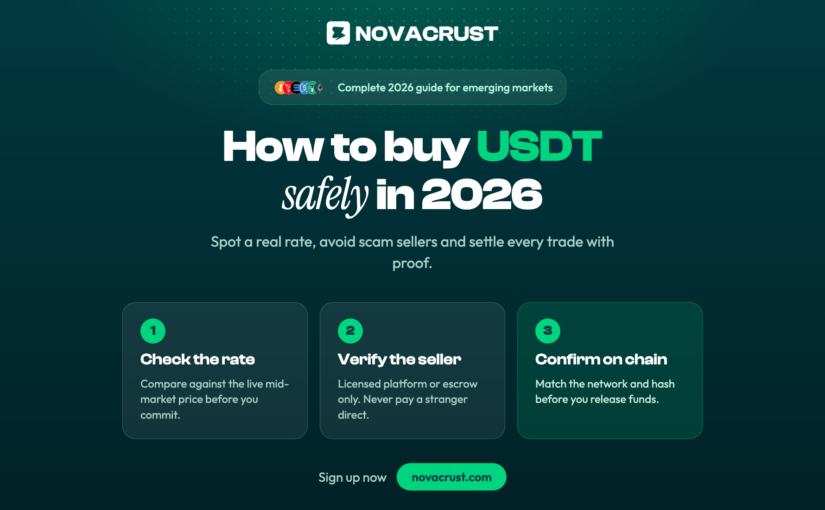
  1. Use a platform that holds your funds in escrow, not a stranger’s word. If a seller asks you to pay first and “trust the process,” that’s not a platform, that’s a bet.
  2. Check the live rate before you commit. Rates can move within minutes. A platform that locks your rate for a short window protects you from last-second changes.
  3. Confirm the network before you send anything. USDT exists on multiple networks (TRC20, ERC20, and others). Sending to the wrong network address can mean losing your funds permanently.
  4. Avoid sellers who won’t verify their identity. Anonymity on your side is fine. Anonymity on the seller’s side, with no recourse if something goes wrong, isn’t.
  5. Start small the first time. Test any new platform or seller with a small amount before moving your full balance.
  6. Keep your funding trail traceable. Bank transfer or mobile money, not cash handoffs, so you have a record if a dispute comes up.

How to buy USDT on Novacrust

Novacrust lets you buy USDT (along with USDC, BTC, ETH, SOL, and more) directly, with the rate and network shown upfront before you confirm.

  1. Create your account. Sign up in a couple of minutes. No US address or SSN required.
  2. Fund your wallet. Pay via bank transfer, mobile money, or an existing crypto wallet.
  3. Buy USDT at the live rate. The rate you see is the rate you get, with no last-minute markup.
  4. Confirm the network. Novacrust shows you the correct network before you send, so your funds land in the right place the first time.
  5. Hold, spend, or convert. Keep it as USDT, convert to your local currency, or move it into your USD Account.

The whole flow runs on one platform, so there’s no handing money to a stranger and waiting to see what shows up.

Buying USDT in Malawi, Maldives, Cameroon, Zambia, Botswana, and Nepal

Country-specific USDT demand is real, and the friction looks similar everywhere: thin local exchange support, P2P groups filling the gap, and rates that shift depending on who you ask.

  • Malawi and Zambia: Local exchanges are limited, so most buyers rely on P2P sellers found through Telegram or Facebook, often paying via mobile money. A licensed platform removes the guesswork around whether the seller will actually deliver.
  • Maldives: Tourism-driven cash flow means many residents and workers want a stable way to hold dollars without going through a traditional bank. USDT fills that role, but only if the buying process is verified.
  • Cameroon: Mobile money is the dominant payment rail, and USDT buyers here need a platform that accepts it directly rather than routing through a third-party wallet first.
  • Botswana and Nepal: Both have smaller but growing USDT demand, usually from freelancers and remote workers who want to hold part of their income in dollars.

The country changes. The core problem doesn’t: buy from a platform that shows its rate and holds funds securely, not from a stranger’s word.

What buying USDT should actually cost

A fair USDT purchase has two costs: the network fee (small, fixed by the blockchain, not the seller) and the platform’s spread (the difference between the live market rate and what you’re quoted). Watch for sellers who bundle in a third, invisible cost: a marked-up rate disguised as a “discount.” If a rate looks meaningfully better than everyone else’s, ask why before you ask how.

USDT vs. other ways to hold dollars

If your goal is simply holding value in USD, USDT isn’t your only option. A Novacrust USD Account gives you a real US account number in your name, no crypto step required. Some people use both: USDT for speed and portability, a USD Account for a bank-like balance they can receive ACH and wire transfers into. Compare what you actually need before picking one.

FAQ

Is it legal to buy USDT in Malawi, Cameroon, Zambia, Botswana, Nepal, or the Maldives?
Rules vary by country and change over time, so check your local regulations. In most of these markets, buying and holding USDT through a licensed platform is legal; the risk is usually with unregulated P2P sellers, not the asset itself.

How long does it take to buy USDT?
On Novacrust, a purchase completes in minutes once your wallet is funded. P2P trades can take much longer, since you’re waiting on another person to respond and confirm.

Can I buy USDT with mobile money?
Yes, on Novacrust you can fund your wallet with mobile money in supported countries and buy USDT directly from that balance.

Is USDT the same as a US dollar?
No. USDT is a stablecoin designed to track the US dollar’s value 1:1, but it’s a crypto asset, not a bank deposit. It moves like crypto and settles fast, which is the main reason people use it instead of, or alongside, traditional banking.

What’s the minimum amount of USDT I can buy?
This depends on the platform. Novacrust supports small first purchases, so you can test the process before committing a larger amount.

Buy USDT without the guesswork

You shouldn’t have to trust a stranger’s screenshot to hold dollars. Buy USDT on Novacrust with a live rate, a verified network, and funds that move in minutes, not hours.

Get Started. It’s Free.
Best Virtual USD Card for Remote Workers and Freelancers in 2026

Most banks charge up to 3% in foreign transaction fees on every swipe you make outside your home country, then flag the same charge as suspicious and block it anyway. If you get paid from abroad and spend on tools billed in dollars, that combination, the fee and the decline, is the real cost of remote work that nobody puts in a job posting. A virtual USD card fixes both problems at once: it is issued in dollars, so foreign merchants stop seeing it as foreign, and it is built for the spending pattern remote workers actually have.

This guide breaks down what a good virtual USD card needs to do, compares the platforms remote workers and freelancers actually use in 2026, and shows where each one falls short for this specific job.

Why remote workers need a different kind of card

A local debit card is built for local spending. It expects you to buy groceries, pay rent, and swipe at a restaurant, all in your home currency, all inside your home country. The moment you subscribe to a US-billed tool, pay for ads on a platform that only charges in dollars, or book a flight from a country your bank has never seen you in, that card starts working against you.

Remote workers and freelancers need a card that assumes the opposite pattern: income in one currency, spending across a dozen merchants billing in a currency you may not hold locally, from a location that changes more than a typical customer’s. A virtual USD card, funded directly from what you earn, removes the conversion step, the decline risk, and the fee that a local card adds to every international charge.

What a bad card setup actually costs you

Run the math on a single month. A $50 ad platform charge, a $20 design tool subscription, and a $15 app store bill add up to $85, and a foreign transaction fee on top of a marked-up conversion rate can quietly take another $6 to $8 before you even count the decline that forces you to retry the payment on a different card, or the day it takes support to unblock your account. Multiply that across a year of subscriptions and client tools, and the “convenience” of using whatever card you already have becomes one of the most expensive habits in a remote worker’s budget. It’s a smaller version of the same mistake covered in our guide to money management for remote workers and digital nomads: the fee you don’t see costs more than the one you do.

What to look for in a virtual USD card

Not every “dollar card” does the same job. Before picking one, check it against five rules.

  • Instant issuance. You should get card details in minutes, not after a physical card ships across a border.
  • Funding flexibility. A card that only accepts a wire transfer isn’t built for freelancers. Look for one you can fund from a local bank transfer, a USD balance, or crypto you convert on the spot.
  • Global merchant acceptance. The card needs to work with the specific tools you use: ad platforms, SaaS subscriptions, app stores, and marketplaces that only bill in dollars.
  • Transparent fees. A card with no monthly fee but a poor exchange rate on funding still costs you money. Compare the full cost, not just the sticker price.
  • No US address or SSN required. If you’re outside the US, the card should not assume you have either.

Comparing virtual USD card options for remote workers in 2026

Here’s how the platforms freelancers and remote workers actually compare on those five rules.

Wise gives you a multi-currency debit card tied to balances you hold in its app, and its mid-market exchange rate is genuinely competitive. The catch for many remote workers outside the US, UK, and EU: opening a Wise account often still asks for proof of address in a supported country, and the card leans on physical delivery for full functionality rather than instant virtual issuance.

Payoneer is built around receiving payments from marketplaces and platforms like Upwork or Amazon, and it issues a card against that balance. It’s a reasonable fit if your income already flows through Payoneer’s partner platforms, but it’s less useful if your clients pay by direct invoice or bank transfer, and withdrawal and card-loading fees can chip away at a freelancer’s margin.

Revolut issues virtual cards quickly and supports multiple currencies, but full features and higher limits sit behind a paid plan, and account opening is still restricted to a specific list of countries. If you’re not in one of them, Revolut isn’t an option no matter how good the card looks on paper.

Grey built its name specifically around freelancers and remote workers in Africa needing a USD account and card without a US address, and its dollar card is a genuine option in that market. It’s a strong comparison point for anyone weighing Novacrust against Africa-focused fintechs specifically.

Where Novacrust’s Virtual USD Card fits

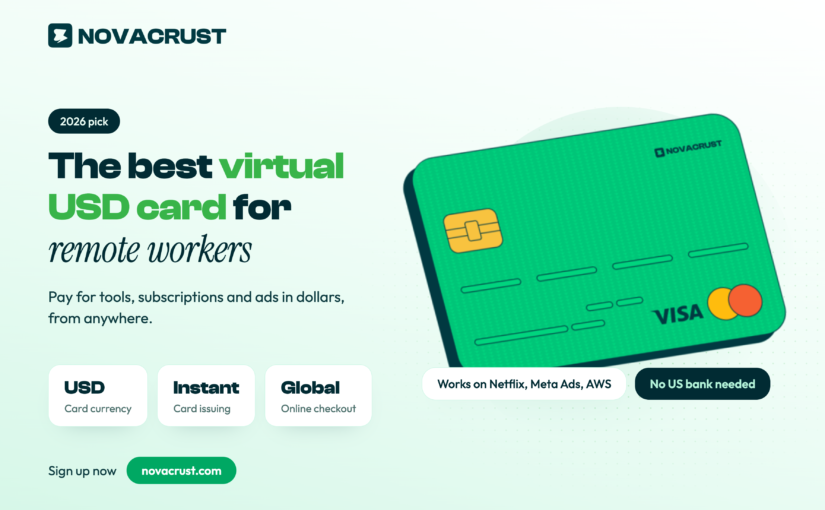
Novacrust issues a Virtual USD Card instantly, no US address or SSN required, and funds it from your local currency, your USD Account balance, or crypto you convert in the same app. That last part matters if you get paid in USDT or USDC directly from international clients or platforms: you don’t need a separate wallet, a separate exchange, and a separate card provider. It’s one balance you can receive into, hold, spend from, and send home, without stitching four services together to do the job one should.

Your Novacrust card works with the tools remote work actually requires: ad platforms, SaaS subscriptions, app store billing, and marketplaces that only charge in dollars, at a transparent rate you can check before you fund it. If you’re weighing a card on its own against a full USD Account for freelancers, the short version is that you don’t have to choose. Both come from the same balance.

Frequently asked questions

What is the best virtual USD card for remote workers in 2026?

The best option depends on where you’re based and how you get paid. If you need instant issuance, no US address requirement, and the ability to fund from local currency or crypto, Novacrust’s Virtual USD Card is built for exactly that setup.

Can I get a USD virtual card without a US address or SSN?

Yes. Novacrust issues a Virtual USD Card to freelancers and remote workers outside the US without requiring a US address or Social Security Number.

Why does my local debit card get declined for international subscriptions?

Banks often flag charges from foreign merchants as suspicious, especially recurring ones billed in a currency you don’t hold locally. A card issued directly in USD avoids that flag because the merchant no longer sees it as a foreign transaction.

How fast can I get a virtual USD card as a freelancer?

With Novacrust, your Virtual USD Card is issued instantly in the app. No physical shipping, no waiting period before you can start spending.

Can I fund a virtual USD card with crypto?

Yes, with Novacrust. Convert USDT, USDC, or other crypto you’re paid in directly to your card balance in the same app, without routing through a separate exchange first.

Is a virtual USD card better than Wise or Payoneer for freelancers?

It depends on how you get paid and where you’re based. Wise suits freelancers already inside its supported countries who want a mid-market rate. Payoneer suits freelancers paid through its partner marketplaces. If you want instant issuance with no US address requirement and the option to fund from crypto or local currency, Novacrust is built for that specific case.

Get a Virtual USD Card built for how remote workers actually get paid. Get Started. It’s Free.

How to Receive Gumroad Payouts Outside the US (Without Losing Money to Fees)

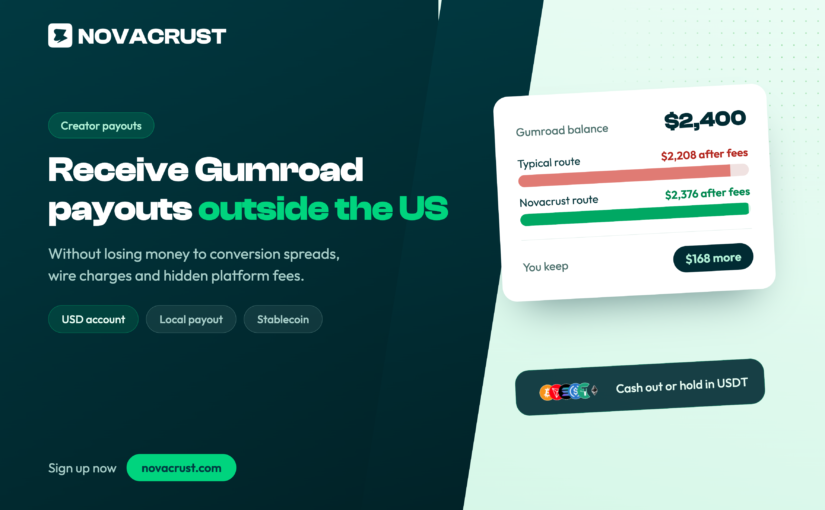
Gumroad does not let you add a payout method if your country is not on its supported list, and that list leaves out most of Africa, plus large parts of Asia and Latin America. Creators in Nigeria, Kenya, Ghana, Pakistan, and dozens of other countries hit the same wall: sales pile up in their Gumroad balance with nowhere to send them.

The usual workaround, routing payouts through a US-based friend’s PayPal or a forwarding service, costs 3 to 8 percent in fees and conversion spread on every payout. On a $500 month, that is $15 to $40 gone before the money even reaches you.

Why Gumroad payouts fail for so many creators

Per Gumroad’s own payout documentation, Gumroad pays out two ways: PayPal, or direct deposit to a US bank account. PayPal is only available in a limited set of countries, and even where it works, PayPal’s own conversion rates run 3 to 4 percent above the mid-market rate. Direct deposit needs a real US bank account with a routing and account number, which is exactly what most creators outside the US do not have.

That second option, direct deposit, is actually the cheaper and faster path. You just need the US account to plug into it.

The fix: a USD Account with a real routing number

A Novacrust USD Account gives you a US account number and routing number you can add directly to Gumroad’s payout settings, the same way a creator living in Ohio would. Gumroad pays out via ACH straight into your account. No PayPal, no forwarding service, no friend holding your money. If you want the mechanics of how ACH payouts actually work, see ACH vs Wire vs SWIFT.

Here is the setup:

  1. Create a Novacrust account and open a USD Account. It takes minutes and needs no US address or Social Security number.
  2. Copy your account and routing number from your Novacrust dashboard.
  3. In Gumroad, go to Settings, then Payments, and add your Novacrust USD Account as a bank payout method.
  4. Set your payout schedule. Gumroad sends funds via ACH, which typically lands in 1 to 3 business days.

Once your dollars land, spend them with a Novacrust USD Virtual Card, convert to naira, cedis, shillings, or another local currency at competitive rates, or send to 50+ countries. You keep the payout in dollars for as long as you want and move it only when you are ready.

It is not just Gumroad

The same routing and account number works for any platform that pays out via US direct deposit or ACH: Upwork, Fiverr, Patreon, Payhip, Podia, and most US-based marketplaces and ad networks. Set it up once on your Novacrust USD Account, and you can add it as a payout method everywhere you get paid. This is the same setup covered in our guide to the US banking system for non-residents, if you want the fuller picture of how a US account number works without a US address.

This is the difference between chasing a payout workaround for every platform and having one dollar account that plugs into all of them.

What this actually saves you

A creator earning $800 a month through Gumroad, routing payouts through PayPal or a forwarding service at a 5 percent blended cost, loses about $40 a month, or $480 a year. Routing the same $800 through a USD Account cuts that to Novacrust’s standard conversion rate, only charged when you actually convert to local currency, and only on the portion you convert.

FAQ

Can I add a Novacrust USD Account to Gumroad if I do not live in the US?
Yes. The USD Account comes with a real US account and routing number that works in Gumroad’s bank payout settings regardless of where you live.

How long does a Gumroad payout take once I switch to direct deposit?
Gumroad sends ACH payouts on your chosen schedule, and funds typically arrive in your Novacrust USD Account within 1 to 3 business days.

Do I need a US address or Social Security number to open a USD Account?
No. Novacrust’s USD Account is built for freelancers and creators outside the US and does not require either.

Can I use the same USD Account for Upwork, Fiverr, or Patreon payouts?
Yes. Any platform that supports US bank direct deposit or ACH can pay out to the same Novacrust USD Account.

What can I do with the dollars once they land?
Hold them in USD, spend them with a Novacrust USD Virtual Card, convert to your local currency at competitive rates, or send to 50+ countries.

Stop losing 5 percent of every Gumroad payout to a workaround. Get Started. It’s Free. Open your Novacrust USD Account in minutes and add it as your payout method today.

How to Send Money to Ethiopia From Abroad (2026 Guide)

The World Bank’s Remittance Prices Worldwide data puts the average cost of sending money to Sub-Saharan Africa at over 7 percent of the transfer, among the highest remittance fees anywhere in the world. Send $500 to Ethiopia through the wrong channel and $35 or more never reaches your recipient. It disappears into a wire fee, a bad exchange rate, or both.

Ethiopia adds its own wrinkle: birr access is tightly controlled, and not every international transfer service pays out directly to a bank account or Telebirr wallet inside the country. This guide covers what actually determines the cost of sending money to Ethiopia, which payout method gets your recipient paid fastest, and how the process works on Novacrust.

Why Sending Money to Ethiopia Costs More Than It Should

Three things drive up the cost of a transfer to Ethiopia specifically: a marked-up exchange rate instead of the real one, a payout network that routes through a correspondent bank before it reaches Ethiopia, and a fee structure that hides part of its cut inside the rate instead of the receipt.

Traditional bank wires are usually the worst offender. A wire from a US or UK bank to Ethiopia can take 3 to 5 business days and cost $25 to $45 in fees before the exchange rate markup is even factored in. Western Union and similar cash-pickup services move faster, but the rate they quote is rarely the mid-market rate, and that gap is where a chunk of your money goes. For a broader look at how transfer costs stack up across methods, see our guide to the best way to send money internationally.

Five Rules for Sending Money to Ethiopia Without Losing Value

  1. Check the live exchange rate before you send. A transfer that looks cheap on fees alone can still cost more than a competitor with a better birr rate. Compare the total amount your recipient gets, not the fee line item.
  2. Confirm the payout method before you commit. Bank deposit to Commercial Bank of Ethiopia, Awash, or Dashen works for most recipients. Telebirr mobile money is faster for recipients without a bank account nearby.
  3. Avoid services that route through multiple correspondent banks. Every extra bank in the chain adds a day and a fee. A platform that pays out directly moves faster and costs less. This is the same routing problem we cover in ACH vs Wire vs SWIFT.
  4. Send in local currency terms your recipient understands. Confirm the birr amount landing on their end, not just the dollar or pound amount you’re sending.
  5. Keep the confirmation. A transfer reference number and payout confirmation are the only things that help if a transfer is delayed on the Ethiopian side.

How to Send Money to Ethiopia on Novacrust in 4 Steps

Step 1: Sign in and select your destination

Sign in to your novacrust.com account, tap Send Money, and choose Ethiopia from the list of 50+ supported countries.

Step 2: Choose bank deposit or Telebirr

Enter your recipient’s bank details or Telebirr mobile number. Both payout options are supported.

Step 3: Confirm the rate and amount

Novacrust shows you the exact birr amount your recipient gets, at the live rate, before you confirm anything.

Step 4: Send

Once you confirm, the transfer is on its way. Most transfers to Ethiopia land within minutes, not days.

Novacrust vs Other Ways to Send Money to Ethiopia

Bank wire Western Union Novacrust
Speed 3-5 business days Minutes to hours for cash pickup Minutes, straight to bank or Telebirr
Rate visibility Often unclear until it lands Marked-up rate, shown late Live rate shown before you send
Fees $25-$45 plus markup Flat fee plus rate markup Transparent fee, shown upfront
Payout options Bank only Mostly cash pickup Bank deposit or Telebirr

Lemfi is a reasonable option for sending to Ethiopia too, with its own dedicated transfer corridor. What changes the decision is what else you can do with your money afterward. On Novacrust, the same account handles crypto, a USD Account, Gift Cards, and a virtual dollar card, not just this one transfer corridor.

Frequently Asked Questions

How long does it take to send money to Ethiopia?
On Novacrust, most transfers land within minutes. A traditional bank wire can take 3 to 5 business days.

Can I send money to a Telebirr wallet directly?
Yes. Novacrust supports payout directly to Telebirr, alongside bank deposit to major Ethiopian banks.

What’s the cheapest way to send money to Ethiopia?
The cheapest option is the one where the total birr amount landing with your recipient is highest, after fees and exchange rate. Always compare that number directly, not just the advertised fee.

Do I need a Telebirr account or Ethiopian bank account to receive money?
Your recipient needs either a Telebirr wallet or an account at a supported Ethiopian bank. Novacrust pays out to both.

The Bottom Line

Sending money to Ethiopia doesn’t have to cost 7 percent of every transfer or take a week to land. A platform that shows you the real rate upfront and pays out directly to a bank account or Telebirr wallet gets your money there faster, for less.

Send money to Ethiopia on Novacrust. Get Started. It’s Free.

USDT: TRC20 vs ERC20, Which Network Should You Use?

Send $500 in USDT on the wrong network and you could pay $20 to $40 in gas fees. Send the same $500 on the right one and it costs less than $1. Same coin, same amount, completely different bill, and the only thing that changed is the network you picked.

If you buy, sell, or hold USDT, this choice comes up every time you deposit or withdraw. Here’s what TRC20 and ERC20 actually mean, how they differ, and how to pick the right one so your money moves fast and cheap.

What TRC20 and ERC20 actually are

USDT isn’t one single token. It’s issued on several different blockchains, and each version needs its own type of wallet address. The two you’ll see most often:

  • TRC20: USDT running on the Tron network.
  • ERC20: USDT running on the Ethereum network.

Same USDT, same $1 peg, same issuer. The network is just the road the transaction travels on, and each road has its own toll and speed limit.

The real differences

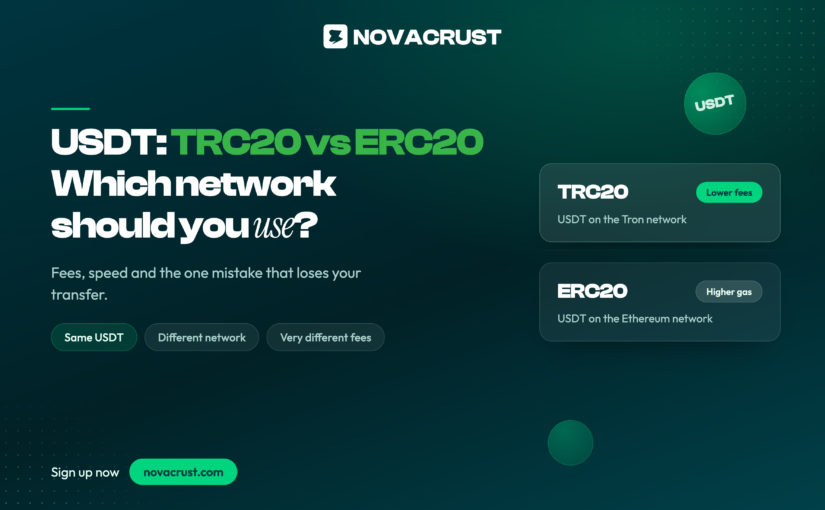
Fees. TRC20 transfers typically cost a few cents. ERC20 transfers run on Ethereum gas fees, which move with network demand and can easily hit $5 to $30, sometimes more when the network is busy. If you’re sending smaller amounts, TRC20 fees won’t eat into your balance the way ERC20 fees can.

Speed. TRC20 transactions usually confirm in seconds to a couple of minutes. ERC20 transactions can take a few minutes as well, but confirmation times stretch out when Ethereum traffic is high.

Wallet and exchange support. ERC20 is the older, more established standard and nearly every wallet and exchange supports it. TRC20 support has caught up fast because of its lower fees, but it’s worth a quick check if you’re using a smaller or newer wallet.

Network security model. Ethereum has a longer track record and a larger validator base. Tron is faster and cheaper but younger and more centralized in how it’s run. For everyday sending and receiving, both are reliable. The fee gap is the difference that actually affects your wallet.

When to use which

Use TRC20 when:

  • You’re sending or receiving everyday amounts and want to keep fees low.
  • You’re moving USDT frequently, since fees add up fast on ERC20.
  • Your wallet or exchange supports both and doesn’t charge extra for the choice.

Use ERC20 when:

  • Your recipient’s wallet only accepts ERC20 addresses.
  • You’re interacting with an Ethereum-based DeFi app or service that requires it.
  • You’re moving a large enough amount that a $10 to $30 fee is a rounding error.

If you’re not sure which one to pick and both are available, TRC20 is the cheaper default for most people sending or receiving everyday amounts.

The one mistake that actually costs you money

TRC20 and ERC20 addresses look similar, but they are not interchangeable. Send TRC20 USDT to an ERC20-only address (or the reverse) and the funds can be lost for good. There’s no support line that reverses a transaction sent to the wrong network.

Before you send:

  1. Confirm which network the receiving wallet or exchange expects.
  2. Match the network when you withdraw or deposit. Don’t assume it defaults to the one you used last time.
  3. When in doubt, send a small test amount first if the platform allows it.

How Novacrust handles this

Novacrust supports USDT and USDC funding and payouts, along with BTC, ETH, SOL, and more, so you can choose the network that makes sense for the amount you’re sending. Fund your Novacrust wallet with crypto, convert it, and spend, hold, or send to 50+ countries in seconds. No guesswork about which chain to use once your funds land.

Read more: Introducing USDC and USDT Funding and Payout on Novacrust and Bitcoin, Solana, Tron, Ethereum, and More Are Now on Novacrust.

FAQ

Is TRC20 always cheaper than ERC20?
Almost always. Tron’s fee structure is built for low-cost transfers, while Ethereum gas fees fluctuate with network demand and can spike well above Tron’s.

Can I convert USDT from ERC20 to TRC20?
Not directly between wallets. You typically need to send it through an exchange or platform that supports both networks and can convert or bridge it for you.

What happens if I send to the wrong network?
In most cases, the funds are unrecoverable. Some exchanges offer manual recovery for a fee, but it’s not guaranteed and can take weeks. Always double-check the network before you send.

Does it matter which network I use if I’m just holding USDT?
Not for holding, only for moving it. Pick whichever network your wallet supports when you’re ready to send or receive.

Which network does Novacrust support?
Novacrust supports USDT and USDC funding and payouts. Check your wallet’s deposit screen for the exact network details before sending.

Sending USDT shouldn’t cost you a small fortune in fees. Get Started. It’s Free.

USD Account for Freelancers: Get Paid in Dollars, No US Address Needed

Freelancers who invoice US clients through PayPal or a marketplace wallet lose money twice: once on currency conversion, and again on withdrawal fees. PayPal’s own fee guide confirms that cross-border currency conversion markups above the mid-market rate commonly run from 1% to 12% industry-wide, and Payoneer’s pricing lists a further fee of up to 3% on non-local currency withdrawals. On a $2,000 invoice, that can mean $60 to $100 gone before you ever touch the money. A USD account in your own name closes that gap: clients pay you like any other US-based freelancer, and you decide when and how to convert.

What a USD account actually is

A USD Account gives you real US account and routing numbers, in your name, without a US address or Social Security number. Clients, marketplaces, and platforms pay it exactly like a domestic US bank account. With Novacrust, you can open one, get your account details, and receive your first ACH transfer the same day.

Why freelancers and creators need one, specifically

  • Direct clients. Send an invoice with US account and routing numbers instead of a PayPal link, and skip PayPal’s cross-border conversion markup.
  • Upwork, Fiverr, and Deel. Route payouts straight to your USD Account instead of a marketplace wallet that charges to withdraw. See our full guide to getting paid from Upwork and Fiverr.
  • Creators on Gumroad, Patreon, and YouTube. Platform payouts land in a real US account instead of a workaround built for freelancers only. See how to receive Gumroad payouts without losing money to fees.
  • Multiple currencies. Hold dollars until the exchange rate moves in your favor, instead of converting the moment a payment lands.
  • One record. Every payment lands in one account you can track, instead of split across PayPal, Payoneer, and a local bank.

How it compares to Payoneer, Wise, and Grey

Payoneer and Wise both offer USD receiving accounts, and Grey does too. All three are solid options freelancers already use. Here’s where they differ in practice:

  • Payoneer charges a 2% fee on marketplace withdrawals (Upwork, Fiverr) on top of its conversion spread.
  • Wise has low, transparent fees but requires more verification steps to open a USD account without a US address.
  • Grey is built for a similar audience, freelancers and remote workers receiving dollars, and is a fair comparison if you’re deciding where to hold your USD.
  • Novacrust gives you a USD Account plus a Virtual Dollar Card and crypto conversion in the same app, so you’re not juggling three logins to receive, spend, and send.

How to open a USD account for freelance income

  1. Sign up on Novacrust and verify your identity. It takes about 2 minutes.
  2. Open your USD Account to get US account and routing numbers in your name. Need the full walkthrough? Read how to open a USD account online in minutes.
  3. Share those details with your client, or add them as your payout method on Upwork, Fiverr, Deel, Gumroad, or Patreon.
  4. Receive ACH or wire transfers directly. No PayPal link, no marketplace withdrawal fee.
  5. Convert to naira, cedis, shillings, or your local currency whenever the rate works for you, or spend straight from your Virtual Dollar Card.

Is this the same as a US bank account?

Not quite. A USD Account gives you real US account and routing numbers without going through the traditional US bank account-opening process. For the fuller picture of how non-residents and immigrants can bank in the US, read our guide to the US banking system for non-residents. If you’re in Nigeria and weighing this against a domiciliary account at your local bank, see what a domiciliary account is and how it differs from a USD Account.

FAQ

Can I get a USD account without a US address or SSN?

Yes. Novacrust’s USD Account works with your identity verification alone. No US address, no Social Security number, no US-based co-signer.

Will Upwork or Fiverr pay directly into a USD account?

Yes. Both platforms accept direct deposit to a US bank account. Add your Novacrust USD Account details as your payout method and skip the marketplace’s own withdrawal fee.

Can creators on Gumroad or Patreon use a USD account too?

Yes. A Novacrust USD Account works the same way for creator platform payouts as it does for freelance marketplaces: add your account and routing number as your payout method and receive dollars directly.

Is a USD account the same as a virtual dollar card?

No. A USD Account receives money (ACH and wire transfers, in your name). A Virtual Dollar Card spends money (online purchases, subscriptions). Novacrust gives you both in one app.

How fast can I receive money after opening the account?

Most ACH transfers land within 1-3 business days, the same timeline you’d get with any US bank account. Wire transfers are typically faster.

Does Novacrust charge a fee to receive payments?

Opening and receiving into your USD Account is free. You only pay a small, transparent fee if and when you choose to convert or transfer out.

What is the best USD account for freelancers outside the US?

The best option gives you real ACH and wire support, no US address or SSN requirement, and lets you hold, spend, or convert your dollars in the same app. Novacrust’s USD Account covers all three, alongside a Virtual Dollar Card and crypto conversion.

Get paid like a US freelancer, from anywhere

Stop losing money to PayPal’s conversion markup or a slow local bank. Open a USD Account on Novacrust, get real US account details in your name, and start receiving from clients and marketplaces today.

Get Started. It’s Free.

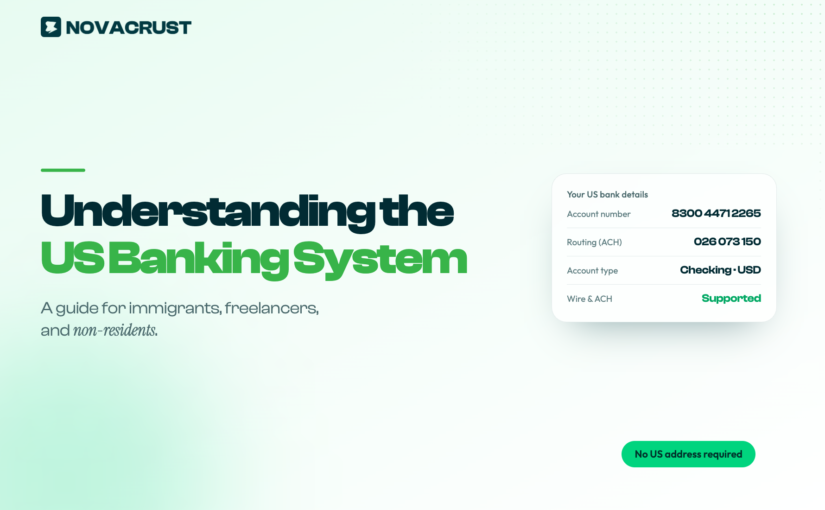
Understanding the US Banking System: A Guide for Immigrants, Freelancers, and Non-Residents

The US has more than 4,000 chartered banks. Almost none of them will open an account for someone with no Social Security number and no US address. That single requirement is why so many freelancers, business owners, and diaspora workers outside the US spend hours filling out bank applications only to get rejected at the last step.

If you get paid in dollars, or want to, understanding how the US banking system actually works, and where it shuts non-residents out, saves you that wasted time. Here is what the system looks like from outside, and the faster way in.

The Three Accounts Everyone Means When They Say “US Bank Account”

Checking accounts. Built for daily use: receiving deposits, paying bills, spending with a debit card. This is the account most freelancers actually need.

Savings accounts. Built to hold money and earn a small amount of interest. Most banks pair a savings account with a checking account, not instead of one.

Credit unions. Member-owned instead of shareholder-owned, often with lower fees, but membership usually requires a US address, employer, or local affiliation, which rules most non-residents out immediately.

What Actually Blocks Non-Residents

Four things stop most applications before they start:

A Social Security Number or ITIN. Chase, Bank of America, and Wells Fargo all ask for one on the standard application. Without it, some branches will still open an account in person; most online applications reject you automatically.

A US address. Banks mail debit cards, statements, and tax forms. No US address usually means no account, even if every other requirement is met.

An in-person visit. Many banks still require you to walk into a branch with a physical ID to finish verification, which is not realistic if you live in Lagos, Nairobi, or Accra.

Minimum deposits and monthly fees. Traditional accounts often carry $10 to $25 monthly fees unless you maintain a minimum balance, on top of the paperwork.

Big Banks vs Online Banks vs Neobanks

Big banks (Chase, Bank of America, Wells Fargo) have the most name recognition and the strictest requirements for non-residents. A handful of branches make exceptions with extra documentation, but this varies by location and isn’t something you can rely on.

Online-only banks loosen some requirements but most still ask for an SSN or ITIN, since they are still bound by the same federal rules as physical banks.

Fintech platforms with USD Accounts work differently. Instead of opening a bank account in the traditional sense, you get real US account and routing numbers issued through a banking partner, without needing an SSN, ITIN, or US address yourself. This is the category Novacrust’s USD Account falls into.

The Vocabulary Worth Knowing

Three terms come up constantly once money starts moving into and out of a US account:

Routing number. Identifies the bank. Every US account has one.

Account number. Identifies you specifically within that bank.

ACH, wire, and SWIFT. The three ways money actually moves. ACH is the standard, low-cost domestic transfer method. Wires move faster and cost more. SWIFT handles international transfers between banks in different countries.

The Faster Way In: A USD Account Built for Non-Residents

You do not need to become a customer of a traditional US bank to receive dollars like one. With Novacrust, your USD Account gives you a real US account and routing number in your name, so clients on Upwork, Fiverr, or direct contracts can pay you exactly like they would pay someone based in the US.

No SSN. No US address. No branch visit. You open it from your phone, and it works alongside your crypto wallet, virtual card, and transfers to 50+ countries in the same account.

Frequently Asked Questions

Can a non-US resident open a US bank account? Rarely through a traditional bank without an SSN, ITIN, or US address. Fintech platforms offering USD Accounts solve this without requiring US residency.

Do I need a Social Security Number to receive USD payments? No. A USD Account from Novacrust gives you US account and routing numbers without an SSN.

What’s the difference between a checking account and a USD Account? A checking account is issued directly by a US bank to US residents. A USD Account is issued through a fintech platform’s banking partner and works the same way for receiving and sending dollars, without the residency requirements.

Can I withdraw or convert the dollars I receive? Yes. With Novacrust, dollars in your USD Account convert to your local currency at a competitive rate, or move on as crypto, whenever you choose.

Is a USD Account the same as a domiciliary account? No. A domiciliary account is held at a bank in your own country and usually still requires branch visits. A USD Account gives you a real US account number directly.

The Bottom Line

The US banking system was not built with non-residents in mind. You don’t need to fight it. Get the parts that matter: a real US account and routing number, without the SSN, the address, or the branch visit.

CTA: Get Started. It’s Free. Open your Novacrust USD Account and get paid in dollars from anywhere.

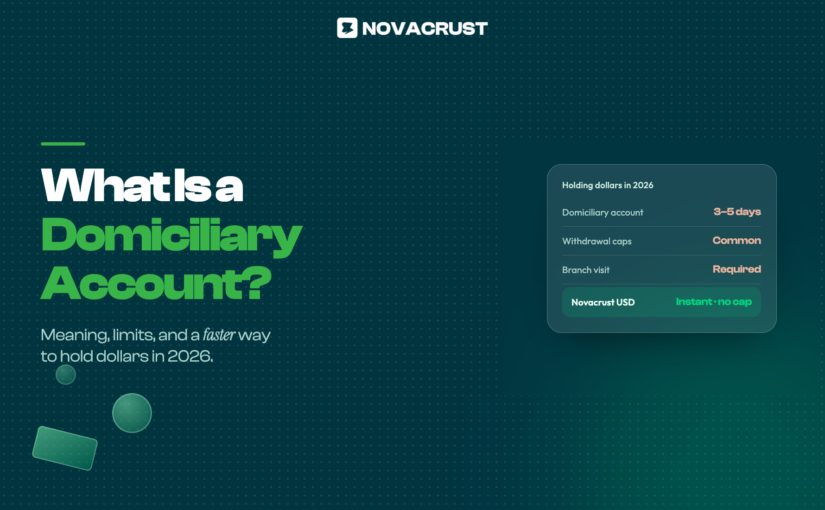
What Is a Domiciliary Account? Meaning, Limits, and a Faster Way to Hold Dollars in 2026

In 2026, the Central Bank of Nigeria rewrote the rules on domiciliary accounts, lifting the withdrawal caps that frustrated dollar savers for years. On paper, you can now withdraw up to $10,000 a day. In practice, cash from an inbound transfer is still capped at around $200, and anything above that has to move through your bank account instead of your hand.

If you have ever searched “what is a domiciliary account” or “domiciliary account meaning,” you are probably trying to figure out one thing: does this account actually solve your problem, or does it just move the paperwork somewhere else? Here is what a domiciliary account really does, where it still falls short, and a faster way to hold and receive dollars.

What is a domiciliary account?

A domiciliary account is a foreign-currency account opened at a Nigerian bank, GTBank, Zenith, Access, First Bank, and UBA all offer one, that lets you hold, save, and transact in US dollars, pounds, or euros instead of naira.

You open it in person, usually with a valid ID, proof of address, and a reference letter. Once it is active, you can receive foreign currency deposits, hold them without automatic conversion to naira, and withdraw or wire the funds out under the bank’s rules.

What a domiciliary account is actually good for

  • Holding savings in dollars. Your balance sits in USD, protected from naira devaluation, until you decide to convert.
  • Receiving occasional large transfers. Family remittances, inheritance, or a one-off payment from abroad land cleanly, in dollars, in an account you already trust.
  • Working inside a bank relationship you already have. No new provider to vet, no new app to learn.

Where a domiciliary account falls short in 2026

  1. It is a Nigerian bank account, not a US account. There is no US routing number attached to it, so Upwork, Fiverr, Deel, and most freelance platforms cannot pay you directly into it. You still need a separate way to receive USD platform payouts.
  2. Cash from an inbound transfer is capped near $200. Anything above that has to be paid into your account instead of handed to you as cash, so a “$10,000 daily withdrawal” headline does not mean $10,000 in your pocket the same day.
  3. Opening one takes a branch visit. ID, proof of address, and often a reference letter, so it is days, not minutes.
  4. Large cash movements can carry real fees. Processing charges on bulk cash transactions have been reported as high as 5% for corporates moving large sums.
  5. The exchange rate is whatever your bank quotes. You are not shopping it against anyone else’s rate.

Domiciliary account vs virtual USD account

 Domiciliary account (Nigerian bank)Virtual USD Account (Novacrust)
Opening timeBranch visit, daysMinutes, fully online
RequirementsID, proof of address, often a reference letterValid ID
Receiving platform payouts (Upwork, Fiverr, Deel)Not supported directlyYes, direct to your account
US account and routing numberNoYes, ACH, wire, and RTP support
Cash accessCapped near $200 per inbound transfer, rest via accountWithdraw to local bank or mobile money anytime
Exchange rateSet by your bankCompetitive, shown upfront
Best forLong-term dollar savings, occasional large transfersRegular international income

A domiciliary account and a virtual USD account are not competing for the same job. One is a savings vault for dollars you already have. The other is built to receive dollars regularly, from clients and platforms, the same week you start using it.

Get a USD account that actually takes freelance and platform payments

Opening a Novacrust USD account takes three steps:

  1. Sign up and verify your identity with a valid government ID. No branch visit, no reference letter.
  2. Get your US account and routing number, the same details any American would hand over to get paid.
  3. Start receiving dollar payments from clients, employers, or platforms like Upwork, Fiverr, Deel, and YouTube, then withdraw to your local bank or mobile money whenever you want.

Frequently asked questions

Is a domiciliary account the same as a USD account?

No. A domiciliary account is a foreign-currency account at a Nigerian bank. A virtual USD account like Novacrust’s gives you real US account and routing details, so it works for direct international payments, not just savings.

Can I receive Upwork or Fiverr payments into a domiciliary account?

No. Domiciliary accounts do not carry a US routing number, so most freelance platforms cannot pay into them directly. A virtual USD account can.

What is the daily withdrawal limit on a domiciliary account in 2026?

Up to $10,000 a day via transfer, under the CBN’s 2026 Foreign Exchange Manual. Cash from an inbound transfer is still capped at around $200, with the rest paid into your account.

Do I still need a domiciliary account in 2026?

If you are saving a lump sum in dollars long-term, it still works well. If you need to receive regular international income, a virtual USD account is faster and built for that job.

The bottom line

A domiciliary account is a real, legitimate way to hold dollars in Nigeria, and 2026’s rule changes made it easier to use. But it was built for savings, not for receiving international income on a regular basis. If you are getting paid from abroad every month, you need an account built for that.

Open your Novacrust USD account in minutes and get real US account details in your own name. No branch visit required.

How to Sell Gift Cards Online Instantly for Cash (2026 Guide)

Sell a $100 Amazon gift card through the wrong channel and you can lose $20 to $30 of it before you even see a bad “convenience fee.” Not because the card lost value, but because whoever bought it priced in a bigger cut than you’d ever accept if you could see it upfront.

Gift cards have quietly become one of the most common ways freelancers, creators, and remote workers get paid, tipped, or refunded by international clients and platforms. The problem was never demand. It was turning that card into cash without losing a third of it to a stranger on a forum or a platform that buries its real rate until the last screen.

This guide covers how to sell gift cards online for instant cash, whether “no ID verification” offers are actually safe to use, which cards are worth the most, and how the process works on Novacrust.

Why Selling a Gift Card Usually Costs You Money

A gift card is worth its face value exactly once: at the till of the store that issued it. The moment you try to convert it to cash, you’re relying on someone else’s rate, and that rate is where most of the value quietly disappears.

Three things drain value from a gift card sale: a hidden rate instead of a published one, a payout that takes days instead of minutes, and a buyer who disappears after you send the code. Fix those three and selling a gift card is no different from moving money you already own.

Is Selling a Gift Card Without ID Verification Actually Safe?

No. A platform that skips verification entirely isn’t doing you a favor. It’s removing the one safeguard that protects you if a trade goes wrong. “No verification” is a marketing line, not a safety feature.

The FTC has tracked gift cards as one of the most common ways scammers collect payment: consumers reported losing $148 million to gift-card scams in just the first nine months of 2021, more than all of 2020 combined, with median losses climbing every year since 2018. Verification exists to catch exactly this kind of fraud before money moves, for the buyer and the seller.

Novacrust verifies every account, and it still takes minutes, not days. The real trade-off worth comparing isn’t “verified vs. no verification.” It’s “verified and instant vs. verified and slow.”

Six Rules for Getting Full Value When You Sell a Gift Card

  1. Check the live rate before you commit. A real rate calculator shows you the exact payout for your card and brand before you send anything. If a platform won’t show you a number until after you’ve submitted the card, that’s the first red flag.
  2. Stick to major, widely-traded brands. Amazon, iTunes, Google Play, Apple, and Steam consistently sell for the best rates because demand for them is high and consistent. Niche or regional cards get discounted hard, if they’re accepted at all.
  3. Use a platform that pays instantly, not “within 24 hours.” Instant payout isn’t a convenience feature, it’s proof the platform actually has the liquidity to buy your card outright instead of waiting to resell it first.
  4. Never send the card code before you see funds move. Treat a gift card code exactly like cash. Once it’s sent, it’s gone, and there’s no chargeback. Legitimate platforms verify and pay in the same flow, they don’t ask you to “send first, trust us.”
  5. Compare real platforms, not vague promises. Cardtonic, Prestmit, GC Buying, and Novacrust all publish rates for major brands. Put your card’s value through more than one before you sell, especially the first time.
  6. Keep a record of every trade. A screenshot of the rate, the card details, and the payout confirmation takes ten seconds and is the only thing that helps if a dispute ever comes up.

How to Sell a Gift Card on Novacrust in 4 Steps

Step 1: Sign in and open Gift Cards

Sign in to your novacrust.com account and tap Gift Cards from your dashboard.

Step 2: Select “Sell Gift Card” and check the rate

Choose your brand, enter the card details, and run it through the rate calculator. You’ll see your exact payout in local currency before you confirm anything.

Step 3: Confirm and submit

Submit the card for review. Verification is quick, and there’s no third party in the middle deciding whether your card is worth buying.

Step 4: Get paid into your wallet

Once approved, the cash lands in your Novacrust wallet. From there, spend it on your virtual dollar card, hold it, convert it, or send it straight to a bank account or mobile money wallet.

Which Gift Cards Sell for the Best Rates?

Not all cards are treated equally by any platform, Novacrust included. In general:

  • Amazon and Apple gift cards trade at the highest rates because global demand for them never dries up.
  • iTunes and Google Play follow close behind, with rates that hold steady across most denominations.
  • Steam cards sell well but rates can move with gaming-market demand, so check the calculator each time rather than assuming last month’s rate.

Novacrust currently buys Amazon, iTunes, Google Play, Apple, and Steam gift cards, with more brands added as demand grows.

Want the payout in crypto instead of cash? Converting a gift card straight into USDT, USDC, or BTC works the same way, just with a different destination for the funds.

Novacrust vs Other Gift Card Platforms

 Typical gift card sitesNovacrust
Rate visibilityOften hidden until after submissionLive calculator before you sell
Payout speedHours to daysInstantly to your wallet
Where the cash landsA separate app or bank transfer onlyYour wallet, then spend, hold, convert, or send
Other featuresGift cards onlyUSD Account, virtual card, crypto, and transfers in one app

Cardtonic, Prestmit, and GC Buying are all reasonable places to check a rate. What changes the decision is what happens after the sale, whether the cash gets stuck in a single-purpose wallet or flows straight into an account you can actually spend, save, or send from.

Frequently Asked Questions

How much will I get for my gift card?

It depends on the brand, denomination, and current demand. Run your card through Novacrust’s rate calculator for an exact number before you sell, rates are shown upfront, not after.

Can I sell a gift card online instantly with no ID verification?

Not safely. Any platform advertising “no verification” sales is describing a risk, not a benefit, since it also means there’s no accountability if something goes wrong. Novacrust verifies every account to protect buyers and sellers, and it still takes minutes, not days.

How fast is the payout?

Once your card is approved, funds land in your Novacrust wallet instantly, ready to spend, hold, or send on.

Is selling gift cards for cash safe?

It’s safe when you control the sequence: check the rate, submit through a platform that verifies both sides, and only release the code as part of that flow. It’s risky the moment someone asks you to send the code first and “trust” the payment will follow.

Which gift cards sell for the best rates?

Amazon and Apple typically lead, with iTunes and Google Play close behind. Steam rates shift more, so always check the live calculator rather than assuming a fixed rate.

The Bottom Line

A gift card sitting unused isn’t doing anything for you. Sold through the wrong channel, it can quietly lose a third of its value. Sold through a platform that shows you the rate upfront, verifies both sides, and pays instantly, it’s just cash you haven’t converted yet.

Sell your gift card on Novacrust and get paid into your wallet in minutes, no third parties, no shady rates.

How to Open a USD Account Online in Minutes (2026 Guide)

Somewhere right now, a freelancer is standing in a bank queue with a folder of documents, two references, and a passport photo, trying to open a dollar account. And somewhere else, another freelancer just opened a USD account online from her phone in under ten minutes, got US account details in her own name, and sent them to her client before lunch.

Same goal. Wildly different experience. The difference is knowing that in 2026, you no longer need a traditional bank, a US address, or a plane ticket to own a dollar account.

This guide covers how to open a USD account online from anywhere in Africa, the Middle East, or Europe, what you can do with it, what to check before choosing a provider, and how to start receiving dollar payments the same week.

What Is a Virtual USD Account?

A virtual USD account is a dollar account you open and manage entirely online. It comes with real US account details in your name, an account number, and a routing number, with support for ACH, wire, and RTP transfers. To anyone paying you, it works exactly like a US bank account. To you, it is an app on your phone.

That single feature unlocks a lot. Clients and employers can pay you the way they pay anyone in America. Freelance platforms can deposit your earnings directly. And your money sits in USD, protected from local currency swings, until you decide to convert.

Who Needs a Dollar Account?

If any of these sound like you, a USD account is not optional; it is infrastructure:

  1. Freelancers and remote workers. You earn from clients in the US, UK, or Europe and need a clean way to receive dollar payments without losing a chunk to middlemen. A USD account for freelancers means you invoice in dollars and keep dollars.
  2. Creators. YouTube, sponsorships, digital product sales. Platform payouts land far more easily in a US account than through legacy transfer chains.
  3. Savers. When your local currency is volatile, holding part of your income in a dollar account is the simplest hedge available. You convert what you need when the rate favors you.
  4. Small businesses and SMEs. Paying international suppliers and receiving from international customers both get easier when you operate a dollar balance.

How to Open a USD Account Online with Novacrust

Here is the entire process, and why it answers the classic search: how to open a dollar account without visiting a bank.

Step 1: Sign up and verify your identity

Sign up on Novacrust, create your account, and complete identity verification with a valid government ID or passport. No branch visit, no references, no minimum deposit. Verification typically takes minutes, not days, and works across most countries in Africa and the wider EMEA region. This is also the answer to another high-intent search: a USD account without a US address. You do not need one. The account is in your name, at your address, wherever you live.

Step 2: Get your US account details

Once verified, you get your account number and routing number with ACH, wire, and RTP support. These are the same details any American would hand over to get paid.

Step 3: Start receiving dollar payments

Share your details with clients and employers, or plug them into platforms like Upwork, Fiverr, Toptal, Andela, Deel, Gusto, Rippling, and YouTube. If you have ever searched for a USD account to receive Upwork payments, this is the setup: withdraw from the platform straight into your own dollar account.

Step 4: Hold, spend, convert, or send

Your dollars are yours to manage. Hold them as savings. Spend them with a virtual USD card on subscriptions, tools, and ads. Convert to your local currency at a competitive rate. Or send money to a local bank account or mobile money wallet, yours or anyone else’s.

What to Check Before Choosing a USD Account Provider

Not every dollar account is built the same. Compare providers on these five points:

  1. Real US account details with ACH and wire support. Some apps only give you an internal wallet. You want an account number and routing number that any US employer can pay, which also covers the search dollar account with ACH and wire support.
  2. Receiving fees. The best providers charge little or nothing to receive ACH payments. Wire fees vary, so check both.
  3. Conversion rates. The exchange rate is the hidden fee. Compare what actually lands in your local currency, not the advertised rate.
  4. Withdrawal options. Look for direct withdrawal to local banks and mobile money in your market, whether that is naira, cedis, shillings, rand, or dirhams.
  5. Everything in one app. A USD account gets far more useful when it lives beside a virtual card, crypto conversion, and local transfers, so your money moves without app hopping. That is the Novacrust ecosystem in one sentence.

Virtual USD Account vs Traditional Foreign Currency Account

 Traditional bank dollar accountVirtual USD account (Novacrust)
Opening timeDays to weeks, branch visitMinutes, fully online
RequirementsReferences, paperwork, and sometimes a minimum balanceValid ID
Receiving a US wire$60 to $100 in combined feesLow, transparent fees
ACH supportRareYes, standard
WithdrawalBranch processesLocal bank or mobile money from the app
Best forLarge occasional transfersRegular international income

For most remote workers in Africa and EMEA, the comparison ends quickly. The best USD account for remote workers in Africa is the one that opens in minutes, receives ACH for little or nothing, and cashes out locally on your schedule.

Smart Ways to Use Your Dollar Account

  1. Split your income the moment it lands. A common freelancer formula: convert what you need for the month, hold the rest in USD as savings, and keep a small buffer on your virtual card for subscriptions.
  2. Time your conversions. Rates move. Because your money sits in dollars by default, you convert on the days that favor you, not the day your payment happens to arrive.
  3. Keep your payment history clean. Regular international income into an account in your own name builds a paper trail that helps with visa applications, apartment hunting, and credit.

Frequently Asked Questions

Can I open a USD account online without a US address?

Yes. Novacrust gives you US account details in your own name using your local identity documents. No US address, residency, or SSN required.

How long does it take to open a dollar account online?

Minutes. Sign up, verify your ID, and receive your account details, typically the same day.

Is a virtual USD account safe?

Reputable providers use identity verification, encryption, and regulated banking partners. Your account details work like standard US banking rails via ACH and wire.

Can I withdraw from my USD account to mobile money?

Yes, in supported markets, you can convert and withdraw funds directly to local banks or mobile money wallets through the app.

Does a USD account work for platform payouts?

Yes. Upwork, Fiverr, Toptal, Deel, YouTube, and many more can pay directly into your US account details.

The Bottom Line

A dollar account used to be a privilege that required the right passport or the patience for bank bureaucracy. Now it is a ten-minute setup. If you earn internationally, save seriously, or run a business across borders, opening a USD account online is the single upgrade that makes everything else about your finances simpler.

Open your Novacrust USD account in minutes and get US account details in your own name. No US address required.